
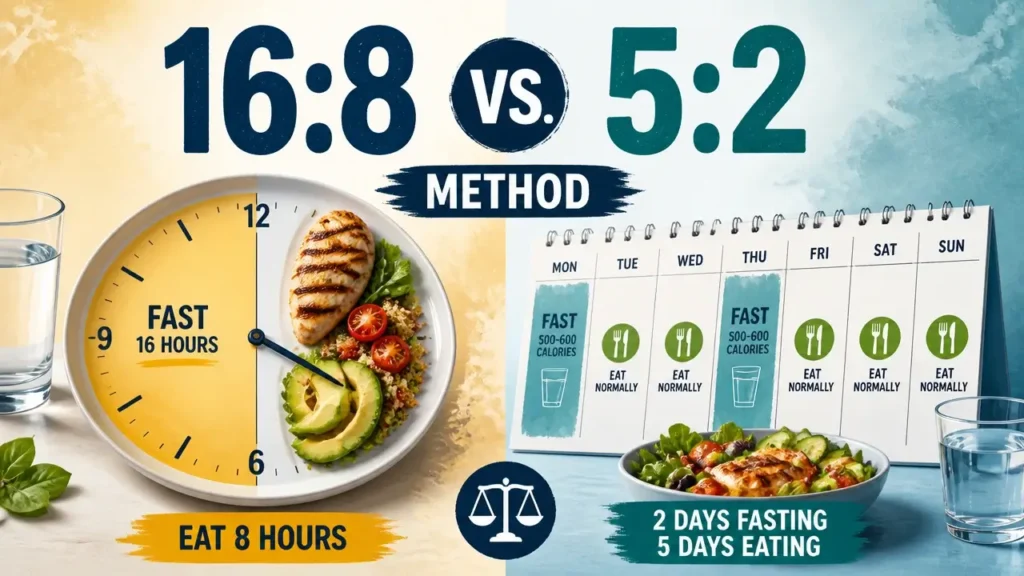
Intermittent fasting, in its two most practiced forms, doesn’t separate winners from losers by willpower – it separates people who chose the wrong friction profile from people who chose the right one. The 16:8 plan and the 5:2 method produce near-identical metabolic outcomes in controlled trials. What they don’t share is how they’ll collide with your Tuesday night dinner, your morning medication, or your three-week work trip.
That’s the comparison nobody makes clearly enough. This article does.
Why the 16:8 vs 5:2 Decision Isn’t Just About Fasting Windows
Intermittent fasting, at this stage of the conversation, doesn’t need a definition for you – you already know the architecture of both protocols. What you’re standing at now is a fork in the road, and the signpost doesn’t say “which window burns more fat.” It says “which kind of disruption can you absorb, week after week, without quitting?”
That reframe matters more than any metabolic data point we’ll cover. The real decision is between two distinct friction profiles: 16:8 asks for daily discipline – the same eating window, every single day, regardless of what life throws at you. The 5:2 method asks for weekly disruption – two days of significant caloric restriction while the other five run completely free. One grinds steadily. The other spikes hard and releases. Neither is objectively easier. They’re just hard in different ways.
To make this comparison useful rather than theoretical, we need four consistent lenses – what I’ll call the comparison pillars – that we’ll carry through every section of this article:
- Daily sustainability: How much mental overhead does the protocol demand on a typical Tuesday?
- Social eating compatibility: Can you sit at a dinner table with other humans without either abandoning the plan or explaining it?
- Muscle retention risk: Does the protocol’s structure make it harder or easier to hit the protein targets that protect lean mass?
- Results timeline: What does the scale actually do, and over what period?
Before we go deep on any of those, it’s worth flagging that a fifth category exists underneath all four – the hidden constraints. Medication timing, unpredictable travel, and social calendars that don’t care about your fasting schedule can override even the most disciplined adherence plan. We’ll get there. For now, know that the conclusion of this article won’t hand you a ranked list. It’ll hand you a framework for matching a protocol to the life you actually live.
The data supports that framing. A head-to-head randomized trial comparing both protocols over six weeks found that 5:2 participants lost an average of 3.38% of body weight while 16:8 participants lost 2.28% – a difference that did not reach statistical significance (p = 0.081). Visceral fat, fasting insulin, and blood pressure moved in parallel between groups. The authors’ conclusion was direct: neither protocol is universally superior, and selection should hinge on which regimen fits an individual’s lifestyle.
A broader network meta-analysis published in BMC Medicine reinforced the same point – no single fasting schedule consistently outperforms others for long-term metabolic health. Adherence and sustained benefit depend more on personal lifestyle compatibility than on the specific protocol. And a compliance meta-analysis tracking retention rates found 94% for time-restricted eating (16:8) and 88% for 5:2 in short-term trials – both high, but diverging in ways that matter when real life shows up after month three.
The science, in other words, has already absolved you from the pressure of finding the “superior” protocol. Your job is to find the compatible one.
How the 16:8 Protocol Really Works: The Daily Rhythm Approach
The 16:8 plan works by compressing your entire day’s eating into an 8-hour window, which creates a 16-hour fasting period that keeps insulin low long enough for your body to shift from burning glucose to burning stored fat – a process called metabolic switching. The reason timing matters here isn’t arbitrary: your cells are more insulin-sensitive in the morning and early afternoon, so an eating window aligned with that natural circadian rhythm extracts more metabolic benefit than the same window pushed to evening hours.
This is the part most explainers skip past. It’s not just “skip breakfast and eat later.” The circadian alignment is what separates a well-executed 16:8 protocol from simply eating late and calling it a fast. When the eating window runs roughly from late morning to early evening, you’re working with your body’s built-in insulin rhythm rather than against it.
What Daily Sustainability Actually Looks Like
Daily sustainability for 16:8 comes from the fact that you never have to count a calorie. The protocol runs on autopilot once the habit sets – you simply don’t eat outside the window. That simplicity is genuinely powerful for people with consistent schedules, because the decision fatigue is front-loaded into the adaptation phase and then largely disappears.
The flip side is that the clock never takes a day off. Miss the window on a Wednesday because of a work lunch that ran long, and you’ve either broken the fast or compressed eating into a smaller window that increases hunger the next day. For people with variable schedules, that daily rigidity becomes the primary failure point – not willpower, just the mechanical impossibility of fitting a fixed window into an unpredictable calendar.
Where Social Eating Fits Inside the Window
Social eating compatibility is where 16:8 shows its sharpest edge. Every social meal – lunch with a client, a birthday dinner that starts at 8 PM, a spontaneous brunch – has to land inside your 8-hour window. If your window runs noon to 8 PM, a 9 PM dinner reservation is a structural conflict, not just an inconvenience.
You can shift the window to accommodate, but that shifts the circadian alignment benefit. Push eating to 2 PM–10 PM to capture late dinners, and you’re eating against your body’s insulin curve rather than with it. The adaptation exists, but it comes at a metabolic cost that partially undermines why you chose the protocol in the first place.
Muscle Retention and the Protein Advantage
Muscle retention under 16:8 is manageable – and that’s genuinely good news if lean mass matters to you. Eight hours is a workable window to hit a meaningful daily protein target. Research on protein distribution suggests that spreading intake across two to three feeding occasions within the window is sufficient to stimulate muscle protein synthesis without the urgency or precision required by more restrictive protocols.
The key caveat: “manageable” assumes you’re actually prioritizing protein, not just eating whatever fits the window. If the 8-hour period fills up with calorie-dense, protein-light foods, the muscle retention advantage evaporates. The window enables adequate protein; it doesn’t guarantee it.
The Realistic Results Timeline
Weight management under 16:8 tends to be steady and gradual rather than dramatic. The mechanism is a modest sustained calorie deficit – most people naturally eat less when they compress their feeding window, without consciously restricting. A compliance meta-analysis shows adherence above 80% in trials under three months, which explains why 16:8 built its reputation for being “easy.” But mean weight loss difference versus traditional calorie restriction is only around 0.26 kg – statistically, the clock itself isn’t a magic accelerant. The loss comes from the deficit, and the clock is just one way to create it.
There’s also a signal worth acknowledging: Mayo Clinic has flagged that a 16-hour fasting cycle may be associated with elevated cardiovascular risk compared to other time-restricted eating patterns. The evidence is preliminary and unreplicated, but if you have existing cardiovascular concerns, this is a conversation to have with your doctor before defaulting to 16:8 as the “safe” option.
Dr. Satchin Panda, Lead Circadian Biologist at the Salk Institute, captures the deeper mechanism at work:
“The rhythms of feeding and fasting may be capable of reversing the gene expression changes caused by absent core clock elements.”
What that means in practice: the timing of your eating window isn’t just a calorie-delivery vehicle. It’s actively communicating with the genetic machinery that governs metabolism. Align the window with your circadian rhythm, and you’re reinforcing a system that was already built to work this way.
How the 5:2 Protocol Really Works: The Weekly Caloric Shock
The 5:2 fasting method works on a completely different axis than 16:8 – instead of a daily clock, it runs a weekly energy cycle: five days of unrestricted eating followed by two non-consecutive days of severe caloric restriction, typically 500–600 kcal. The weekly deficit created by those two low-calorie days is large enough to drive fat loss without requiring any daily discipline on the other five days.
That’s the structural appeal. You don’t think about fasting on Monday. You don’t think about it on Friday. You plan two specific days – say, Tuesday and Thursday – accept that those days will be genuinely hard, and otherwise live your life.
What Autophagy Looks Like Under 5:2
The extended low-calorie periods on fast days may stimulate greater autophagy – the cellular cleanup process where the body recycles damaged proteins – than the shorter daily fasting window of 16:8. The biological logic is sound: a deeper, longer energy deficit signals the body more urgently to enter maintenance mode. But it’s important to be precise here. This effect is acute, triggered on the fast days themselves, not something that accumulates progressively across the week. The five “normal” days reset the cellular environment. You’re not building a continuous autophagic state – you’re spiking it twice a week.
Daily Sustainability and the Two Hard Days
Daily sustainability for 5:2 is genuinely high on the five unrestricted days – you eat normally, you don’t count anything, and the mental overhead is near zero. The cost is concentrated entirely in the two fast days, where 500–600 kcal demands precise calorie counting, active hunger management, and navigating low energy and brain fog that some people find professionally disruptive.
Whether that trade-off works for you depends on a simple question: would you rather have mild daily friction or two days of significant friction per week? Neither is objectively lighter. They’re just distributed differently.
Social Eating Under 5:2
Social eating compatibility is where 5:2 has a genuine structural advantage over 16:8. On your five normal days, you can eat whatever, wherever, with whoever – no window math, no clock-watching, no explaining why you can’t eat the appetizer. The protocol bends to your social calendar on most days.
The vulnerability appears when an unavoidable social event lands on a planned fast day. A surprise birthday dinner, an impromptu work lunch, a family gathering – any of these on a fast day forces a binary choice: blow the plan or withdraw socially. Neither option is neutral. Withdraw often enough, and adherence starts eroding not from hunger but from isolation.
Muscle Retention Under 5:2: The Real Risk
Muscle retention is where 5:2 demands the most strategic thinking. On fast days, hitting any meaningful protein target within 500–600 kcal is nearly impossible – you’d need roughly 40–50g of protein just to meet minimum thresholds, which consumes 160–200 kcal of your entire day’s budget. In practice, most people on fast days are in a protein-deficient state.
That means muscle preservation under 5:2 depends almost entirely on what happens on the five normal days – specifically, whether you’re eating sufficient protein and doing resistance training to offset the catabolic signal from the fast days. It’s a deliberate nutritional balancing act, not a passive benefit. If your five normal days are protein-light, the scale may be going down for the wrong reasons.
The Results Timeline and the Compensation Trap
Initial weight loss under 5:2 can feel faster than 16:8 because the acute weekly deficit is larger and more dramatic. Some trial data supports this short-term edge. But the rate of loss tends to equalize over time as the body adapts and the initial water-weight component resolves.
The more persistent risk is compensation psychology – the unconscious tendency to eat more on normal days because “you earned it” on fast days. This isn’t a character flaw; it’s a well-documented behavioral pattern. When restriction and freedom alternate in a predictable cycle, the brain starts treating normal days as a reward rather than a baseline. If compensation creeps in, the weekly energy deficit that makes 5:2 work gets quietly erased.
According to data from ZOE and a supporting clinical trial published in the journal Food Science & Nutrition, alternate-day fasting – the closest structural relative to 5:2’s severe restriction days – carries a dropout rate of approximately 38%, compared to 29% for standard calorie restriction. That gap exists precisely because the binge-restrict rhythm is psychologically taxing in ways that daily mild restriction isn’t. 5:2 sits on the same spectrum, and while its two-day format is gentler than true alternate-day fasting, the dropout pattern is a real signal worth taking seriously.
Dr. Michelle Harvie, Research Dietitian and pioneer of intermittent energy restriction, raises a concern that goes beyond adherence:
“Another critical limitation of IF involves the substantially elevated risk of micronutrient deficiencies when dietary quality is not carefully prioritized. Deficiencies are primarily driven by lower total energy intake and reduced consumption of nutrient-dense foods during fasting periods… ADF and TRE have reported reductions in intake of calcium, magnesium, potassium, folate, vitamin C, and vitamins from the B complex.”
The implication is direct: the two fast days aren’t just low in calories – they’re structurally low in micronutrient density. Unless the five normal days are deliberately nutrient-rich, 5:2 can quietly create deficiency patterns that don’t show up on the scale but do show up in energy, immunity, and long-term health markers.
Head-to-Head: Sustainability, Social Life, Muscle, and Results Timeline Compared
Fasting methods comparison becomes genuinely useful only when the four pillars sit side by side with honest assessments rather than brand-loyal talking points. Here’s what the evidence and real-world adherence data actually say across each dimension.
Here’s how the two protocols stack up across every dimension that matters:
| Pillar | 16:8 | 5:2 | Edge |
|---|---|---|---|
| Daily Sustainability | Low daily friction once habit forms; rigid daily window | Zero friction 5 days/week; high friction on 2 fast days | Tie – depends on your friction preference |
| Social Eating Compatibility | All meals must fit a fixed daily window | Normal days absorb social life freely | 5:2 |
| Muscle Retention Risk | Easier daily protein distribution; lower risk | Protein nearly impossible on fast days; risk managed through normal days | 16:8 |
| Results Timeline | Steady, gradual loss; modest deficit | Faster initial loss possible; equalizes over time | 5:2 short-term; tie long-term |
| Side Effect Pattern | Daily mild hunger during adaptation | Intense hunger + fatigue twice weekly | Personal preference |
| Dropout Risk | ~6% in short-term trials | ~12% (proxied from ADF data) | 16:8 |
Where the Energy Deficit Actually Lives
The most important thing to understand about this comparison is that both protocols are delivery vehicles for the same destination: a sustained energy deficit. The fasting window or the fasting day is how you get there, not why the weight moves. A meta-analysis on intermittent fasting compliance found that IF and traditional calorie restriction produce statistically indistinguishable weight loss, with a mean difference of just 0.26 kg (p=0.37). That number should reframe the entire conversation. You’re not choosing between two metabolic mechanisms. You’re choosing between two scheduling strategies for achieving the same caloric outcome.
The Effectiveness Paradox
Here’s the nuance that the head-to-head data reveals: alternate-day fasting – the strictest form of discontinuous restriction, and the closest analogue to 5:2’s severe fast days – ranks highest in effectiveness among all intermittent fasting types in some analyses. It also carries the highest dropout rate. The pattern holds a lesson: the most aggressive version of a protocol isn’t the most useful one if it’s the one people quit. Compliance above 80% holds for both 16:8 and 5:2 in trials under three months, but the compliance meta-analysis data makes clear that real-world adherence diverges significantly beyond that window – and that’s precisely where most people are actually living their protocol, not in a controlled trial.
What This Means for Your Choice
No universal winner exists here, and calling one would be misleading. What the data does tell us is this: if social flexibility is your primary constraint, 5:2’s structure genuinely accommodates it better. If daily simplicity and muscle preservation are your priorities, 16:8 has the structural edge. If your primary goal is seeing the fastest number move on the scale in the first four weeks, 5:2’s acute deficit may deliver that – with the caveat that the advantage narrows sharply after the initial phase. The protocol that “wins” is the one you’re still running at month six.
The Hidden Constraint That Makes Both Protocols Fail (And What to Do)
Hidden constraints are the silent variables that no fasting guide puts in the introduction – and they’re the reason people who understand both protocols perfectly still find themselves abandoning both by week six. Medication timing, unpredictable travel, and social calendars that weren’t consulted when you chose your fasting schedule can override disciplined planning more efficiently than hunger ever could.
This section is where the real decision actually lives.
The Medication-Food Coupling Problem
The medication-food coupling issue is the most underaddressed conflict in the intermittent fasting conversation, and it affects more people than the research literature acknowledges. Many common morning medications – certain blood pressure drugs, metformin, thyroid medications, and anti-inflammatories – require food at the time of administration to prevent gastric irritation, ensure proper absorption, or avoid nausea. These aren’t optional instructions.
For a 16:8 practitioner whose eating window opens at noon, taking a 7 AM medication “with food” creates a genuine dilemma: eat early and break the fast, take the medication without food and risk reduced efficacy or GI distress, or attempt workarounds like coffee or sparkling water that have no safety data behind them. The Reddit-documented reality is that people routinely choose the coffee-with-meds workaround without any clinical guidance – a quiet risk that expert blogs consistently ignore.
This isn’t a minor scheduling inconvenience. It’s a safety question that belongs in a conversation with your prescribing physician before you commit to any fasting protocol.
Here’s a visual that captures the tension this creates in daily practice:

Travel and the Drifting Window
Travel disruption hits 16:8 practitioners in a specific, predictable way. Cross two time zones, and your eating window is already misaligned. Add a delayed flight, an early hotel breakfast that’s the only food available, and a business dinner that starts at 9 PM local time, and the “window” has effectively dissolved into a 14-hour eating period across an irregular day. What follows isn’t a single broken day – it’s the emotional decision of whether to restart the protocol from scratch or accept a modified version that feels like a compromise.
The psychological cost of that restart decision is underestimated. Every time a traveler “resets,” they’re re-entering the adaptation phase at a lower motivational baseline than the first time. Enough resets, and the protocol stops feeling like a sustainable habit and starts feeling like a recurring failure.
Social Unpredictability and the 5:2 Fast Day Collision
For 5:2 practitioners, the equivalent breaking point is the fast day that gets ambushed by an unavoidable social event. You’ve planned Tuesday as a 500-kcal day. Tuesday afternoon, your team announces a celebratory dinner. The choices are: skip the dinner, attend and blow the fast day, or reschedule the fast day to Wednesday – which may already have its own complications.
None of those options is frictionless. Attend and blow the day often enough, and the protocol starts to feel incompatible with having a normal social life. Reschedule often enough, and the two fast days start clustering together or migrating to weekends, which creates a different set of social conflicts. The weekly flexibility that makes 5:2 appealing has a load-bearing assumption: that you control which two days are “quiet.”
The Hybrid Protocol: A Caution, Not a Recommendation
Some practitioners, frustrated with the limitations of both protocols, have independently arrived at a hybrid approach – combining a shortened daily eating window (around 4 hours) with two 500–600 kcal fast days per week. The appeal is obvious: maximum restriction, dual mechanisms, faster results. Anecdotal reports from online communities describe significant short-term weight loss.
The problem is that this approach has no controlled safety data behind it. Stacking a severely compressed daily window with two near-total fast days per week creates a caloric environment where micronutrient adequacy is nearly impossible to maintain without medical supervision and targeted supplementation. The nutrient deficiency risks that Dr. Harvie flags for individual protocols compound when both are layered simultaneously. If you’ve heard about this approach and are considering it, the appropriate first step is a conversation with a registered dietitian or physician – not a trial run.
The real lesson the hybrid protocol teaches isn’t about fasting windows. It’s about what happens when people feel like neither available option fits their life. That’s the actual problem worth solving.
Dr. Monica A. O’Neal, Clinical Trial Specialist, documented the external forces that derail adherence in clinical settings:
“Social events, family obligations, and work commutes are external barriers that commonly influence… Dining out, having visitors, and having drinks after work [were] the most frequent social barriers.”
The barriers she’s describing aren’t discipline failures – they’re structural incompatibilities between the protocol’s design and the actual shape of a person’s week. The solution isn’t more willpower. It’s choosing a protocol whose structure bends toward the barriers you face most often.
Your Final Decision Framework: Matching the Protocol to Your Life, Not Your Willpower
The decision framework for choosing between intermittent fasting protocols doesn’t start with metabolism – it starts with an honest inventory of your week. Neither 16:8 nor 5:2 is objectively superior. The research has settled that question. What remains is a simpler, more personal one: which protocol fits the life you actually live on a random Wednesday in November, not the one you’re planning to live starting Monday?
Here’s how to match your profile to your protocol.
The Structured Daily Grinder
If your work hours are consistent, your meal timing is largely within your control, and you function best with automatic habits rather than weekly planning decisions, 16:8 is the natural structural fit. The daily window becomes invisible once it’s established – you stop thinking about it the way you stop thinking about brushing your teeth. Muscle retention is manageable because you have a reliable window to hit protein targets. Social life requires some navigation, but if most of your social eating happens in the evening and your window can accommodate that, the friction is low.
The one thing to check before committing: do you take any morning medication that requires food? If yes, stop here and have that conversation with your doctor before choosing any protocol.
The Social-Calendar Nomad
If your evenings are unpredictable, your social life is a genuine priority, and the idea of watching a clock at every meal creates more stress than hunger does, 5:2 is the better structural fit. Five normal days absorb your social life completely. You plant your two fast days on the quietest days of your typical week – often mid-week days with no social commitments – and the rest runs free. The trade-off is that those two days are genuinely hard, and you’ll need to be intentional about protein and micronutrient density on your normal days to protect muscle and avoid deficiency.
The vulnerability to watch: compensation psychology. If normal days start feeling like rewards for fast days, track your intake loosely for two weeks to see if the weekly deficit is actually intact.
The Medication-Dependent or High-Travel Individual
If you take morning medication that requires food, or if your schedule involves frequent travel across time zones, neither protocol should be your first move. The medication-food coupling issue is a genuine safety question, not a scheduling inconvenience. The travel-induced window drift is a structural incompatibility, not a willpower problem. The right first step is a conversation with your prescribing physician and, ideally, a registered dietitian who can map a protocol around your medication timing and travel patterns rather than asking you to map your life around a protocol.
The “Test Both” Approach
If you sit between profiles and aren’t sure which friction type you can absorb, try 16:8 for two weeks while logging the specific moments it breaks down – social events you missed, windows you blew, hunger patterns that disrupted work. Then try 5:2 for two weeks with the same log. The protocol that produces fewer friction entries is the one to keep. This isn’t indecision – it’s using your own behavioral data rather than someone else’s trial results.
And if both protocols produce high friction? The network meta-analysis is clear: traditional mindful calorie awareness is equally effective for weight loss. Fasting purity is not a prerequisite for results. Consistency is.
One final note worth carrying forward: even 16:8 – often treated as the default, beginner-safe choice – carries an unresolved question from Mayo Clinic about potential cardiovascular risk at the 16-hour fasting threshold. The evidence is preliminary, but it’s a reminder that “common” doesn’t mean “universally benign.” The truest safety net for any intermittent fasting protocol is personalized medical advice, particularly for anyone with a history of eating disorders, pregnancy, type 1 diabetes, or medication dependence.
Here’s a visual framework to help you map your profile to the right protocol:

Dr. Ghada A. Soliman, expert in Precision Nutrition and Public Health, puts the principle directly:
“Individualized, tailored IF and TRE protocols may be adopted for personalized precision nutrition that increases compliance, tolerability, and sustainability to achieve optimal health outcomes.”
The word “individualized” is doing the real work in that sentence. Not “optimized.” Not “most aggressive.” Individualized – because the protocol that fits your life is the one that actually runs long enough to produce the outcome you’re after.
Key Takeaways on Intermittent Fasting
- A six-week head-to-head trial found no statistically significant weight loss difference between 16:8 and 5:2, making lifestyle fit the only meaningful differentiator.
- The 16:8 plan suits consistent daily schedules; 5:2 suits people with unpredictable social calendars who can tolerate two hard days per week.
- Muscle retention favors 16:8 because daily protein distribution is structurally easier; 5:2 requires deliberate compensation on normal eating days.
- Alternate-day fasting – 5:2’s closest relative – carries a 38% dropout rate, signaling that weekly restriction freedom has a real adherence cost.
- Morning medication that requires food is a silent deal-breaker for both protocols and requires medical guidance before any fasting schedule begins.
- Both intermittent fasting protocols produce outcomes statistically equivalent to traditional calorie restriction; consistency, not fasting method, is the actual driver.
Frequently Asked Questions About Intermittent Fasting
Is 16:8 actually better than 5:2 for weight loss?
Not according to the controlled trial data. A six-week randomized comparison found a weight loss difference of about 1.1 percentage points between the two protocols, and that gap wasn’t statistically significant. The protocol you can stick to for six months will outperform the one you quit after six weeks, regardless of which one looks better on paper.
Can intermittent fasting raise cortisol levels?
It can, particularly during the fasting window when blood glucose drops and the body responds by releasing cortisol to mobilize stored energy. For people who are already chronically stressed or sleep-deprived, layering a fasting protocol on top of an elevated cortisol baseline can amplify the effect – showing up as increased anxiety, disrupted sleep, or difficulty losing fat around the midsection. If you already know your cortisol runs high, it’s worth discussing IF with your doctor before starting.
Does intermittent fasting affect erectile function?
There’s no direct clinical evidence linking intermittent fasting specifically to erectile dysfunction. What exists is indirect: IF can improve insulin sensitivity and reduce visceral fat, both of which are associated with better cardiovascular and hormonal health – factors that do influence erectile function. The reverse is also theoretically possible if severe restriction leads to caloric deficit deep enough to suppress testosterone production, though this hasn’t been well-studied in IF-specific trials.
Can intermittent fasting lower A1c levels?
Short-term trial data suggests yes, particularly for people with prediabetes or type 2 diabetes. Both 16:8 and 5:2 have shown reductions in fasting insulin and some improvement in glycemic markers. That said, anyone on diabetes medication – especially insulin or sulfonylureas – should not start any fasting protocol without medical supervision, since fasting-induced drops in blood glucose combined with glucose-lowering drugs can cause dangerous hypoglycemia.
What happens if I break a fast day on 5:2 because of an unplanned event?
One broken fast day doesn’t derail the protocol – it just reduces that week’s total energy deficit. The real risk isn’t the single missed day; it’s the psychological pattern that follows. If breaking fast days starts feeling acceptable or routine, the weekly deficit that makes 5:2 work quietly disappears. Reschedule the fast day to the next available quiet day in the same week rather than simply skipping it.
Is there a best time of day to place the 16:8 eating window?
Circadian biology research suggests earlier windows – roughly late morning to early evening – align better with peak insulin sensitivity than late windows. An eating window running from 10 AM to 6 PM extracts more metabolic benefit than the same 8 hours running from 2 PM to 10 PM. That said, a window you can actually maintain consistently will outperform a theoretically optimal window you drift away from within two weeks.
Can you do intermittent fasting if you work night shifts?
Both protocols become significantly more complicated with inverted sleep-wake cycles because the circadian alignment that gives IF part of its benefit is disrupted. For night shift workers, the most practical adaptation is to anchor the eating window to your personal wake cycle rather than the clock – treating your “morning” as whenever you wake up, regardless of the actual hour. This is an area where individualized guidance from a dietitian is worth more than any general protocol recommendation.
How long before intermittent fasting produces noticeable results?
Most people see measurable scale changes within two to four weeks, largely driven by reduced overall caloric intake and some initial water weight loss tied to lower glycogen stores. The more meaningful metabolic adaptations – improvements in fasting insulin, blood pressure, and visceral fat – tend to emerge over eight to twelve weeks of consistent adherence. Expecting dramatic results in the first two weeks sets a timeline that the biology doesn’t support.
References
- A Comparison Between The 5:2 And 16:8 Intermittent Fasting Methods on Weight Loss in Overweight And Obese Individuals – researchgate.net
- Effects of different types of intermittent fasting on metabolic outcomes: a network meta-analysis – pmc.ncbi.nlm.nih.gov
- A meta-analysis comparing the effectiveness of alternate day fasting (compliance assessment) – pmc.ncbi.nlm.nih.gov
- Satchidananda Panda Lab – Salk Institute for Biological Studies – salk.edu
- Alternate Day Fasting and Dropout Rate – Food Science & Nutrition – pmc.ncbi.nlm.nih.gov
- Micronutrient Deficiencies in Intermittent Fasting – Frontiers in Nutrition & ScienceDirect – sciencedirect.com
- Social Barriers to Intermittent Fasting Adherence – Frontiers in Nutrition – frontiersin.org
- Individualized IF and TRE Protocols for Precision Nutrition – Frontiers in Public Health – frontiersin.org