
Intentional zero-based budgeting flips the entire logic of how most people handle money – instead of tracking where your dollars went, you decide where they’re going before the month even begins. Every dollar gets a job: rent, groceries, savings, fun. Nothing floats.
The method sounds almost too simple, but that simplicity is exactly why it works when other systems don’t. Once you understand the mechanics behind it, the “zero” stops feeling scary and starts feeling like the most in-control you’ve ever been with your money.
What Zero-Based Budgeting Actually Is (and How It’s Different)
Zero-based budgeting is a proactive monthly method where every dollar of your income gets assigned to a specific expense, savings goal, or debt payment – so that income minus all assigned expenses equals exactly zero. That zero isn’t your bank balance. It’s the target on your planning sheet, meaning no dollar is left without a purpose. Think of it less like a spending limit and more like a pre-game play call: you’re deciding the outcome before the whistle blows, not reviewing the tape after you’ve already lost.
The contrast with traditional budgeting is where this gets interesting. Most people budget by looking backward – they pull up last month’s credit card statement, maybe trim a few categories, and roll those numbers forward. Savings, if it happens at all, is whatever’s left after everything else gets paid. Zero-based budgeting inverts that sequence entirely. You start from a blank slate each month, and savings gets assigned first, just like rent does.
The core formula is this: Income – Expenses = $0. But “expenses” here includes savings contributions, investing, sinking funds, and even a small buffer – not just bills. Every dollar has a destination before it has a chance to disappear.
The method didn’t start in personal finance. Peter A. Pyhrr introduced zero-based budgeting in a 1970 Harvard Business Review article (Vol. 48, No. 6, pp. 111–121) while working as accounting and control manager at Texas Instruments. His framework replaced incremental budgeting – where last year’s budget is the starting point – with a system that required every activity to be justified from zero, ranked by priority, and funded only if it earned its place. Government agencies tested it next. Personal finance adopted the philosophy later, and the core discipline carried over: nothing gets money just because it got money before.
Jesse Mecham, founder of YNAB and one of the most recognized voices in personal budgeting, puts the philosophy plainly:
“Give every dollar a job. This is the heart of zero-based budgeting. When you give every single dollar a specific purpose-whether it’s for rent, groceries, retirement savings, or a fun night out-you’re telling your money where to go instead of wondering where it went.”
That phrase – telling your money where to go instead of wondering where it went – is the clearest one-line summary of what separates this method from every passive approach to personal finance.
Why Most Budgets Fail (and How Zero-Based Thinking Changes That)
The typical budget fails not because people spend too much, but because unallocated money has no loyalty. When cash sits in a checking account without a label, it doesn’t wait patiently for the right moment – it leaks. A dinner out here, a subscription you forgot about there, a “I’ll figure it out later” purchase that becomes a habit. None of it feels like a decision. That’s the problem.
Traditional budgets create this leak by design. They set category limits, but they rarely assign every dollar before the month starts. So there’s always a pool of vague “extra” money sitting in the account, and that pool funds the invisible spending that quietly undermines every savings goal you set in January.
Zero-based budgeting closes that gap by making ambiguity structurally impossible. Before the month starts, you name a destination for every dollar – savings, debt payment, bills, groceries, and yes, fun money too. When a dollar has a job, spending it on something else requires a conscious decision to reassign it. That moment of friction is the whole point.
One way to feel that shift: instead of asking “did I spend too much this month?” you start asking “do I want to move money from my dining-out category to cover this?” It turns every purchase into a deliberate choice rather than a passive habit.
This intentionality directly reduces impulse spending and decision fatigue. When the plan is already made, you’re not making dozens of micro-decisions throughout the month about whether you can “afford” something. You already know. That clarity is a psychological shift as much as a financial one – and it’s the reason people who stick with zero-based budgeting often describe it as the first time money felt manageable rather than stressful.
The scale of the problem this solves is real. According to a Study Finds survey, a significant share of Americans report being only months away from financial collapse – a gap that isn’t just about income level, but about the absence of a system that accounts for every dollar before it gets spent.
Dave Ramsey, personal finance expert and host of The Ramsey Show, frames the leak problem this way:
“When you have money sitting around without a plan, it leaks out of your pocket. By doing a zero-based budget, you prevent those leaks because you force yourself to allocate every single dollar to a category. When there’s no ‘extra’ money left over, there’s no room for mindless, unassigned spending.”
Even with total intention, though, a budget can break the moment an unexpected bill hits – if you haven’t built in a realistic safety net. That’s the buffer sizing gap: experts universally say “keep a little cushion,” but almost nobody tells you how much. That specific number matters, and we’ll get to a usable formula in a later section.
The Simple Math That Makes It Work
The zero-based budgeting technique is more concrete than most people expect – the math is just subtraction, and the power is in what you subtract. Walk through a real example and it clicks immediately.
Say your monthly take-home pay is $3,000. Here’s what a zero-based plan looks like:
Here’s a sample breakdown to make it tangible:
| Category | Amount |
|---|---|
| Rent | $1,000 |
| Groceries | $400 |
| Utilities | $200 |
| Car (payment + gas) | $300 |
| Savings | $300 |
| Debt payoff | $200 |
| Fun / dining out | $200 |
| Buffer | $100 |
| Total Assigned | $2,700 |
| Remaining | $300 |
| Invest / extra debt | $300 |
| Final Balance | $0 |
Every dollar of the $3,000 has a name. Nothing floats.
The part most people miss: “expenses” in this system includes savings, investing, and sinking funds. Those aren’t separate from the budget – they’re line items in it, treated with the same weight as rent. If saving $300 this month is the goal, it gets assigned before discretionary categories are filled in, not after.
And once more, because this trips people up: that zero is on the planning sheet, not in your checking account. Your bank balance stays positive because the money sitting there is already spoken for – it’s earmarked for next week’s groceries, next month’s car insurance, the buffer for a surprise bill. The account looks funded because it is funded. You just know exactly what each dollar is doing.
This is a plan you build before the month, not a scorecard you judge after. The difference between those two things is the difference between steering and reviewing.
Here’s what a filled-in zero-based budget worksheet looks like in practice:

“Zero Balance = Broke?” and Other Myths That Scare Beginners Away
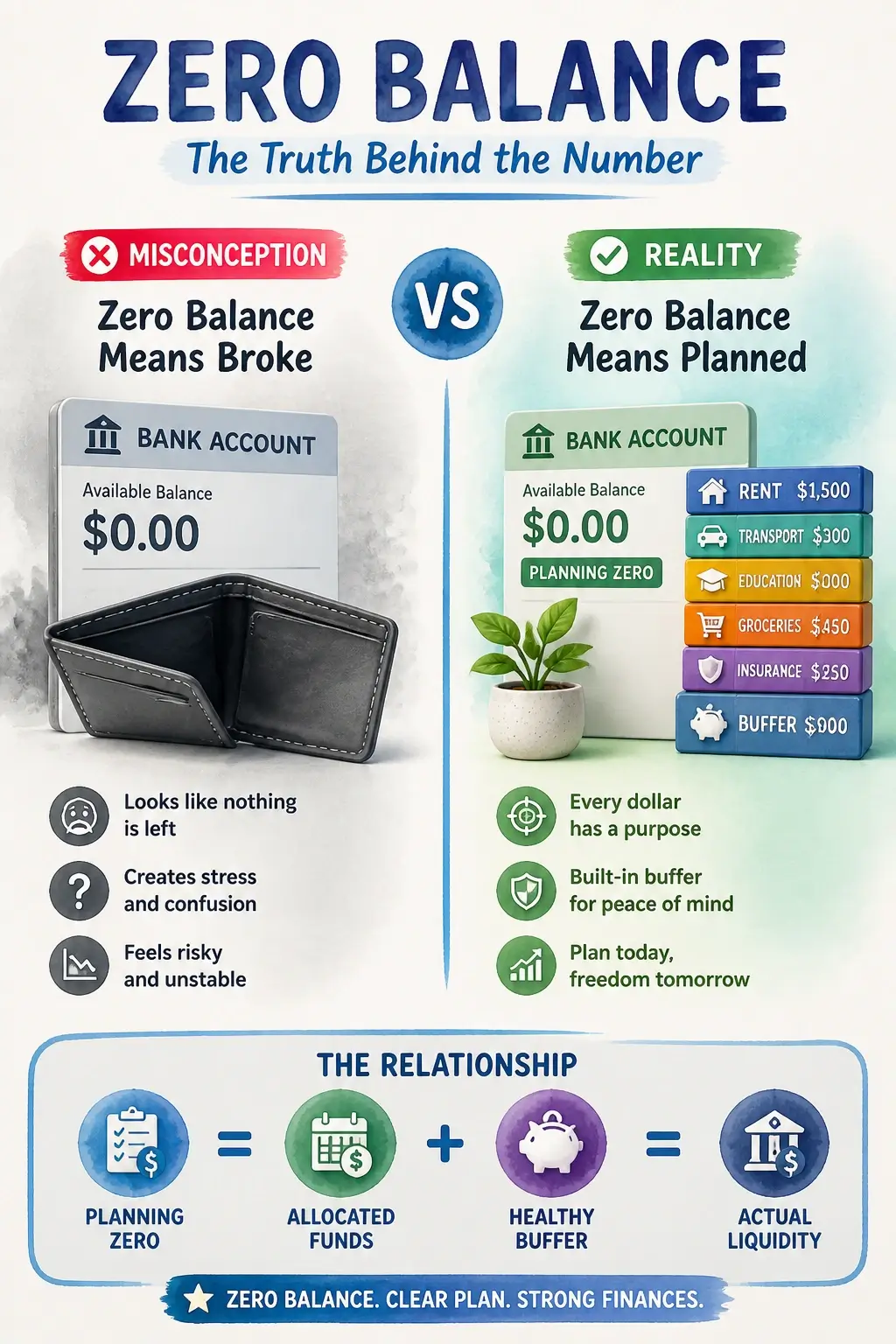
The emergency fund is the first thing people worry about when they hear “budget to zero” – and that worry is based on a myth worth clearing up right now. The myth: zero-based budgeting means you end the month with zero dollars in your bank account. That’s false, and understanding why changes how the whole system feels.
Zero means zero unassigned dollars. It does not mean zero dollars. Every dollar in your account is still there – it’s just already claimed. Your emergency fund is a budget category. Your buffer is a budget category. Your savings for next month’s irregular bills is a budget category. The account looks healthy because you put money into those buckets on purpose, before the month started.
Think of it like a parking lot with assigned spaces. The lot isn’t empty – every car has a spot. Zero-based budgeting just means there are no cars double-parked in the fire lane because you ran out of plan.
Building a buffer category – even a modest $100–$300 to start – is how you stay liquid while still satisfying the zero rule. That buffer absorbs the unexpected water bill, the co-pay you forgot about, the toll charge that showed up late. It doesn’t violate the system; it’s part of the system.
YNAB, the budgeting software company that has built its entire product around zero-based principles, addresses this directly:
“A common misconception is that zero-based budgeting means you must have zero dollars in your bank account. In reality, ‘zero’ means that your budgeted categories exactly equal your incoming revenue. You still have money in your checking account, savings accounts, and investment portfolios-the unassigned pool is simply what is brought down to zero.”
This misunderstanding is one of the biggest reasons beginners avoid zero-based budgeting entirely. They hear “zero” and picture financial tightrope walking. The reality is the opposite – a fully assigned budget is one of the most financially stable positions you can be in, because you’re never surprised by where the money went.
There’s a deeper mental reframe worth making here too. That buffer sitting in your account isn’t vacation money or bonus savings – it’s a reserve you owe to future variable bills. Think of it as pre-paying next February’s higher heating bill, or next quarter’s car registration. When you see it as a reserve liability instead of net worth, you stop feeling disappointed that your “savings” number isn’t climbing. It’s doing its job. It’s protecting the plan.
Here’s a visual breakdown of how zero-based budgeting actually differs from the “broke” myth people fear:
Who Zero-Based Budgeting Actually Works For (and When It Doesn’t)
The zero-based budget style works best for a specific kind of person in a specific kind of situation – and being honest about that fit upfront saves a lot of frustration later. This isn’t a universal prescription. It’s a tool, and like any tool, it works better in some hands than others.
The ideal candidate usually looks like this:
- Steady, predictable income – knowing exactly what lands in your account each month makes assigning every dollar much easier.
- Comfort with detail – you don’t need to be a spreadsheet person, but you do need to be willing to check in on your categories regularly.
- Clear financial goals – paying off debt, building an emergency fund, saving for a house. Zero-based budgeting is especially powerful when you have a target you’re working toward.
- Desire for full spending visibility – if you genuinely want to know where every dollar goes, this system gives you that picture more clearly than any other method.
The genuine challenges are worth naming too. Zero-based budgeting takes regular maintenance. The first month especially feels like a lot of work. And for people with variable or irregular income – freelancers, gig workers, commission-based earners – it adds a layer of complexity because your starting number changes month to month.
That said, irregular income doesn’t disqualify you from using this approach. It just demands an extra strategy: budget based on your lowest expected monthly income, not your average, and treat any overage as a surplus to assign. Specific tactics for irregular income budgeting go deeper than this article needs to go – that’s territory for a dedicated spoke piece – but the core system still applies.
The comparison below lays out who tends to thrive with zero-based budgeting versus who might find a simpler method more sustainable:
| Factor | Good Fit for ZBB | Consider a Simpler Method |
|---|---|---|
| Income type | Steady, salaried | Highly variable, freelance |
| Comfort with detail | Enjoys tracking categories | Prefers minimal check-ins |
| Financial goal | Specific target (debt, house, fund) | General “spend less” intention |
| Time commitment | Willing to review weekly | Wants a set-and-forget system |
| Past budget experience | Ready to be intentional | Just starting, needs low friction |
One thing worth saying plainly: no budget method is morally superior to another. The personal finance world sometimes treats zero-based budgeting like the gold standard everyone should aspire to – and that framing creates real guilt when it doesn’t fit your life. Community evidence consistently shows high dropout rates among people who forced themselves into ZBB when a simpler 50/30/20 split would have been more sustainable and more effective for them.
The most effective budget is the one you’ll actually use next month. If zero-based budgeting fits your life, it’s one of the most powerful financial tools available. If it doesn’t, choosing a method you can maintain is the smarter call, full stop.
Your First Zero-Based Budget: A Simple Start Without the Overwhelm
The budgeting process doesn’t need to start with a ten-tab spreadsheet or a two-hour financial audit. It needs to start with three numbers and thirty minutes. Here’s a stripped-down launch sequence that works for month one.
Step 1: Write down your monthly take-home pay. Not gross income – what actually hits your account after taxes and deductions. That’s your total to assign.
Step 2: List your fixed obligations and savings goals first. Rent, utilities, car payment, insurance, minimum debt payments. Then your savings targets – emergency fund contribution, retirement, whatever goal you’re working toward. These get funded before anything discretionary.
Step 3: Assign the remainder to flexible categories until you hit zero. Groceries, gas, dining out, entertainment, personal spending. Adjust until every dollar has a home and the plan reaches zero.
That’s the whole structure. The categories can be as simple or as detailed as you want – what matters is that nothing is left unassigned.
For tools, the simplest recommendation is to pick one and stick with it for at least a month before evaluating. YNAB (You Need A Budget) is built specifically around zero-based principles and does a lot of the friction-reduction work for you. EveryDollar is another beginner-friendly option with a clean drag-and-drop interface. A basic spreadsheet works too – the tool matters less than the consistency.
Before you start month one, set the right expectation: it’s going to be messy, and that’s correct. Month one is a calibration run, not a pass/fail test. You’ll discover that you underestimated groceries, forgot about a quarterly subscription, or misjudged your gas spending. That information is the point. You’re learning your real numbers, not performing a perfect budget.
Build in a buffer of $100–$300 from the start. A good heuristic: start with 10% of your monthly income or the single highest variable bill you’ve paid in the last year, whichever is larger. That buffer is what keeps an unexpected expense from derailing the whole plan. A more precise, data-driven formula for sizing it goes deeper than a first-month setup needs – that’s covered in a dedicated spoke article – but this number gets you started safely.
One resilience tactic worth adding early: for variable bills like electricity or gas, don’t budget the average – budget the highest bill from the last 12 months. When the actual bill comes in lower, sweep the difference into a category-specific sinking fund. That way, when the high-bill month arrives, it’s already pre-funded. Zero-based budgeting stops feeling rigid the moment you realize sinking funds are what make it flexible.
If you want to see this whole process in action before you build your own, this walkthrough covers it step by step:
Jesse Mecham offers a practical frame for building a budget that doesn’t collapse under real-life pressure:
“To build a resilient zero-based budget that doesn’t break when unexpected expenses arise, you need a system. Use a simple three-step template (Income, Obligations, Goals), integrate automation tools to track transactions, and most importantly, establish a buffer category and sinking funds. Sinking funds turn large, irregular expenses like car repairs or holiday shopping into predictable, bite-sized monthly lines in your budget.”
From here, the natural next steps are the spoke articles: how to handle irregular income, a deep comparison of budgeting tools, and how to set up sinking funds that actually hold. The foundation is the same across all of them – every dollar has a job, and the plan starts before the money moves.
Key Takeaways on Zero-Based Budgeting
- Zero-based budgeting assigns every dollar of income to a specific category so that income minus all assignments equals zero on the planning sheet, not in your bank.
- The zero target means zero unassigned dollars – your actual bank balance stays positive because every dollar is already claimed.
- Traditional budgets roll last month’s numbers forward; zero-based budgeting starts from a blank slate each month, with savings funded first.
- Unallocated “leftover” money is the silent killer of most budgets – ZBB eliminates it by forcing a name onto every dollar before the month starts.
- A small buffer of $100–$300 (or 10% of monthly income) protects the plan from unexpected expenses without violating the zero rule.
- Month one is a calibration run, not a test – the goal is learning your real numbers, not executing a perfect budget.
Frequently Asked Questions About Zero-Based Budgeting
What is zero-based budgeting in plain terms?
It’s a monthly system where you assign every dollar of your take-home pay to a specific category – bills, savings, debt, fun – so that income minus all assignments equals zero. The zero is on your planning sheet, not in your bank account.
Does zero-based budgeting work if my income changes every month?
It works, but it requires one adjustment: budget based on your lowest expected monthly income, not your average. Any money that comes in above that floor gets assigned as a surplus when it arrives, so nothing floats unplanned.
What’s the difference between a buffer and an emergency fund in this system?
They serve different purposes. A buffer – typically $100–$300 – absorbs small, unexpected expenses within the month so one surprise doesn’t blow up the whole plan. An emergency fund is a larger, separate savings category built to cover major disruptions like job loss or a medical bill.
How is Dave Ramsey’s zero-based budgeting method different from others?
Ramsey’s version, promoted through his EveryDollar app, follows the same core mechanic – income minus all assigned categories equals zero – but pairs it with his debt snowball framework, so debt payoff categories are treated as high-priority line items alongside essential bills.
What are the four basic components of a zero-based budget?
The four building blocks are income (your total take-home pay), fixed obligations (rent, insurance, minimum debt payments), savings and goals (emergency fund, investing, sinking funds), and flexible spending (groceries, gas, dining, entertainment). Every dollar falls into one of these four buckets.
How long does it take to build a zero-based budget each month?
After the first month, most people spend 20–30 minutes setting up the next month’s plan. Month one takes longer – closer to an hour – because you’re learning your real category numbers for the first time.
What happens if I overspend a category mid-month?
You move money from another category to cover it. That’s the system working correctly, not failing. The decision to reallocate is a conscious one, which is exactly the kind of friction zero-based budgeting is designed to create.
Is zero-based budgeting better than the 50/30/20 rule?
Neither is objectively better – they solve different problems. Zero-based budgeting gives you maximum visibility and control, which makes it powerful for aggressive debt payoff or specific savings goals. The 50/30/20 rule is lower maintenance and more forgiving, which makes it more sustainable for people who want a simpler system they’ll actually stick with.
References
- The Return of Zero-Base Budgeting – McKinsey.com
- You Need A Budget Official Method Guides & Educational Resources – YNAB.com
- Ramsey Solutions Financial Academy and Budgeting Guides – RamseySolutions.com
- Most Americans Are Months Away From Financial Collapse, Survey Finds – StudyFinds.com
- YNAB Methodology & Philosophy Center – YNAB.com