

Email marketing platforms don’t fail you when you sign up – they fail you when you try to leave. The real cost of a wrong choice isn’t the monthly fee; it’s the data you can’t take with you, the sender reputation you have to rebuild from zero, and the automations you have to reconstruct by hand.
This guide skips the feature checklist. Instead, we’ll map five leading platforms – Klaviyo, MailerLite, Brevo, Kit, and ActiveCampaign – against the criteria that actually matter when your business is three growth stages from where it is today.
The Hidden Cost of Choosing the Wrong Platform
Platform migration risks are not a technical inconvenience – they’re a structural business threat that most comparison articles never acknowledge. When you move from one email marketing platform to another, you’re not just clicking “export contacts” and calling it done. You’re walking away from behavioral profiles, campaign history, segmentation logic, and a sender reputation that took months to build.
That reputation, by the way, doesn’t travel with you.
Three real costs land on your desk the moment you switch:
- Data discontinuity – your new platform has no memory of who opened what, who clicked what, or how your segments were built. Every behavioral trigger you relied on starts from a blank slate.
- Deliverability reset – your new sending IP and domain are unknown to inbox providers. You have to warm them up, and during that warm-up window, a measurable share of your emails lands in spam. According to research on platform migration patterns, businesses commonly experience a 10–40% inbox placement decline after switching providers – a drop that hits hardest right when you’re trying to maintain momentum.
- Operational rework – every automation, integration, and template has to be rebuilt from scratch on the new tool. For a solopreneur who’s grown from 500 to 5,000 subscribers, that means at minimum 4–6 weeks of degraded deliverability and a complete rebuild of their welcome sequence, abandoned-cart flows, and post-purchase drip – all while the business keeps running.
Most comparison articles are designed to help you start, not to help you stay. They optimize for the initial selection decision while treating everything that happens after sign-up as someone else’s problem. The $9/month entry price looks clean in a comparison table. What it doesn’t show is what that same platform costs at 10,000, 25,000, or 50,000 contacts – and the answer, in most cases, is dramatically more. A plan that starts at $9 can quietly become $150 or $500 per month within 18 months of real growth.
The structural flaw in most reviews isn’t bad data – it’s the wrong question. They answer “Which platform should I begin with?” The question intermediate buyers actually need answered is harder: “Which platform will still support my business when I’m 10x larger?”
MDPI’s peer-reviewed research on SME digital infrastructure puts it plainly:
“The primary risk for SMEs is the profound difficulty of achieving the seamless integration upon which the entire framework rests. We identify this as the ‘integration illusion’, the assumption that disparate SaaS tools can be easily connected to form a cohesive ecosystem. In reality, SMEs face persistent challenges with data silos, inconsistent data formats, and brittle API connections. Without high-quality, interoperable data, the AI agents cannot sense effectively, and the CRM cannot reconfigure processes meaningfully…”
That integration illusion applies directly to platform switching. The assumption that migrating is easy is precisely the mindset that makes it expensive. Migration difficulty, data portability, and vendor lock-in risk are the three items universally absent from mainstream comparisons – and they’re exactly what this guide is built to fill.
Beyond the Feature Checklist: The Four Real Evaluation Criteria
Email marketing platform evaluation criteria should be built around four structural questions, not a feature matrix. If you walk into a platform decision asking “Does it have automation?” you’re asking the wrong thing. The right question is always: “Does this architecture still work for me at 3x my current size?”
Here’s the framework that actually filters for long-term fit.
Pricing Scalability: Read the Curve, Not the Entry Tier
Pricing scalability curves reveal more about a platform’s true cost than any headline number. The monthly price at 1,000 contacts is not representative of what you’ll pay at 25,000 or 50,000. What you need to examine is the gradient – how steeply does the cost climb as your list grows?
A platform that charges per contact and per feature module can silently become 10–30x more expensive as you scale. A send-volume model, by contrast, can remain relatively flat regardless of how many contacts you accumulate. The rule of thumb: always price the platform at your next growth stage before committing to it at your current one.
Automation Depth: Past “Does It Have It?”
Conditional logic capability is the real separator between platforms that call a three-email drip “automation” and platforms that offer a true visual workflow engine. The questions worth asking: Can it branch on behavior? Can it trigger on page views or product clicks? Does it support if/else splits? Does it include native lead scoring tied to CRM data?
The gap between a basic drip tool and a genuine behavioral automation engine is wide – and the platforms that blur that line in their marketing are the ones most likely to require a mid-growth migration.
Deliverability Infrastructure: The System Behind Inbox Placement
Inbox placement rate isn’t a single score – it’s the output of a system. That system includes the platform’s sending infrastructure, the availability of shared versus dedicated IP options, automatic bounce and complaint handling, and the platform’s support for SPF, DKIM, and DMARC authentication.
The evidence here is unambiguous. A large-scale ACM peer-reviewed measurement study found SPF validation activity across up to 85% of examined domains, establishing a direct link between authentication adoption and successful delivery. The Digital Bloom B2B Email Deliverability Benchmarks 2025 reinforce this with a three-tier breakdown: senders with full SPF + DKIM + enforced DMARC achieve 85–95% inbox placement, while partially authenticated streams drop to 55–70%, and unauthenticated senders fall to 30–50%. Digital Applied’s 2026 deliverability guide adds that enforcing a strict DMARC policy alone contributes a 5–10% baseline improvement by eliminating spoofed messages.
The uncomfortable truth is that deliverability is the single metric that determines whether your emails generate revenue or disappear – and independent, cross-platform testing of it is almost entirely absent from the industry. Any deliverability ranking you see in a standard comparison is an educated guess, not a measured result.
Security and Compliance: The Hard Stop Most Reviews Ignore
GDPR compliance documentation, CCPA alignment, HIPAA requirements, and SOC2 certification are not footnotes for regulated businesses – they’re hard stops. A platform without a clear data processing agreement or a defined EU-US data flow policy creates legal exposure that dwarfs any missing feature. Yet across the leading reviews in this space, these requirements are either omitted entirely or reduced to a single checkbox bullet.
If your business operates in healthcare, finance, or any market that handles subscriber data under regulatory frameworks, compliance posture belongs at the top of your evaluation, not the bottom.
Academic researchers specializing in structured technical and economic risk mitigation frameworks capture the stakes clearly:
“During the evaluation and selection process, organizations can encounter inconsistencies when looking at multiple criteria, but MULTIMOORA allows them to select the most appropriate one based on unique needs and mitigating risks through a comprehensive evaluation review… Technical capabilities of the platform; these include security and scalability. Without these two elements, the flow of business processes becomes problematic.”
Security and scalability aren’t premium features. They’re the load-bearing walls of your email infrastructure. Now, let’s see how the actual platforms measure up.
Klaviyo: The Ecommerce Revenue Engine
Klaviyo is a behavioral-data-first email platform built from the ground up for direct-to-consumer commerce, and its architecture reflects that with real-time purchase triggers, predictive analytics, and deep native integrations with ecommerce stacks like Shopify. It does one thing exceptionally well: turning transaction data into personalized email flows that drive measurable revenue per send.
That focus is also its boundary.
Klaviyo’s Pricing Curve at Scale
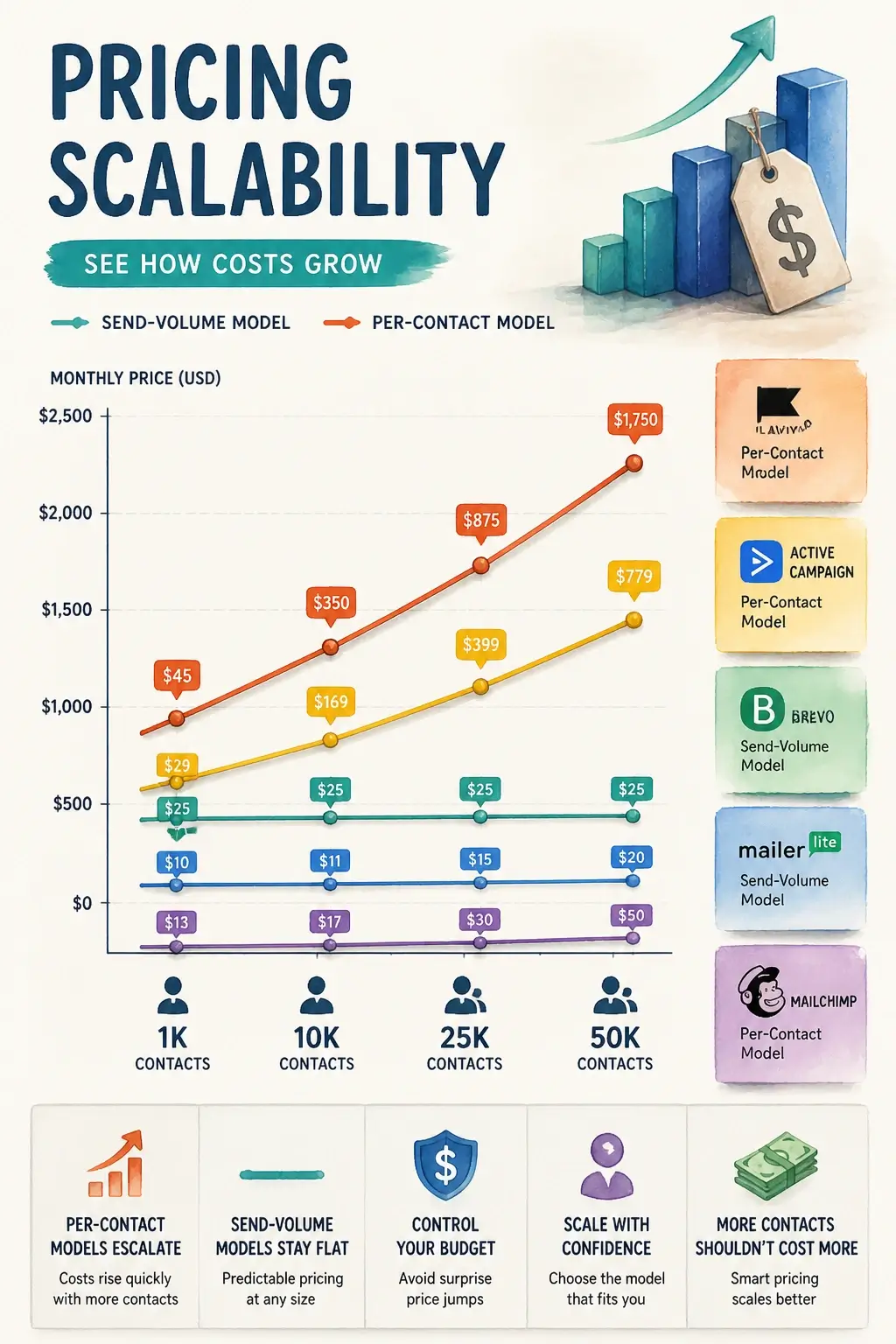
Klaviyo’s contact-based pricing model starts around $45/month for up to 15,000 emails, but the cost structure is built on both contact count and send volume – a combination that makes predictive budgeting essential for any store with a growing or volatile list. What looks manageable at launch can cross $500/month at 50,000 contacts, a 10x+ jump that standard comparison articles rarely disclose. Before committing, run the numbers at your projected list size, not your current one.
Behavioral Automation Built for Commerce
Klaviyo’s automation engine is its signature strength: flows triggered by real-time commerce events – viewed product, abandoned cart, post-purchase behavior, and predictive lifetime value segments. These aren’t generic drip sequences. They’re behavioral decision trees tied directly to what a customer did or didn’t do in your store. The predictive analytics layer adds future revenue attribution per segment, which is genuinely useful for merchandising and campaign prioritization.
For a practical walkthrough of how these flows are built, this tutorial covers the abandoned cart and checkout sequence in detail:
Deliverability and Compliance Posture
Klaviyo carries a strong industry reputation for deliverability within Shopify ecosystems, but it’s worth being precise: no independent cross-tool benchmark exists that measures its inbox placement against competitors head-to-head. The reputation is real, but it’s built on user reports and platform-provided data, not a controlled study. Implementing custom DKIM, SPF, and DMARC on a dedicated sending domain remains mandatory regardless of the platform’s standing.
On compliance, Klaviyo is GDPR-aligned and offers appropriate data processing agreements. Regulated sectors – HIPAA, FINRA – must verify directly, because most comparisons never flag this distinction.
Industry economics research on data-driven pricing and high-volume buyers offers a useful frame for understanding Klaviyo’s value proposition:
“High-volume consumers often account for a disproportionate share of demand and are frequently the primary targets of data-driven pricing strategies… switching costs scale with purchase volume. Put simply, personalization pays off only when high-volume customers are both economically important and willing to switch suppliers; otherwise, it tends to intensify competition and erode profits.”
That logic maps directly to Klaviyo’s use case. If your revenue is concentrated in repeat buyers and your store’s data is rich enough to act on, Klaviyo’s personalization engine earns its price. If you’re not running a DTC or ecommerce operation, the architecture is working against you, not for you.
Best fit: DTC brands and ecommerce operators who measure success in revenue-per-email and have the list growth trajectory to justify the cost curve.
MailerLite: The Lean Powerhouse for Budget-Conscious Operators
MailerLite is a deliberately streamlined email platform that makes an honest promise – predictable pricing, clean automation, and a free tier that doesn’t expire after 30 days – and then keeps it. For the solopreneur or small content business, that kind of reliability has real compounding value.
A Pricing Model That Doesn’t Punish Growth
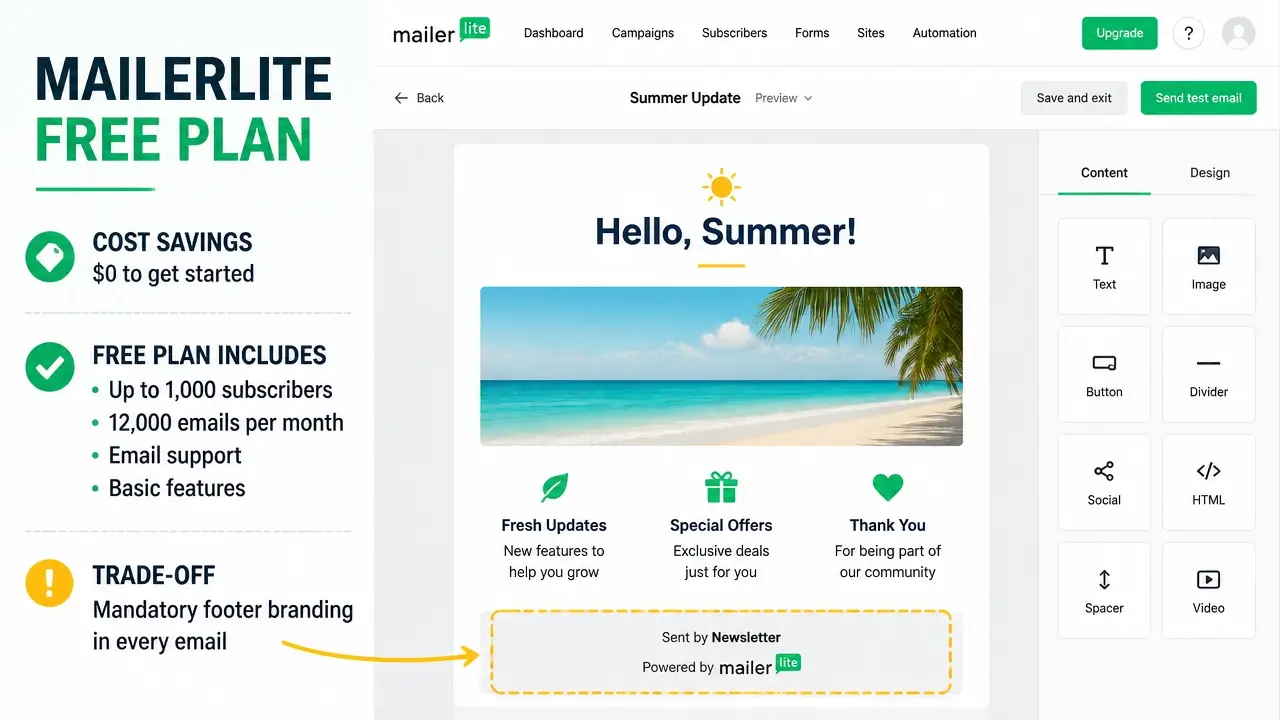
MailerLite’s free tier covers 1,000 subscribers and 12,000 emails per month, and the paid progression scales smoothly without arbitrary per-contact cost explosions. A 25,000-contact list on MailerLite stays significantly cheaper than the same list on Klaviyo or ActiveCampaign – not because MailerLite cuts corners, but because the pricing model isn’t built on per-contact surcharges layered over per-feature modules.
One trade-off on the free plan worth knowing: MailerLite branding appears as a footer badge on outgoing emails. It’s a small thing, but it matters for brand perception at the professional level. The upgrade removes it, and the cost remains low enough that it’s rarely a real obstacle.
Here’s what that footer badge looks like in practice:
Automation That Matches the Workload
MailerLite’s visual automation builder handles welcome sequences, drip campaigns, and simple conditional splits with minimal friction. For a solopreneur managing a newsletter or a small product launch cadence, that’s enough. Where it starts to feel limiting is in complex multi-branch, event-driven flows or any workflow that needs to pull from CRM lead scoring. The tool is honest about what it is – and what it isn’t.
Deliverability and Compliance
MailerLite provides DKIM, SPF, and custom domain authentication tools alongside a user-friendly reputation health dashboard. Without an independent cross-platform benchmark, the honest read is: above-average for small and mid-sized lists, with the standard warm-up requirement on shared IPs. The platform’s inbox placement is generally reliable for lists under 50,000 contacts.
B2B purchasing behavior research offers an insight that applies directly to MailerLite’s positioning:
“Purchasing professionals arguably choose a price plan that leads to the lowest costs-all else being equal-for their companies when buying services. However, evidence suggests that they prefer flat rates, even where these are more expensive than pay-per-use options.”
That preference for flat-rate predictability is exactly what MailerLite delivers. And unlike most “affordable” platforms, the affordability claim actually holds up at scale – because the pricing model doesn’t gradually reshape itself into something unrecognizable as your list grows.
Best fit: Solopreneurs, small content businesses, and budget-conscious creators who need transparent pricing and reliable delivery without enterprise automation complexity.
Brevo: High-Volume Sender with Omnichannel Reach
Brevo solves a specific problem that most email platforms quietly ignore: what happens to your cost structure when your list is large but your revenue-per-contact doesn’t justify per-contact pricing? Its send-volume-based model decouples cost from list size entirely, which makes it a structurally different animal from the contact-count platforms that dominate most comparison articles.
A Pricing Architecture Built for Volume
Brevo’s free tier allows up to 300 emails per day with no contact limit – a genuinely unusual offer in the market. The Starter plan begins at €8.08/month, with pricing tied to how many emails you send rather than how many contacts you store. For newsletter publishers, content platforms, and international SMBs with large audiences, this is the model that keeps “affordable” true at 50,000 and 100,000 contacts, not just at 1,000.
The daily sending limits are worth understanding: they’re not arbitrary restrictions. They function as a built-in IP warm-up mechanism that protects deliverability by preventing sudden volume spikes. During high-stakes launches, this requires planning ahead.
To see how Brevo’s pricing holds up against a contact-based model like Klaviyo at scale, the difference becomes significant:
Omnichannel Automation in One Flow
Brevo’s automation engine supports multi-step workflows with branching logic, and its standout capability is the integration of transactional email, SMS, and WhatsApp within a single flow. For businesses with international audiences or multi-channel touchpoint strategies, that’s a meaningful operational simplification. The conditional logic is less granular than ActiveCampaign’s – complex if/else branching at the behavioral level will hit a ceiling – but for the use cases Brevo is built for, it’s more than sufficient.
Research on over-the-top messaging dynamics provides useful context on why this omnichannel integration matters:
“OTT messengers such as Facebook and WhatsApp have gained wide popularity among mobile users while the traffic of text messaging is in strong decline… raising the average number of interactions with messaging apps by 16 per day increases the number of sent text messages by 1 per day. Consequently, both markets are interrelated but do not constitute a joint market…”
That interrelation is the operating reality for businesses trying to reach audiences across channels. Brevo’s architecture acknowledges it natively – rather than forcing a separate SMS tool and a separate email tool into a brittle integration.
Deliverability and Compliance
Brevo invests in dedicated IP options and automatic list hygiene tools, both of which contribute to inbox placement health at high send volumes. EU-based data hosting and explicit GDPR compliance tools are built in – a meaningful advantage for European businesses and any sender managing subscriber data under EU law. PCI-DSS or HIPAA-level compliance, as with most platforms, requires direct verification.
Best fit: High-volume newsletter publishers, content platforms, international businesses, and any sender for whom contact-count pricing becomes punitive at scale.
Kit (formerly ConvertKit): The Creator’s Deliverability Champion
Kit is a purpose-built email platform for the creator economy – newsletter authors, digital product sellers, and content entrepreneurs who monetize their audience directly. Its architecture isn’t trying to serve everyone. That narrowness is the point, and it’s what makes it genuinely excellent for the use case it’s designed for.
A Free Tier That Respects the Creator Model
Kit’s free plan covers up to 10,000 subscribers with unlimited email sends – one of the most generous free tiers in the industry, and one that’s consistently under-reported in broad platform comparisons. Paid tiers scale on subscriber count rather than send volume, which means an engaged list that sends frequently doesn’t generate unexpected cost spikes. For a content creator building toward monetization, this is a structurally honest model.
Automation Designed for Simplicity, Not Complexity
Kit’s visual automation builder handles email sequences, subscriber tagging, and engagement-based segmentation cleanly. It’s deliberately streamlined – not because the team couldn’t build more complexity, but because the creator use case doesn’t need multi-branch CRM scoring or commerce-triggered flows. What it needs is reliable delivery of text-heavy content to engaged readers, and that’s exactly what Kit’s architecture is tuned for.
Deliverability as a First Principle
Kit’s entire infrastructure is oriented around inbox placement for creator-driven newsletters. Paid creators benefit from dedicated sending infrastructure and strong authentication defaults. The platform’s reputation for deliverability is well-established in the creator community, though the independent cross-tool benchmark gap applies here as it does everywhere – treat it as documented reputation, not a measured score, and run your own 30-day trial to validate.
Business strategy researchers specializing in the creator economy capture the structural shift that explains Kit’s rise:
“The cadre is no longer needed (or is needed to a lesser extent) and thus neither is the need to raise substantial amounts of capital to fund them… low-code tools are being developed for use in many industries, mostly notable the ‘creator’ economy where artists, musicians, and writers set up as entrepreneurs who scale and monetize their creative talents.”
Kit is, in many ways, the infrastructure expression of that shift. Because it decouples cost from send volume, a creator with a loyal 20,000-subscriber list pays a predictable, linear rate as they grow – directly solving the hidden cost trap for content-first businesses.
Best fit: Newsletter authors, content creators, and digital product sellers who prioritize inbox placement, audience relationship depth, and straightforward monetization over ecommerce flows or sales pipeline management.
ActiveCampaign: When Automation Complexity Is Your Competitive Edge
ActiveCampaign is not a newsletter tool with a CRM bolted on – it’s a mid-market automation engine that happens to send email. The distinction matters, because the businesses that get the most from it are the ones where the email sequence must adapt to lead behavior, CRM data, and sales pipeline stage in real time.
A Pricing Model That Climbs With Capability
ActiveCampaign’s contact-based pricing starts around $15/month for 500 contacts, but the features that make it worth choosing – predictive sending, lead scoring, deep CRM integration – live in higher tiers. At 25,000 contacts with the full automation suite, monthly costs can reach $200–$300, a trajectory that surface-level comparisons consistently obscure. The rule from earlier applies here too: price it at your next growth stage before committing.
The Automation Engine That Earns the Complexity
ActiveCampaign’s visual workflow builder supports if/else logic, split conditions, site tracking triggers, lead scoring, and a built-in CRM that unifies email with deals and tasks in a single interface. For a B2B service firm running a multi-touch nurture sequence, or a SaaS company triggering onboarding flows based on in-app behavior, this is the platform that actually handles the workload. No other tool in this comparison bridges email automation and deal-stage management with the same depth.
That said, this architecture is over-engineered for a simple newsletter or a basic ecommerce store. Choosing ActiveCampaign because it’s “the most powerful” – without the operational complexity to justify it – is the exact feature-list-driven mistake that leads to needless cost and, eventually, migration.
Deliverability and Compliance
ActiveCampaign’s deliverability reputation is mixed but manageable, and heavily dependent on configuration. The platform offers deliverability coaching resources and authentication tools, but sending to unengaged lists is more punishing here than on platforms with more aggressive automatic list hygiene. Clean your list before you send, and configure authentication properly from day one.
GDPR tools and data processing agreements are available. SOC2 and HIPAA compliance must be verified directly – as with every platform in this comparison, that nuance is systematically absent from most reviews.
Best fit: B2B service firms, SaaS companies, agencies, and high-ticket sales operations where email is one layer of a broader CRM-driven revenue process.
Your Platform, Your Business Model: The No-Nonsense Matchmaker
Business model-platform fit is the only question that actually matters after you’ve absorbed everything above – not which platform has the most features, the best marketing, or the most five-star reviews. The platforms we’ve covered represent five distinct architectural philosophies, and the right choice is the one whose DNA matches how your business generates revenue.
Here’s how that maps out across the three personas most likely reading this:
One natural transition before the table: the comparison below synthesizes the four evaluation criteria – pricing scalability, automation depth, deliverability reputation, and best-fit rationale – across each platform and persona. Use it as a decision anchor, not a ranking.
| Business Persona | Primary Recommendation | Secondary Option | Pricing Scalability | Automation Depth | Deliverability Reputation | Best-Fit Rationale |
|---|---|---|---|---|---|---|
| Solopreneur on a Budget | MailerLite | Brevo | Flat, predictable | Welcome flows, simple drips | Above-average for small lists | Transparent pricing that holds at scale; no per-contact penalty surprises |
| Small E-commerce Store | Klaviyo | Brevo | Steep per-contact curve | Behavioral commerce flows, predictive analytics | Strong within Shopify ecosystems | Revenue-per-email architecture; project costs at 25k–50k before committing |
| Content Creator | Kit | MailerLite | Linear per-subscriber | Tagging, sequences, engagement-based | Deliverability-first infrastructure | Unlimited sends on free tier; cost stays linear with engaged list growth |
The solopreneur on a budget belongs on MailerLite first, with Brevo as a strong alternative if high-volume sending or multi-channel reach matters more than visual design flexibility. If the business model is content-led, Kit is equally viable – the free tier alone makes it worth testing.
The small ecommerce store belongs on Klaviyo, with one firm condition: run the cost projection at 25,000 and 50,000 contacts before you commit. If multi-channel reach or international SMS matters more than deep behavioral commerce flows, Brevo is a legitimate secondary option that avoids the contact-count cost trap.
The content creator belongs on Kit. The 10,000-subscriber free tier with unlimited sends is one of the most under-reported advantages in the market, and the deliverability-first architecture is purpose-built for exactly this use case. MailerLite serves as a secondary choice for creators who want stronger visual design flexibility without sacrificing affordability.
One anti-pattern worth naming explicitly: choosing ActiveCampaign because it’s “the most powerful” option for a simple newsletter or basic ecommerce operation is the exact kind of feature-list-driven decision that leads to unnecessary cost, operational complexity, and – eventually – migration. ActiveCampaign earns its place when the business genuinely runs on CRM-driven pipeline management. For anything else, it’s the wrong tool.
B2B segment optimization research frames the underlying principle cleanly:
“Yankelovich specified the detail criteria of market segmentation: (1) align with the company’s strategy, (2) specify where revenue and profit come from, (3) articulate customer’s business values, (4) focus on actual business behaviors… [and] make sense to executive teams…”
That logic applies directly to platform selection. The right platform isn’t the one with the most capabilities – it’s the one whose capabilities align with how your business actually generates revenue and how your audience actually behaves.
Two final anchors worth holding onto as you make this decision:
Because independent cross-platform deliverability data doesn’t exist in any rigorous form, every recommendation above is built on architectural fit and documented reputation – not a head-to-head inbox placement score. Run a 30-day trial. Use your own delivery monitoring as the final validation.
And because the most common failure mode in this market is choosing a platform that becomes financially or technically untenable at the next growth stage, every recommendation here prioritizes predictable cost scaling. Align the platform’s DNA with your business model from day one, and the switching-cost problem that plagues so many growing businesses becomes someone else’s story.
Key Takeaways on Email Marketing Platforms
- Platform migration costs include data discontinuity, a deliverability reset of 10–40% inbox placement, and a full automation rebuild that can take 4–6 weeks minimum.
- The monthly entry price is the least useful number in a platform comparison – always model cost at your next growth stage, not your current one.
- Deliverability is a system, not a score; SPF, DKIM, and enforced DMARC together drive 85–95% inbox placement versus 30–50% for unauthenticated senders.
- No independent cross-platform deliverability benchmark exists, meaning any “best deliverability” label in a comparison article is reputation-based, not measured.
- Klaviyo fits ecommerce, Kit fits creators, MailerLite fits budget-conscious operators, Brevo fits high-volume senders, and ActiveCampaign fits CRM-driven sales operations – none of them is universally best.
- Security and compliance posture – GDPR, HIPAA, SOC2 – are systematically omitted from most platform comparisons but represent hard stops for regulated businesses.
Frequently Asked Questions About Email Marketing Platforms
Can I really not just export my list and move platforms later?
You can export your contact list, but you can’t export behavioral data, engagement history, segmentation logic, or your sender reputation – those stay behind, and rebuilding them on a new platform takes weeks of degraded deliverability and operational rework.
How do I warm up a new sending IP after switching platforms?
Start by sending to your most engaged subscribers only – people who’ve opened in the last 30–90 days – and gradually increase volume over 4–6 weeks while monitoring bounce rates and spam complaints. Sending to a cold or unengaged list during warm-up is the fastest way to damage your new domain’s reputation permanently.
Is a free email marketing plan actually usable for a real business?
Kit’s free plan at 10,000 subscribers with unlimited sends and MailerLite’s free tier at 1,000 subscribers and 12,000 monthly emails are both genuinely functional – not just trial windows. The trade-offs are platform branding in footers and limited automation depth, not artificially throttled deliverability.
What’s the difference between shared and dedicated IP sending?
On a shared IP, your deliverability is partially influenced by the sending behavior of other users on the same infrastructure. A dedicated IP is yours alone, which means your reputation is entirely self-determined – but it also requires enough consistent send volume to maintain that reputation, typically 50,000+ emails per month.
Does platform choice affect GDPR compliance for my subscribers?
Yes, directly. The platform you choose becomes a data processor under GDPR, which means you need a signed Data Processing Agreement with them and clarity on where subscriber data is stored and how EU-US data transfers are handled. Several platforms offer EU-based hosting; others require additional configuration to meet the standard.
Why does ActiveCampaign cost so much more at scale than it looks upfront?
ActiveCampaign’s full automation suite – predictive sending, lead scoring, CRM integration – lives in higher pricing tiers, not the entry plan. A 500-contact account at $15/month can become a 25,000-contact account at $200–$300/month once you add the features that actually differentiate the platform.
How do I know if a platform’s deliverability claims are real?
You largely can’t verify them from the outside, because no independent cross-platform inbox placement study exists. The practical approach is to run a 30-day trial sending to a representative segment of your list, monitor placement using a tool like GlockApps or MXToolbox, and treat the results as your actual benchmark – not the platform’s marketing copy.
Is Brevo a good fit if I only send email and don’t need SMS?
Yes – Brevo’s send-volume pricing model is valuable even without the SMS layer, particularly for high-volume newsletter senders and content platforms where a contact-count model would become expensive. The omnichannel features are there if you need them, but you don’t pay a penalty for not using them.
References
- The Great Migration: Why Companies Switch Email Providers – mailpool.ai
- Measuring Email Sender Validation in the Wild – dl.acm.org
- B2B Email Deliverability Benchmarks 2025 – thedigitalbloom.com
- Email Deliverability: Authentication & Inbox Placement Guide 2026 – digitalapplied.com
- MDPI Journal of Information: Business Resilience and CRM for SMEs – mdpi.com
- MDPI Applied Sciences: Frameworks for Low-Code and Process Automation Systems – mdpi.com
- Journal of Business Research: Data-Driven Pricing and Multi-Unit Buyers – sciencedirect.com
- Journal of Business Research: Pricing Plan Choices and Purchasing Bias – sciencedirect.com
- Telecommunications Policy: Over-the-Top Messaging Interrelationship Analysis – sciencedirect.com
- Journal of Business Venturing: Low-Code and Creator Economy Growth Trajectories – sciencedirect.com
- Future Generation Computer Systems: Value-Based Segment Modeling – sciencedirect.com