
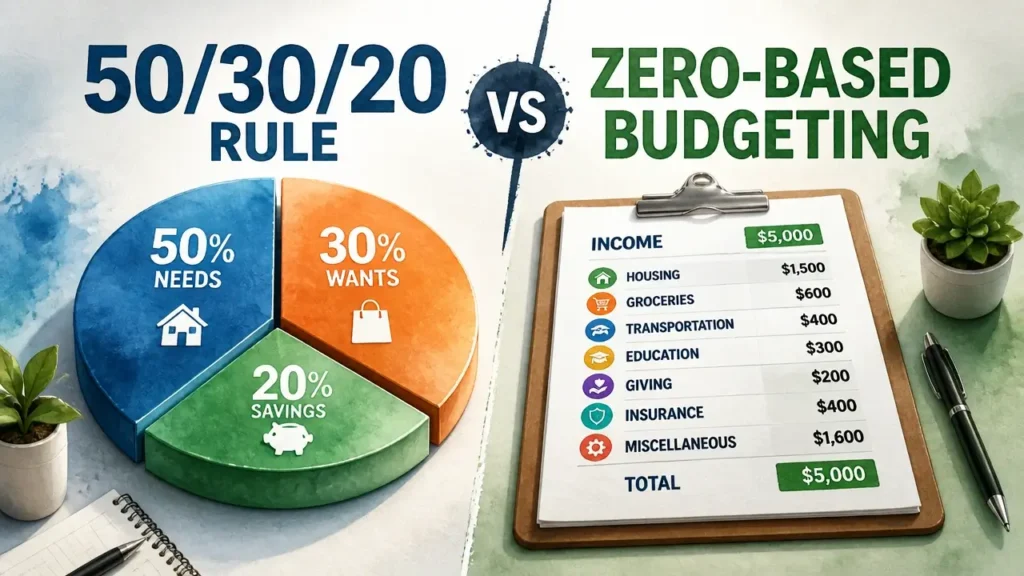
Effective budgeting methods don’t just track your money – they shape how every dollar behaves before you spend it. The 50/30/20 rule and zero-based budgeting are both legitimate systems, but they operate at completely different levels of control, and using the wrong one for your situation is the reason most budgets quietly collapse.
The difference isn’t about discipline. It’s about fit. Understanding how each framework is actually built – not just what the percentages say – is what lets you make a confident, lasting choice.
The Two Budgeting Blueprints, Clearly Defined
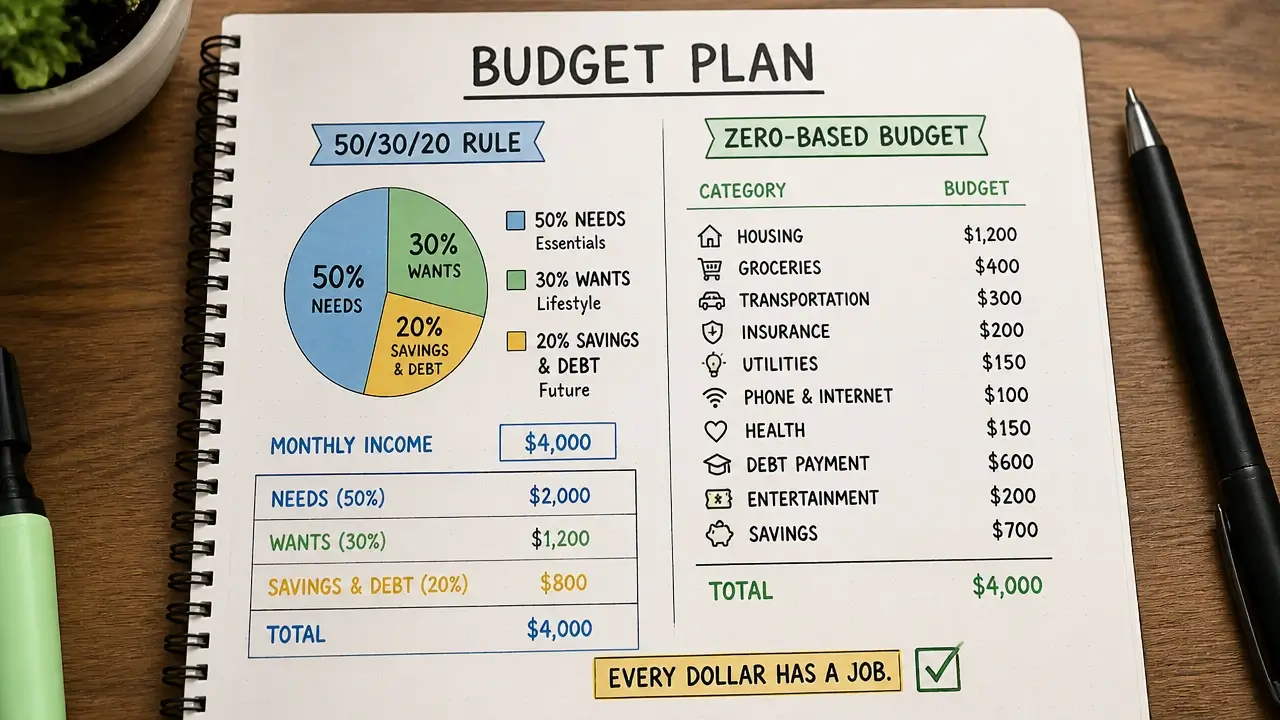
Competing budgeting frameworks solve the same problem from opposite angles – one draws a wide map, the other assigns a job to every single dollar. The 50/30/20 rule splits your after-tax income into three proportional buckets: 50% toward needs, 30% toward wants, and 20% toward savings or debt repayment. It’s a guideline built for balance, not precision.
Zero-based budgeting (ZBB) works differently. You start with your income and subtract every planned expense – rent, groceries, subscriptions, savings transfers, sinking funds – until the math hits exactly zero. Not zero in your account, zero unassigned. Every dollar has a specific destination before the month begins.
The philosophical gap between them is real. The 50/30/20 rule asks: are my spending proportions healthy? Zero-based budgeting asks: what is every dollar doing? One is a monthly health check. The other is a daily operating system. That distinction matters more than any percentage comparison.
Here’s the part most comparisons skip: these two methods aren’t competing for the same job. They operate at different layers. The 50/30/20 rule works at the macro level – it tells you whether your financial structure is sound. ZBB works at the micro level – it tells you whether your execution matches your intentions. You can actually run both at once: use 50/30/20 to set your proportional targets, then zero-base inside each bucket to control where the money actually goes.
Before we go any further, here’s a clean side-by-side view of how they differ at a structural level.
Elizabeth Warren, U.S. Senator and former Harvard Law Professor, put the 50/30/20 philosophy plainly:
“This is not a budget where you have to write down every single penny you spend… Instead, it is about getting your basic financial structure in balance. If you keep your Must-Haves to 50% or less, your Wants to 30% or less, and your Savings at 20%, the rest of your money will take care of itself.”
That framing is the key insight. The 50/30/20 rule was never designed to account for every transaction. It was designed to keep your financial architecture from collapsing. ZBB handles what happens inside that architecture – and that’s where the real comparison begins.
The Four Factors That Decide Which System Works
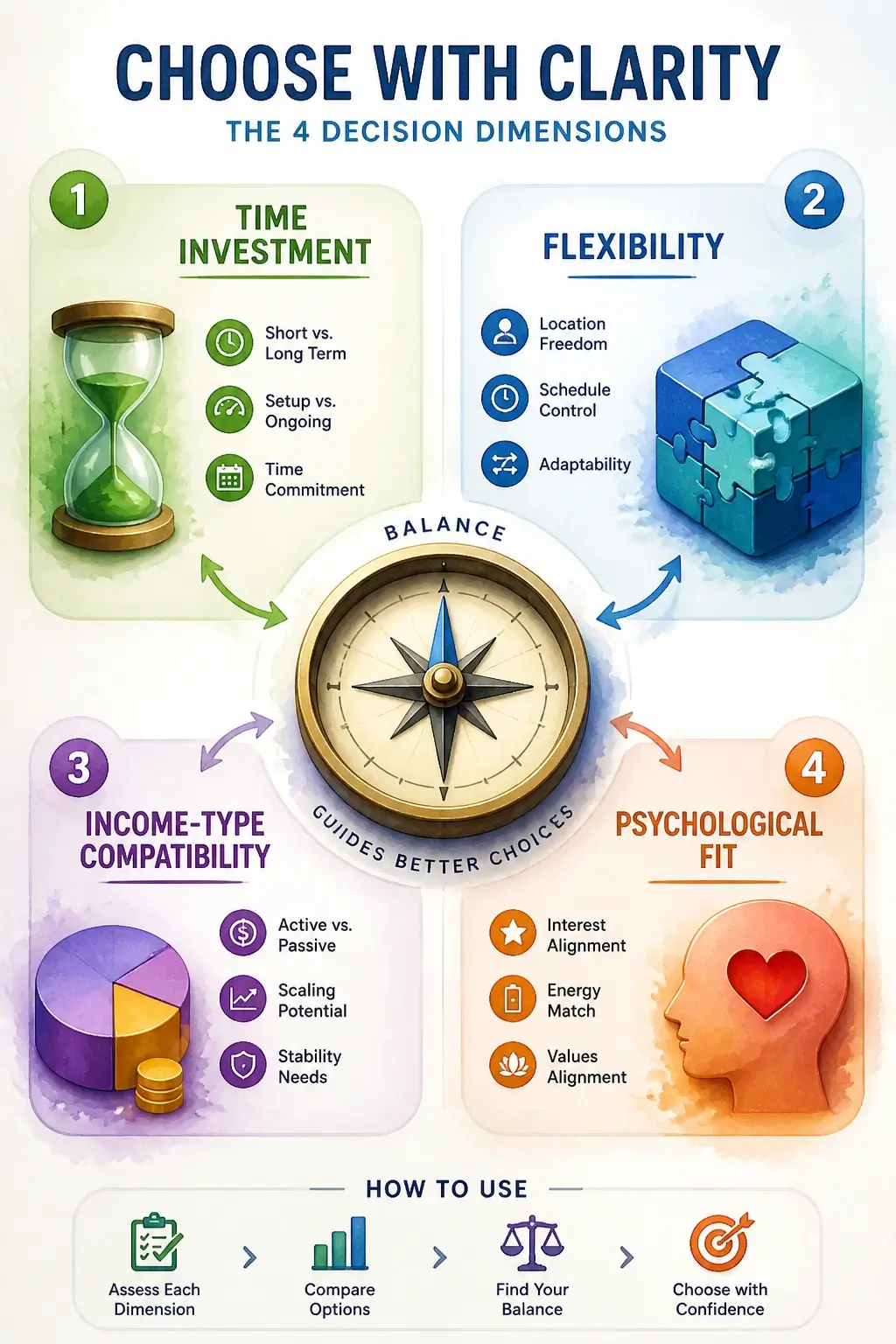
Solid evaluation factors separate a smart method choice from a lucky one – and there are four that actually move the needle: time investment, flexibility, income-type compatibility, and psychological fit. These aren’t abstract categories. They’re the four places where a budgeting system either holds together or quietly breaks down.
Time investment is the ongoing attention a method demands – not the one-time setup, but the weekly and monthly maintenance it requires to stay functional. A system that needs daily check-ins from someone who checks their budget monthly will always drift. Matching the method’s maintenance rhythm to your actual behavior is non-negotiable.
Flexibility means how well the system absorbs the unexpected without requiring a rebuild. A surprise car repair, a freelance payment that lands two weeks late, or a month where your utility bill doubles – a rigid framework that can’t accommodate these without breaking will get abandoned the first time life gets messy.
Income-type compatibility is about predictability. A stable salaried income makes percentage-based planning easy because the denominator never changes. Variable income – freelance work, commission, gig economy – means the denominator shifts every month, and any system that assumes a fixed number will produce a different kind of math problem each time.
Psychological fit is the one most people ignore until it’s too late. Some people feel liberated by guidelines and suffocated by granular tracking. Others feel anxious without a plan for every dollar and find broad buckets too vague to trust. Neither response is wrong – but matching your motivation style to your method is what determines whether you stick with it past month three.
These four dimensions aren’t a scoring rubric. They’re a lens. The goal isn’t to declare a winner across all four – it’s to understand which trade-offs you’re actually willing to make.
A peer-reviewed study published in Frontiers in Psychology makes the income-stability dimension concrete:
“Income volatility can have detrimental effects on personal financial planning. Volatility, even if it is perceived to be controllable by a worker, may reduce budgeting, self-insurance against risks, and savings… leaving workers more financially vulnerable.”
That finding matters because it reveals the hidden cost of a method mismatch: it’s not just that the budget gets harder to follow – the volatility itself erodes the behaviors that budgeting is supposed to protect. Picking the right framework for your income type isn’t a preference question. It’s a structural one.
Head-to-Head: How Each Method Performs on What Counts
Direct method performance comparison cuts through the noise faster than any general overview. Here’s how the 50/30/20 rule and zero-based budgeting actually perform across each of the four dimensions – plus two additional factors that only show up when you run the numbers.
Time investment: The 50/30/20 rule requires a one-time setup and a light monthly check-in – maybe 20 minutes to review your bank statement and verify your proportions are intact. ZBB demands deliberate planning at the start of every month and regular mid-month monitoring to keep the zero balance accurate. For most people, that’s a meaningful difference in weekly cognitive load.
Flexibility: ZBB actually has the edge here, which surprises most people. Because every dollar gets reassigned at the start of each period, ZBB naturally resets when income changes – you’re just working with a different number. The 50/30/20 rule assumes a stable income base. When income dips or spikes, the percentages don’t automatically adjust to reflect the new reality.
Income-type compatibility: The 50/30/20 rule is built for predictable, salaried income. The math is clean when you know what 50% of your take-home will be. ZBB is naturally suited to variable income – freelancers, commission-based workers, and anyone with irregular cash flow – because the entire system resets monthly around whatever you actually earned.
Psychological fit: The 50/30/20 rule feels permissive. It gives you permission to spend 30% on wants without guilt, and it doesn’t require you to justify individual purchases. ZBB feels empowering to people who want control – every allocation is a conscious choice. But that same quality feels exhausting to people who don’t want to think about their budget more than once a month.
Savings potential: This is where the structural gap is most significant. The 50/30/20 rule caps savings at 20% by design. If your goal is aggressive debt payoff, early retirement, or a down payment on a compressed timeline, 20% may not be enough – and the framework doesn’t offer a clean mechanism to change that without abandoning the rule entirely. ZBB can be tuned to any savings rate. You simply assign more dollars to savings before anything else.
Blind spots: The 50/30/20 rule’s broad categories can hide overspending – $400 in streaming services, unused gym memberships, and impulse buys all sit comfortably inside “wants” without triggering any alarm. ZBB’s intensity creates a different problem: the sheer number of decisions required can lead to decision fatigue and eventual abandonment. Both risks are real, and both deserve a closer look.
A study published in the Journal of Economic Psychology captured how people actually use budget categories in practice:
“While more than 85 percent of respondents would either adjust their spending or update their spending limits if they overspent… less than 30 percent would make such changes if they underspent… households budget in order to constrain (often category-specific) spending rather than simply as a means of tracking.”
That asymmetry explains why the 50/30/20 rule’s broad buckets create a specific blind spot: people notice when they’ve blown past a limit, but they rarely notice when they’re quietly drifting inside one. ZBB’s granularity forces the awareness that broad categories suppress.
Here’s the full comparison in one place.
| Dimension | 50/30/20 Rule | Zero-Based Budgeting |
|---|---|---|
| Time Investment | Low – one-time setup, light monthly review | High – full reset each month, regular check-ins |
| Flexibility | Low – assumes stable income; breaks under volatility | High – resets monthly around actual income |
| Income Compatibility | Best for stable, salaried income | Best for variable, freelance, or irregular income |
| Psychological Fit | Freedom-seekers; low-maintenance preference | Control-seekers; thrive on data and structure |
| Savings Potential | Capped at 20% by design | Tunable to any savings rate |
| Primary Blind Spot | Broad categories hide spending drift | Granularity triggers decision fatigue and burnout |
The Hidden Failure Points No One Talks About
Every budgeting method has failure patterns that only surface in real-world use – not in the explainer articles, not in the setup tutorials, but three months in when life stops cooperating. The test of any system isn’t how it performs when everything goes according to plan. It’s how it handles the mess.
Here are the four failure points that trip up even well-intentioned budgeters.
Subscription creep and the irregular-expense gap. The 50/30/20 rule’s “wants” bucket is where silent budget leaks live. Streaming services, app subscriptions, annual memberships – they’re individually small, collectively significant, and structurally invisible inside a broad category. ZBB’s granularity catches them because every subscription gets its own line item. The practical fix that experienced budgeters use regardless of method: create a dedicated subscriptions sub-category (a ZBB-style move even inside a 50/30/20 framework) and fund a separate irregular-expenses bucket with roughly 5% of income. A $100–$300 checking buffer further smooths the cash-flow gaps that irregular expenses create.
The “needs exceed 50%” ceiling. When fixed expenses – rent, utilities, insurance, minimum debt payments – exceed 50% of take-home pay, the 50/30/20 framework doesn’t bend gracefully. It breaks. There’s no built-in adjustment mechanism, no guidance on what to do when the math is simply impossible. This is the single most common reason people abandon the 50/30/20 rule: not because they lack discipline, but because their cost of living makes the framework structurally non-viable. If your fixed costs are already above 50%, ZBB or a custom hybrid isn’t a preference – it’s the only path that produces accurate numbers.
The 20% savings floor is too low for serious goals. For anyone targeting early retirement, aggressive debt payoff, or a down payment on a compressed timeline, 20% savings is a ceiling, not a floor. ZBB can be tuned to any savings ambition – you simply assign more dollars to savings before allocating anything else. The 50/30/20 rule artificially caps savings at 20% unless you consciously override the framework, and that ambiguity undermines the simplicity that made it appealing in the first place.
ZBB’s hidden tax: tracking fatigue. Most descriptions of zero-based budgeting present it as “time-consuming.” That undersells the real problem. Sample ZBB budgets from tools like Monarch Money show 8 categories. Real-world ZBB users often run 20 or more. Maintaining a true zero balance requires daily or weekly check-ins, and that sustained micro-decision load has a measurable cognitive cost.
Two separate bodies of research explain why this matters. A meta-analysis published in Psychological Bulletin – pooling data from more than 800 experiments – found a reliable, medium-sized reduction in performance on tasks that followed any act of self-control, with the depletion effect growing when tasks were cognitively demanding. A separate experimental study published in the Journal of Personality and Social Psychology established a direct causal link between the act of choosing and the depletion of a limited executive-function resource – even trivial choice tasks reduced participants’ ability to exert self-control afterward. Applied to ZBB, the perpetual need to select, justify, and allocate every budget line creates exactly the kind of sequential self-control demand that both studies identify as depleting. The fatigue isn’t a personal weakness. It’s a predictable mechanical outcome of how the system works.
A study published in Frontiers in Behavioral Economics connects this directly to budgeting abandonment:
“When the strategy breaks down, all [control] falls through… each time [they fail], leaving them in paralysis… success assumes that the client has the cognitive agency and low stress to cope with this complexity.”
The implication is direct: ZBB is not a universally scalable system. Its effectiveness is conditional on the user having sufficient cognitive bandwidth to sustain it. For people operating under high stress, irregular schedules, or already-depleted mental resources, the system’s demands can exceed what’s realistically available – and that’s when abandonment happens.
Who Thrives With Which Budgeting Method
Concrete budgeting user personas cut through the abstract dimensions and give you a mirror. Most people fit cleanly into one of three profiles – and knowing which one describes you is the fastest way to skip the trial-and-error phase.
The ZBB Archetype: Control-Driven and Goal-Focused
Detail-oriented budgeters who want maximum visibility over their money are the natural fit for zero-based budgeting. This includes freelancers and commission-based workers whose income resets every month, anyone carrying aggressive savings targets (early retirement, rapid debt payoff, a large down payment), and people who feel genuinely anxious when they can’t account for every dollar. The granularity isn’t a burden for this group – it’s the point. The monthly reset that ZBB requires is actually a feature for variable-income earners, because the budget is rebuilt around whatever actually came in, not a projected average.
The 50/30/20 Archetype: Stable, Simple, and Low-Maintenance
Salaried employees with predictable income and fixed costs comfortably under 50% of take-home pay are the ideal 50/30/20 user. This is also the right starting point for anyone new to budgeting who needs a framework that produces results without demanding daily attention. The rule’s permissive structure – you have explicit permission to spend 30% on things you enjoy – removes the guilt that causes many first-time budgeters to quit. If your financial life is relatively straightforward and you don’t have aggressive near-term goals, the simplicity of 50/30/20 is a genuine advantage, not a compromise.
The Hybrid Archetype: Macro Structure, Micro Control
High-fixed-cost households and anyone who wants intentionality without full granularity land in the hybrid zone. The most functional version of this approach uses 50/30/20 to set proportional targets at the macro level, then applies zero-based logic inside the “wants” and “savings” buckets – the two categories most prone to drift. This gives you the structural health check of the 50/30/20 rule and the leak-prevention of ZBB, without requiring you to track every grocery line item. It’s also the natural choice for people who start with 50/30/20, hit a savings goal that demands more precision, and need to step up their control without rebuilding from scratch.
The psychological dimension runs through all three profiles. People who feel constricted by detailed tracking will abandon ZBB – not because they lack discipline, but because the system’s demands conflict with how they’re wired. People who feel anxious without a plan for every dollar will find 50/30/20 too loose to trust. The method that matches your motivation style will outlast the method that matches your math.
To see what this looks like in practice with a real income, this walkthrough is worth your time.
The Decision Map: Your Budgeting System, Chosen
A clear budgeting decision tree turns everything you’ve absorbed about these two methods into a single, personalized path – no guesswork, no coin-flip. Here’s how to work through it.
Start with your fixed-cost percentage. Add up your non-negotiable monthly expenses: rent or mortgage, utilities, insurance, minimum debt payments, groceries. Divide that total by your after-tax income. If the result is above 50%, the 50/30/20 rule is mathematically non-viable for your situation. Skip it. Move directly to ZBB or a custom hybrid.
If you’re at or below 50%, assess your income stability. Variable income – freelance, commission, gig work – points toward ZBB, because the monthly reset is a feature, not a chore. Stable, predictable income makes you a candidate for either system.
Next, evaluate your tracking tolerance honestly. If the idea of logging 20+ budget categories and checking your balance weekly sounds like a job you don’t want, ZBB in its full form will exhaust you. A simplified ZBB hybrid – broad buckets with zero-based logic applied only inside “wants” and “savings” – gives you control without the overhead.
Finally, check your savings ambition. If 20% gets you to your goal on your timeline, the 50/30/20 rule works as designed. If you’re targeting early retirement, aggressive debt payoff, or any goal that requires a savings rate above 20%, ZBB’s flexibility is not optional – it’s the only framework that lets you tune the number to what you actually need.
One thing worth normalizing: switching methods is not a failure. Many successful budgeters start with 50/30/20 – it’s a low-friction entry point that builds the habit of looking at your finances – and transition to ZBB when their goals become more aggressive or their income becomes less predictable. That progression is a sign of financial growth, not instability.
A practical insight from Strategia-X’s fintech UX research on budgeting app abandonment reinforces why fit matters more than any specific method’s features: a significant share of users abandon their chosen budgeting approach within the first few months – not because the system is flawed, but because it was never matched to their actual behavior patterns in the first place. The method you’ll actually use consistently is always the right method, regardless of what any comparison table says.
An academic framework published in MDPI’s Economic Integration research adds a useful structural lens:
“The need for integrated approaches that address challenges at all three levels simultaneously also emerged… providing structural support at the macro-level… coordination at the meso-level… and direct assistance at the micro-level.”
That multi-level framing maps directly onto the hybrid approach: the 50/30/20 rule provides macro-level structural guidance, ZBB provides micro-level execution control, and the hybrid coordinates between them. Neither method alone addresses all three levels. Together, they can.
One last practical note regardless of which path you choose: adopt a $100–$300 checking buffer and fund a separate 5% irregular-expense account. These two tweaks – borrowed from real-world budgeters who’ve stress-tested both systems – make either framework resilient when life doesn’t follow the plan.
The bottom line: ZBB offers unmatched control for those who can sustain it. The 50/30/20 rule offers unbeatable simplicity for those whose finances fit within its boundaries. There is no winner. There is only the method that fits your real life.
Key Takeaways on Budgeting Methods
- The 50/30/20 rule is a macro health check; zero-based budgeting is a micro execution system – they solve different layers of the same problem.
- When fixed costs exceed 50% of take-home pay, the 50/30/20 framework breaks mathematically and ZBB becomes the only viable path.
- ZBB’s granularity creates a measurable cognitive cost – sustained micro-decisions deplete self-control, which is the primary driver of abandonment.
- Variable-income earners benefit most from ZBB because the monthly reset adapts to whatever was actually earned, not a projected average.
- The 50/30/20 rule caps savings at 20% by design; any goal requiring a higher savings rate needs ZBB’s tunable allocation system.
- The method you’ll consistently follow is always the right method – adherence beats theoretical optimality every time.
Frequently Asked Questions About Budgeting Methods
What is the 70/10/10/10 budget rule?
The 70/10/10/10 rule splits after-tax income into 70% for living expenses, 10% for savings, 10% for investing, and 10% for giving or charity. It’s a proportional framework like the 50/30/20 rule, but it builds investing and giving into the structure as separate categories rather than folding them into a single savings bucket.
What is the 40/40/20 rule of finance?
The 40/40/20 rule allocates 40% of income to needs, 40% to savings and debt repayment, and 20% to wants. It’s a more savings-aggressive variant of the 50/30/20 rule, designed for people who want to prioritize wealth-building over lifestyle spending without switching to a fully zero-based system.
Is there something better than the 50/30/20 rule?
There’s no universally better system – only a better fit for your specific income, goals, and psychology. If your fixed costs exceed 50% of income or you have aggressive savings targets, ZBB or a hybrid gives you more control and accuracy than the 50/30/20 rule can.
Can I combine the 50/30/20 rule and zero-based budgeting?
Yes, and it’s arguably the most practical approach for most people. Use the 50/30/20 rule to set your proportional targets at the macro level, then apply zero-based logic inside the wants and savings buckets to prevent drift and plug silent leaks.
What is the 3/6/9 rule in finance?
The 3/6/9 rule is an emergency fund guideline, not a budgeting method. It suggests holding 3 months of expenses if you’re single with stable income, 6 months if you have dependents or variable income, and 9 months if you’re self-employed or in a volatile industry. It’s a savings target framework, not a spending allocation system.
How do I know if ZBB is too time-consuming for me?
If you’re not willing to spend 30–60 minutes at the start of each month rebuilding your budget from zero, and you won’t check your allocations at least weekly, ZBB’s full form will drift and eventually get abandoned. A simplified hybrid – zero-basing only inside your wants and savings buckets – gives you most of the benefit at a fraction of the time cost.
Does the 50/30/20 rule work on a low income?
It often doesn’t, because low income typically means fixed costs consume more than 50% of take-home pay. When that ceiling is already breached before discretionary spending begins, the framework has no room to function. In that scenario, a zero-based or needs-first approach gives you more accurate control over what little flexibility actually exists.
When should I switch from 50/30/20 to zero-based budgeting?
Switch when your savings goals require a rate above 20%, when your income becomes variable, or when you suspect your broad categories are hiding spending you can’t account for. Starting with 50/30/20 and upgrading to ZBB as your goals intensify is a normal and healthy progression – not a sign that you chose wrong initially.
References
- All Must-Haves to 50%: The Warren-Tyagi Balanced Money Formula – warren.senate.gov
- Income Volatility and Personal Financial Planning – Frontiers in Psychology – frontiersin.org
- Budgeting to Constrain Spending: Category-Level Evidence – Journal of Economic Psychology – sciencedirect.com
- Ego Depletion and the Strength Model of Self-Control: A Meta-Analysis – Psychological Bulletin – pubmed.ncbi.nlm.nih.gov
- Making Choices Impairs Subsequent Self-Control – Journal of Personality and Social Psychology – pmc.ncbi.nlm.nih.gov
- Behavioral Strategy Breakdown Under Cognitive Load – Frontiers in Behavioral Economics – frontiersin.org
- Why Budgeting Apps Fail: 30-Day Fintech UX Data – strategia-x.com
- Integrated Approaches to Economic Challenges at Macro, Meso, and Micro Levels – MDPI Economic Integration – mdpi.com