
Effective email marketing is one of the most misunderstood channels in digital – most people treat it like a megaphone when it’s actually closer to a conversation. The mechanics behind it are simple once you see the full loop: permission, relevance, timing, and measurement working together as one system.
Get any one of those pieces wrong and the whole thing underperforms. Get them right and you have a direct line to your audience that no platform update can cut off.
What Email Marketing Actually Is
Email marketing is a direct, permission-based communication channel that moves subscribers through a relationship – from stranger to buyer to loyal customer – using targeted, value-driven messages. It’s not a blast engine. It’s a system where the quality of every message determines whether the next one gets opened at all.
That distinction matters more than most beginners realize. When you send an email to someone who asked to hear from you, you’re not interrupting them – you’re showing up on an invitation. That’s a fundamentally different dynamic than a paid ad appearing between someone’s vacation photos.
The business case is well-established. An often-cited industry benchmark puts email’s return on investment at roughly $44 for every $1 spent, which makes it one of the highest-leverage channels available to any size of business. Treat that number as a directional signal, not a personal guarantee – your actual return depends entirely on how well you execute the system.
A useful mindset to adopt early is the 80/20 rule: roughly 80% of your emails should deliver genuine value – education, entertainment, useful tips – and only 20% should make a direct commercial ask. That ratio keeps subscribers engaged and conditions them to open your emails even when they don’t know what’s inside.
The other structural advantage email has over social media is list ownership. Your Instagram following lives on Instagram’s platform. Your email list lives in a file you control. No algorithm change, no account suspension, no platform pivot can take that away from you.
Dr. Charles Dennis and colleagues, published in the Journal of Interactive Advertising, put the mechanism plainly:
“Permission marketing combines databases of customers who agree to receive marketing messages with low-cost, customized e-mails that attempt to slice through advertising clutter, attract increased customer support, and change behavior.”
That’s the engine in one sentence. Everything else in this article is about how to run that engine without blowing it up.
The Permission‑First Mindset
Permission-based marketing isn’t a legal formality – it’s the sender reputation the entire system rests on. Before segmentation, before copywriting, before automation, a subscriber has to genuinely want to hear from you. Without that, every technical optimization downstream is working against a current you created yourself.
The reason this matters mechanically is deliverability. Internet service providers – Gmail, Outlook, Apple Mail – are constantly measuring how recipients respond to your emails. High open rates and low spam complaints tell those providers your messages are welcome. Low engagement and high complaints tell them the opposite, and they act on it by routing your emails to spam. Sender reputation is not a score you can game; it’s a mirror reflecting how your audience actually feels about receiving your messages.
Researchers in industrial marketing describe the underlying dynamic well. Published in Industrial Marketing Management:
“The birth of a relationship is a process. This process is the result of the decisions and the actions of the actors who are involved… Interaction processes, moderated by trust-building scenarios, create the conditions that allow actors to keep on building relationships.”
That framing applies directly here. Every email you send is either building or eroding the trust that keeps your inbox placement strong. The technical and relational sides of deliverability are the same problem from different angles.
Double Opt-In’s Role in Subscriber List Quality
Double opt-in is the cleaner path to a high-quality subscriber list, even though it slows down list growth in the short term. Here’s how the two approaches compare before we go further.
With single opt-in, someone enters their email and they’re immediately added to your list. Fast, frictionless, and prone to typos, fake addresses, and low-intent signups. With double opt-in, that person receives a confirmation email and must click a link to verify. Only then do they join your list.
That extra step filters out bots, mistyped addresses, and people who were only half-interested. What you’re left with is a list of people who actively confirmed they want to hear from you – and that explicit consent directly feeds your sender reputation. Fewer spam complaints, higher open rates, better inbox placement. The smaller list is the stronger list.
Here’s a side-by-side look at how the two approaches stack up:
| Criteria | Single Opt-In | Double Opt-In |
|---|---|---|
| List growth speed | Faster | Slower |
| Engagement quality | Lower | Higher |
| Spam complaint risk | Higher | Lower |
| Deliverability impact | Weaker | Stronger |
| List hygiene over time | More maintenance | Less maintenance |
Compliance and Technical Deliverability Infrastructure
Email compliance regulations – primarily CAN-SPAM in the US and GDPR in the EU – aren’t optional layers you add after the system is running. They’re structural requirements that define what a legal email program looks like from day one.
CAN-SPAM requires that every commercial email include a physical mailing address, a working unsubscribe mechanism, and honest subject lines. GDPR goes further: it requires that you have a documented lawful basis for emailing EU residents, which for most marketers means explicit, freely given consent. Violating either regulation carries real financial penalties – and more immediately, it trains your audience to distrust you.
Even when you have explicit permission, your emails can still vanish into spam if you ignore the technical side of deliverability. The real gatekeeper isn’t just consent – it’s your domain’s authentication infrastructure.
Three technical records govern whether receiving servers trust your emails: SPF (Sender Policy Framework), which tells mail servers which IP addresses are authorized to send on behalf of your domain; DKIM (DomainKeys Identified Mail), which adds a cryptographic signature that verifies the message wasn’t tampered with in transit; and DMARC, which tells receiving servers what to do if SPF or DKIM checks fail. Without all three configured correctly, even a clean, permission-based list will see deliverability problems.
Beyond authentication, a deliberate domain warm-up – gradually increasing send volume from a new domain over several weeks – is the step most beginner guides skip entirely. Jumping straight to large-volume sends from a cold domain triggers spam filters regardless of how good your list is. Most major email service providers offer warm-up guidance; use it.
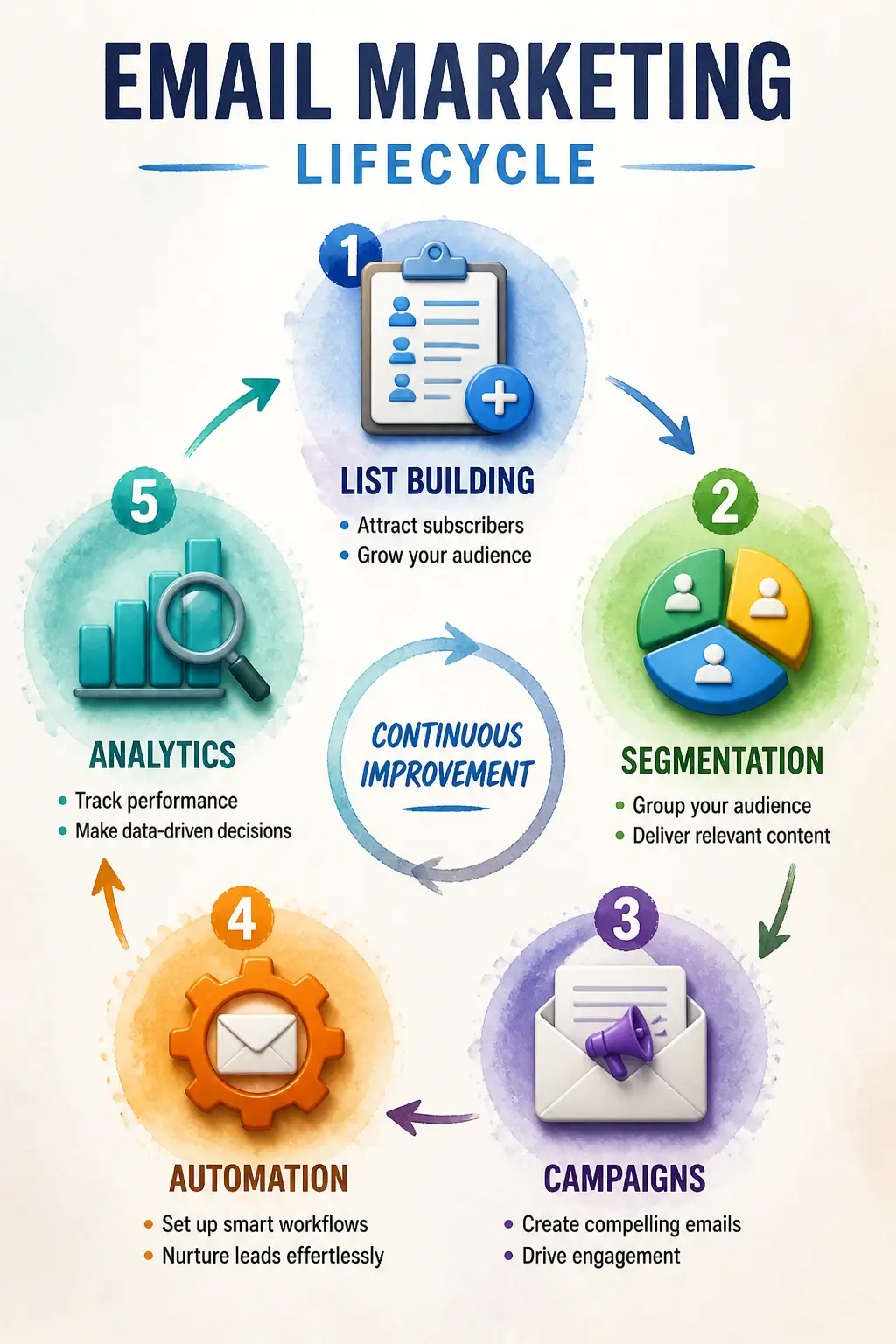
This visual walks through how compliance and deliverability infrastructure fit together across the subscriber lifecycle:
The Lifecycle of an Email Subscriber
The subscriber lifecycle in email marketing runs as a continuous five-phase loop – list building, segmentation, campaigns, automation, and analytics – and understanding the loop as a whole is what separates a system from a series of one-off sends.
Most beginners think of these phases as a straight line: build a list, send some emails, check the numbers, repeat. The loop model flips that. Analytics don’t just measure the last campaign – they feed back into how you build and segment the list going forward. Every data point you collect reshapes who gets what message next.
A single subscriber’s journey makes this concrete. Someone finds your lead magnet and signs up. They receive a welcome email within minutes – the highest open-rate message you’ll ever send. Over the following weeks, regular value-driven emails build familiarity. When their behavior signals interest in a specific product or topic, a personalized offer arrives. They buy. From there, loyalty emails keep the relationship active, turning a one-time buyer into a repeat customer.
That path isn’t a funnel you send people through once. It’s a cycle. New subscribers enter at the top, but existing subscribers are always moving through the loop at different speeds based on how they engage.
Each of the five phases gets its own section from here. What matters right now is seeing them as one connected system – because optimizing any single phase in isolation, without understanding how it affects the others, is where most email programs stall.
Building and Segmenting Your List Smarter
Effective list segmentation starts before a single subscriber joins – it starts with who you invite and how you invite them. The list you build determines the ceiling of every campaign you’ll ever run.
Organic list building comes down to three fundamentals. Lead magnets – a free guide, a discount code, a useful checklist – give someone a specific reason to hand over their email address. Sign-up forms placed with intent (at the end of a relevant blog post, in a welcome pop-up after 30 seconds on page, not plastered across every surface) attract people who are actually interested in what you do. And buying email lists is never an option – those addresses haven’t consented to hear from you, they’ll tank your sender reputation within weeks, and they violate both CAN-SPAM and GDPR.
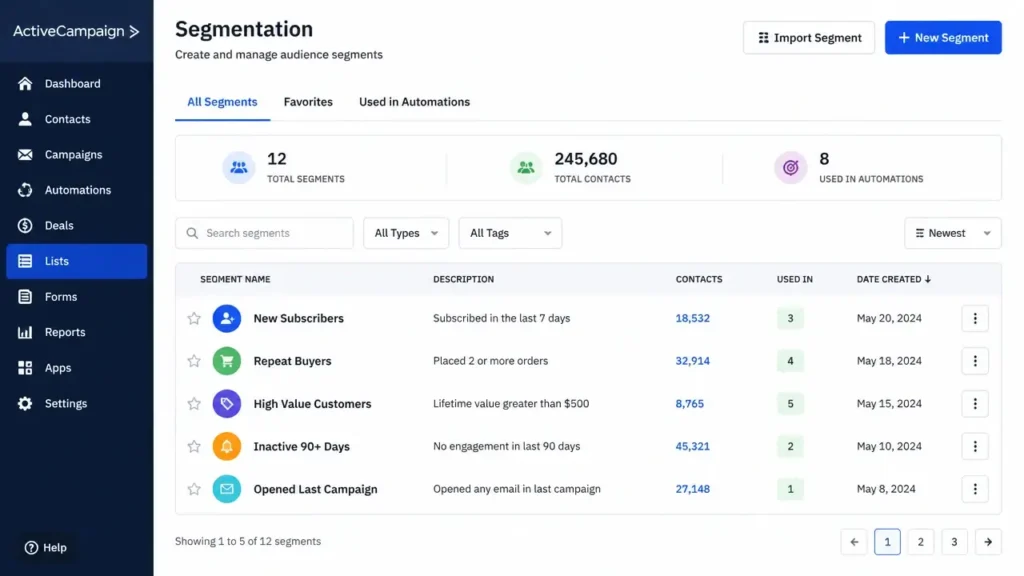
Once people are on your list, segmentation is how you make sure the right message reaches the right person. In plain terms: you group subscribers based on what they do, what they’ve told you they like, or where they are in their relationship with your brand. A new subscriber who’s never clicked anything gets different content than someone who’s purchased twice. Someone who clicked your email about Product A is telling you something – act on it.
Even simple segments produce measurable improvements. New subscriber vs. repeat buyer. Clicked a link vs. never clicked. Joined via lead magnet X vs. lead magnet Y. These aren’t sophisticated data science projects – they’re common-sense groupings that any email platform can handle.
The 80/20 rule applies here too. A small portion of your list will generate most of your opens, clicks, and purchases. Serve that group exceptionally well. Don’t neglect the rest, but don’t chase volume at the expense of relevance.
Before any segmented email goes out, run it through the 5 C’s of Communication: is it clear, concise, coherent, complete, and courteous? These aren’t stylistic preferences – they’re quality gates. An email that fails any one of them will underperform regardless of how well the list was segmented.
A note on a number you’ll see everywhere: the claim that segmentation increases revenue by 760% circulates across marketing blogs without any disclosed methodology, sample size, or attribution window. The mechanism behind the number is real – relevance drives engagement, engagement protects sender reputation, and reputation ensures future emails get delivered – but the specific figure isn’t traceable to a published study. The flywheel effect of targeted emails is the real insight: fewer complaints and higher interaction rates compound over time, effectively lowering your cost per email and improving ROI on every subsequent send.
Here’s what a segmentation setup actually looks like inside a marketing automation platform:
Researchers in predictive analytics and send-time optimization, published in Applied Sciences (MDPI), point to where segmentation is heading:
“In the future, subscribers can be segmented using the Recency, Frequency and Monetary value, the Lifetime Value, or Stream Clustering approaches that allow more personalized and tailored experiences for subscribers.”
RFM segmentation – grouping subscribers by how recently they engaged, how often they engage, and how much they spend – is the logical next step once you’ve mastered basic behavioral segments. You don’t need it on day one, but knowing it exists tells you the system has real depth to grow into.
From One‑Off Campaigns to Automated Flows
Email automation is what turns a list from a passive database into an active revenue system – it delivers the right message to the right person at the right moment, without you manually hitting send each time. The distinction between the two send modes is where most beginners get their first real leverage.
Broadcast campaigns are one-time sends: a flash sale announcement, a new product launch, a newsletter going to your full list on a Tuesday morning. They’re useful, but they’re manual and they don’t scale. Automated flows are sequences triggered by subscriber behavior – someone joins your list, they enter the welcome sequence; someone abandons a cart, they receive a reminder. The trigger fires once, and the sequence runs on its own from there.
An Email Service Provider like Mailchimp, Omnisend, or Campaign Monitor is what makes both modes possible without writing a line of code. These platforms let you build visual automation workflows, set behavioral triggers, and schedule broadcasts – all from a single dashboard. The tool is not the strategy, but choosing one and learning it well removes the execution bottleneck.
The Rule of 7 is directly relevant to automation design. A subscriber typically needs multiple meaningful touches before they’re ready to convert – not because they’re indecisive, but because trust takes time to build. Automation ensures those touches happen consistently, at the right intervals, without depending on you remembering to send them.
The welcome sequence is the most universally valuable automated flow to build first. It goes out immediately after someone subscribes, when your brand is freshest in their mind and their intent is highest. Welcome emails consistently outperform every other message type in open rates – often by a significant margin – because they arrive at a moment the subscriber chose. A well-built welcome sequence introduces who you are, delivers on whatever you promised in the lead magnet, sets expectations for future emails, and makes a soft ask. That’s four jobs done automatically, every time someone joins your list.
One thing automation doesn’t change: the emails still have to sound human. The sequences are pre-written, but they shouldn’t read like they were. Write each automated email as if you’re sending it to one specific person at a specific moment in their journey. That’s what keeps automation from feeling robotic.
A word on a claim you’ll encounter: some sources describe email as “40 times more effective than Facebook and Twitter combined.” That figure has no traceable methodology and no definition of “effective” attached to it. The strategic truth behind the comparison is real – email reaches an opted-in audience with demonstrated intent, while social media primarily serves top-of-funnel awareness – but the two channels are complementary, not competing. Email converts. Social builds awareness. Both have a role.
This walkthrough shows exactly how to build a welcome sequence inside a popular ESP, from trigger setup to the actual email content:
The Numbers That Tell the Truth
Email metrics are only useful if you know what each one is actually measuring – and where each one starts to lie. Three numbers form the foundation of any honest performance review.
Open rate is the percentage of delivered emails that were opened. It tells you whether your subject line and sender name are doing their job – whether people are curious enough to click. Click-through rate (CTR) is the percentage of recipients who clicked at least one link inside the email. It tells you whether the content delivered on the promise the subject line made. Unsubscribe rate is the percentage who opted out after opening. A spike there is feedback: something in the message didn’t match what subscribers expected to receive.
Use these three as trend signals over time, not as benchmarks to hit. An open rate of 25% means nothing in isolation – but an open rate that’s been dropping for three consecutive campaigns means something is shifting, and you need to find out what.
Here’s the important caveat on open rates: they’ve become increasingly unreliable since Apple’s Mail Privacy Protection (MPP) launched in 2021. MPP pre-loads email content – including tracking pixels – on Apple devices, which registers an “open” even if the subscriber never actually read the email. On lists with a significant Apple Mail audience, open rates are now inflated and partly fictional. The practical fix is to pair opens with clicks. Click data doesn’t get distorted by privacy protections the same way, so CTR gives you a much cleaner signal of genuine engagement.
There’s also a direct connection between these metrics and your earlier segmentation work. A well-segmented list should show measurably higher open and click rates than an unsegmented one – because the messages are more relevant to each group. If your segmented campaigns aren’t outperforming your broadcast sends, the segments need refining.
The deeper metrics – the ones most introductory guides never mention – are revenue per email sent and customer lifetime value from the email channel. Revenue per email forces a direct question: did this send actually generate sales, or just opens? Customer lifetime value reframes the whole channel: you’re not just trying to convert a subscriber once, you’re trying to build a relationship that generates repeat purchases over months and years. Without those two metrics in your dashboard, you can be busy and engaged and still have no idea whether email is actually profitable for your business.
FreshMail researchers, working with technical collaborators to analyze real subscriber behavior at the ESP level, describe what meaningful measurement actually looks like:
“The key element of the proposed solutions are the conditional attributes used, i.e., instead of analysing the content of an email, we use statistics collected by the ESP system on the response of servers and subscribers… associated with negative phenomena such as hard and soft bounces, users complaints, or resignations…”
That’s the professional framing: the most informative data isn’t whether someone opened your email – it’s how servers and subscribers respond to your sending behavior over time. Bounces, complaints, and unsubscribes are the metrics that predict deliverability failure before it happens.
More Subscribers ≠ Better Results
List hygiene is the most overlooked profitability lever in email marketing, and the one that causes the most silent damage when ignored. The widespread belief that a bigger list means more revenue is the single most common mistake beginners make – and it’s the one that can quietly destroy everything else you’ve built.
Here’s the mechanism. When unengaged subscribers accumulate on your list, your complaint rate rises relative to your engagement rate. Internet service providers read that ratio and interpret it as a signal that your emails are unwanted. They respond by routing more of your messages to spam – including messages going to subscribers who actively want to hear from you. The damage isn’t contained to the inactive segment. It spreads to your entire deliverability.
List hygiene in practice means regularly identifying subscribers who haven’t opened or clicked in a defined window – 90 days, 180 days, whatever fits your send frequency – and either running a re-engagement campaign to win them back or removing them. That sounds counterintuitive when you’re staring at a subscriber count that’s about to drop. But a list of 2,000 engaged subscribers will outperform a list of 10,000 indifferent ones every time, on both deliverability and revenue.
This connects directly back to the permission-first foundation. The subscribers who explicitly opted in and confirmed their interest are the ones who keep your sender reputation strong. The ones who signed up under pressure, never engaged, or forgot who you are are the ones pulling it down.
The “highest ROI channel” claims attached to email always omit a critical footnote: that return is highly dependent on list quality, industry vertical, and attribution model. A focused list of 500 highly engaged buyers can generate more profit than 5,000 people who signed up for a discount and never opened another email. The metric worth obsessing over isn’t subscriber count – it’s the percentage of your list that actually buys.
Industry researchers analyzing direct database marketing, published in Tourism Management and the Journal of Interactive Marketing, identify exactly how this trust erodes:
“Through misuse, permission that was granted can be revoked and potential business lost… expected personal relevance, entertainment, and consumer information control directly affect the probability of consumers granting permission…”
The word “misuse” is doing a lot of work in that sentence. Sending too frequently, sending irrelevant content, or treating permission as a permanent license rather than an ongoing relationship – all of it chips away at the subscriber’s willingness to stay. Email marketing works when it functions as a system of relationships. The moment it becomes a numbers game, the numbers start working against you.
Key Takeaways on Email Marketing
- Email marketing is a permission-based system – subscribers who opted in willingly are the only audience worth building around.
- The 80/20 rule keeps lists healthy: 80% value-driven content and 20% promotional sends sustains long-term engagement.
- Double opt-in produces a smaller but more engaged list that protects sender reputation and inbox placement over time.
- SPF, DKIM, and DMARC authentication records are non-negotiable infrastructure – without them, even a clean list hits the spam folder.
- Open rates alone are an unreliable performance signal; pair them with click-through rate and revenue per email for a truthful picture.
- A smaller, active, permission-based list will consistently outperform a large, disengaged one on both deliverability and actual revenue.
Frequently Asked Questions About Email Marketing
How does email marketing work step by step?
A subscriber opts in through a sign-up form or lead magnet, gets added to your list, and enters an automated welcome sequence. From there, they receive a mix of value-driven and promotional emails based on their behavior and segment until they convert – and ideally keep buying over time.
What is the Rule of 7 in email marketing?
The Rule of 7 is the principle that a subscriber typically needs around seven meaningful interactions with your brand before they’re ready to make a purchase. Automated email sequences are the practical tool for making sure those touches happen consistently without manual effort.
Does list size actually determine how much revenue email generates?
Not directly. Revenue depends far more on list quality – how engaged subscribers are and whether they match your offer – than on raw subscriber count. A focused list of 500 active buyers will frequently outperform a bloated list of 5,000 unengaged contacts.
What’s the 3-3-3 rule in marketing?
The 3-3-3 rule isn’t a formalized email-specific framework, but in general marketing practice it refers to capturing attention in 3 seconds, delivering your core message in 3 sentences, and including a clear call to action within 3 steps – principles that apply well to email subject lines and preview text.
Why do my emails end up in spam even when people signed up for my list?
The most common cause is missing or misconfigured authentication records – SPF, DKIM, or DMARC – on your sending domain. A sudden jump in inactive subscribers raising your complaint rate relative to your engagement rate can also trigger spam filtering, even for subscribers who want your emails.
When should I remove subscribers from my list?
If a subscriber hasn’t opened or clicked any email in 90 to 180 days, it’s worth sending a single re-engagement campaign. If they don’t respond to that, remove them. Holding onto unengaged addresses to protect your subscriber count is a false economy that damages deliverability for everyone else on your list.
Is email marketing still worth building for a small business?
Yes, specifically because you own the list. Social media reach is rented – platform algorithm changes can cut your organic visibility overnight. An email list is an asset you control directly, which makes it one of the most defensible channels a small business can invest in building.
How often should I email my list?
There’s no universal answer, but consistency matters more than frequency. A weekly email your audience expects and looks forward to will outperform a daily email they start ignoring. Watch your unsubscribe rate and click-through rate as frequency changes – they’ll tell you if you’re pushing too hard.
References
- Permission marketing and email behavior – ScienceDirect (Journal of Interactive Advertising)
- Relationship building in industrial marketing – ScienceDirect (Industrial Marketing Management)
- Advanced segmentation and send-time optimization – MDPI Applied Sciences
- FreshMail ESP subscriber response analysis – MDPI Applied Sciences
- Permission revocation and consumer control – ScienceDirect (Tourism Management / Journal of Interactive Marketing)