
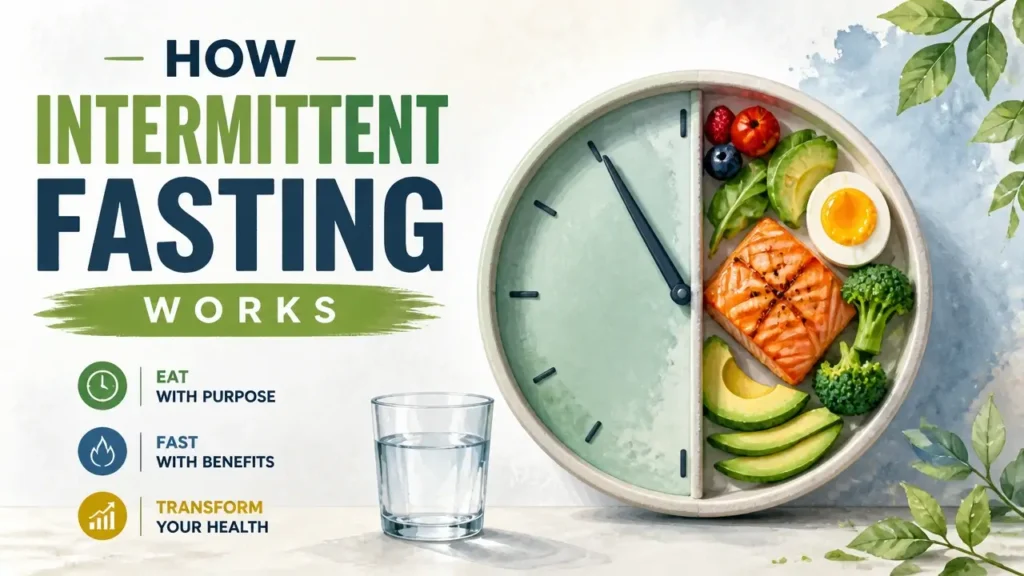
Structured intermittent fasting is one of the most studied eating patterns of the last two decades – and one of the most misunderstood. Most people think it’s a willpower diet. It isn’t. It’s a timing strategy, and the biology behind it is surprisingly well-mapped.
This guide walks through exactly what happens inside your body during a fast, which schedules are backed by real evidence, where the science still has gaps, and how to find a rhythm that fits your actual life – not a lab protocol.
What Intermittent Fasting Actually Is
Intermittent fasting is an eating pattern built entirely around when you eat, not what you eat. There are no banned food groups, no calorie-counting requirements, no special meals to buy – just a defined window of time for eating and a longer window of not eating.
That distinction matters more than it sounds. Traditional diets hand you a list of rules about food itself – cut carbs, measure portions, eliminate sugar. Intermittent fasting hands you a clock. During your eating window, you eat normally. During your fasting window, you don’t eat. That’s the entire structure.
Here’s something that might reframe the whole concept for you: you’re probably already doing a version of this. If you finish dinner at 8 p.m. and don’t eat again until 8 a.m., you’ve just completed a 12-hour fast. Intermittent fasting, at its most basic, is simply the practice of making that overnight gap intentional – and, for some methods, extending it further.
What IF doesn’t do is tell you to eat kale instead of pasta, or to weigh your chicken breast. The time limits are the only rule. And because there’s no single “correct” method, the goal isn’t to find the most extreme version – it’s to find a fasting rhythm you can actually maintain.
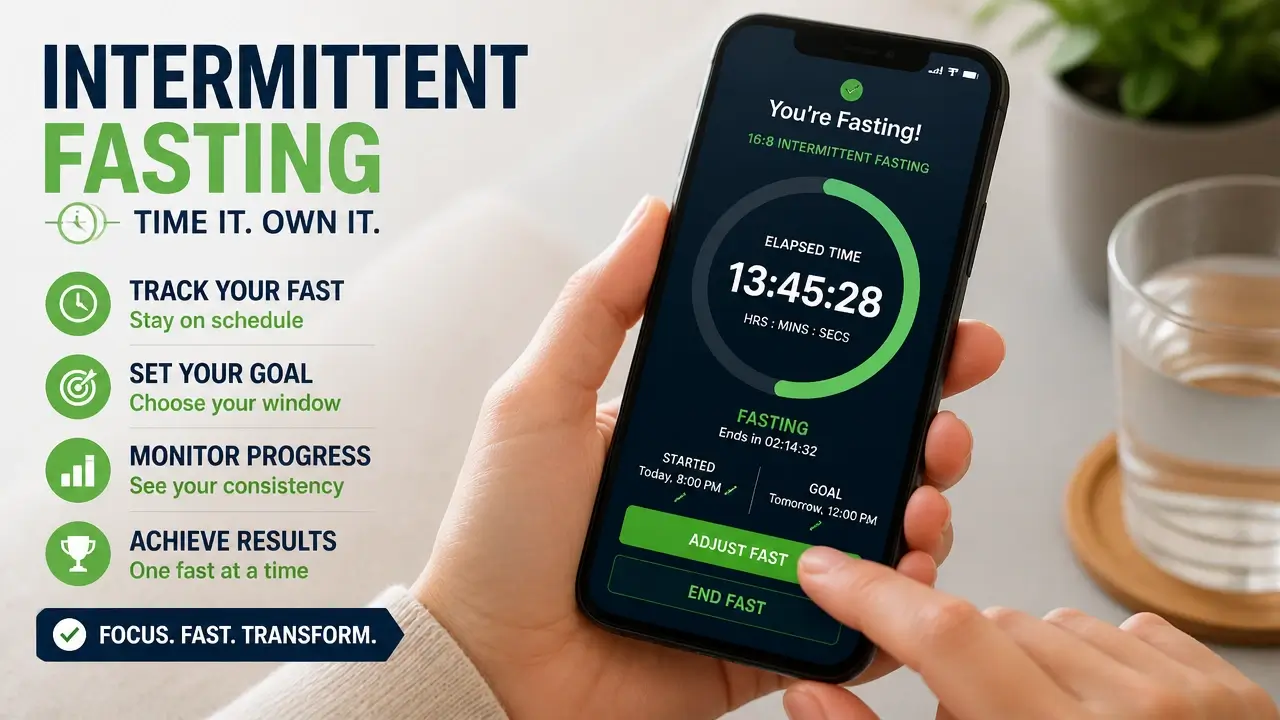
Here’s a look at what that timing-based approach looks like in practice – a simple app timer representing the fasting and eating windows at the core of every IF schedule.
Dr. Rafael de Cabo and Dr. Mark P. Mattson, researchers at the National Institute on Aging (NIH) and Johns Hopkins University School of Medicine respectively, put it plainly in their landmark review:
“IF is fundamentally a timing strategy that manipulates the placement and nature of feeding and fasting intervals… IF can be broadly defined as any type of eating pattern involving prolonged periods of fasting (or highly restricted caloric intake) through the course of the day or the week.”
The takeaway here is worth sitting with: what makes IF different from every other eating framework isn’t a food rule – it’s a time rule. That’s a genuinely different lever to pull, and understanding why that lever works requires looking at what your body does with those hours.
What Happens Inside Your Body During a Fast
Your body isn’t “turning off” during a fast – it’s switching fuel sources. The fasting state is an active metabolic environment, and the chain of events that unfolds over those hours is well-documented, even if a few pieces of it are still being worked out in humans.
The Metabolic Switch from Glucose to Fat During Fasting
The fed state is simple: you eat carbohydrates, they break down into glucose, and your body uses that glucose as its first-choice fuel. Insulin – your storage hormone – rises after a meal, shuttling excess glucose into the liver and muscles as glycogen. Whatever doesn’t fit gets packed away as body fat. This is normal, healthy function.
The fasting state is what happens when that system runs out of easy fuel. Around 10–12 hours after your last meal, your liver’s glycogen stores run low. At that point, your body makes what researchers call a “metabolic switch” – it shifts from burning glucose to burning stored fatty acids and ketones. Insulin levels fall sharply during this window, which is the key unlock: lower insulin means fat cells release their stored energy more readily, making it available to burn.
This is the metabolic switch, not starvation mode. Insulin dropping isn’t your body panicking – it’s your body doing exactly what it was designed to do when food isn’t immediately available.
Now, here’s where it gets genuinely interesting – and a little murky. Major health institutions don’t fully agree on how long the fast needs to be to trigger this switch. Mass General Brigham states that the metabolic switch begins at 10–12 hours. Harvard Chan School, on the other hand, defines daily intermittent fasting as requiring a 16-hour window. Neither source acknowledges the other’s threshold.
The honest answer is that the effective minimum probably varies from person to person, depending on how much glycogen you stored before your last meal, how active you’ve been, and how your metabolism runs. The 10–12 hour mark is a reasonable starting point, not a guaranteed trigger.
Dr. Mark P. Mattson, Professor of Neuroscience at Johns Hopkins, describes the mechanism precisely:
“The liver glycogen store can contain up to the equivalent of about 700 calories. It is depleted when energy intake does not occur for a period of 10–12 h at least… The onset of metabolic switch is the point of negative energy balance at which liver glycogen stores are depleted and fatty acids are metabolized.”
If you want to see this switch explained visually, this video walks through the transition from glucose to ketones in a way that makes the biochemistry click:
Hormonal and Cellular Effects During Extended Fasting
Beyond the fuel switch, fasting sets off a few other biological responses worth knowing – and one that deserves more honest framing than it usually gets.
Human growth hormone (HGH) levels can rise significantly during a fast. This matters because HGH plays a role in preserving lean muscle tissue, which means short-term fasting isn’t the muscle-wasting process many people fear. Your body has a built-in mechanism to protect muscle while it burns fat. That said, this protection has limits – it works well within normal fasting windows, not during prolonged deprivation.
Then there’s autophagy – probably the most hyped term in the entire intermittent fasting conversation. Autophagy is a cellular recycling process where your cells break down and clear out damaged or dysfunctional components. It’s real, it’s fascinating, and it may peak somewhere around the 14–17 hour fasting mark. But here’s what the headlines routinely skip: the bulk of strong autophagy evidence comes from animal and cellular studies, not from living, free-moving humans.
A peer-reviewed study in Cell Metabolism using a scheduled fasting model in mice showed that fasting intervals – even without cutting total calories – activated autophagy across multiple organs, cleared liver fat, lowered blood glucose, and preserved muscle mass. Compelling results. The same researchers, however, were direct about the translational limitations: human studies can’t easily biopsy tissue to confirm autophagy the same way, rely instead on surrogate markers like white blood cell samples, and face the ongoing problem that strict fasting protocols are hard for people to maintain long-term.
Mass General Brigham correctly notes that animal and cellular studies suggest autophagy may reduce inflammation – but then lists autophagy as a “pro” of intermittent fasting without the caveat that it isn’t confirmed in free-living humans. That’s a gap worth naming.
Here’s the practical takeaway: the metabolic switch from glucose to fat is well-established in human research, and that’s the core engine behind most of IF’s documented benefits. Autophagy is a compelling theory with strong preclinical support – but don’t let it be the reason you fast. The fuel-switching story is strong enough on its own.
The Most Common Intermittent Fasting Schedules
There’s no single “right” intermittent fasting schedule – and that’s genuinely good news. The three most well-studied approaches each have a different structure, and which one makes sense depends entirely on your life, not on which one sounds most impressive.
12:12 (Overnight Fasting) – You eat between, say, 8 a.m. and 8 p.m., and fast for the 12 hours overnight. This is the most accessible entry point because it requires almost no behavioral change if you already stop eating after dinner. Most people are already doing a 10–11 hour version of this without thinking about it. Extending to 12 hours is a minimal adjustment.
16:8 (Time-Restricted Eating) – You fast for 16 hours and compress all your meals into an 8-hour window. A common example: eat between noon and 8 p.m., skip breakfast. The window is adjustable – some people do 10 a.m. to 6 p.m., others 1 p.m. to 9 p.m. depending on their schedule. This is probably the most widely practiced IF method, and it’s the one most clinical research has focused on.
5:2 Method – Five days a week, you eat normally. Two non-consecutive days, you limit intake to around 500–600 calories (essentially one small meal). This approach suits people who find daily time restrictions frustrating but can handle two harder days with some planning. The flexibility is the appeal: your “normal” days are genuinely unrestricted.
During any fasting window, water, plain black coffee, and unsweetened tea are always fine – they don’t trigger an insulin response. Some people use a “dirty fast” that includes a splash of cream or MCT oil in their coffee. Technically, that breaks a strict fast. Practically, it keeps insulin low enough that most fat-burning benefits are preserved. Whether that matters to you depends on your goals.
If you’re new to this, the standard advice is to start with 12:12 and extend the window gradually over a few weeks. There’s no benefit to jumping straight to 16 hours if you’ve never fasted intentionally before – the adaptation period is real, and rushing it makes the first two weeks harder than they need to be.
Dr. Valter D. Longo, Director of the Longevity Institute at the University of Southern California, describes the landscape of methods clearly:
“The IF schedule can be categorized into alternate-day fasting (ADF) or time-restricted eating (TRE) patterns… TRE includes some of the most popular methods including the 16/8 approach (fasting for 16 h and eating within an 8 h window)… The 5:2 diet is a weekly intermittent fasting strategy in which participants consume little to no calories on two non-consecutive days, eating normally for the remaining 5 days.”
The most effective schedule, across every source and every researcher, is the one you can stick with consistently. Perfection isn’t the goal. Consistency is.
What the Research Actually Shows – and What It Doesn’t
Intermittent fasting has real, documented benefits. It also has a structural blind spot running through nearly all of its research – and if you don’t know about that blind spot, you can’t make a properly informed decision.
The Documented Benefits of Fasting for Weight Loss and Metabolism
The commonly cited intermittent fasting benefits are real, and they’re backed by research: modest but consistent weight loss, improved insulin sensitivity, reduced inflammatory markers, and early signals pointing toward cognitive and cardiovascular benefits.
On weight loss specifically, a useful benchmark from Harvard Chan School: a typical daily calorie deficit of around 250 calories – which IF often produces naturally by compressing your eating window – may lead to roughly half a pound of weight loss per week. That’s not a dramatic number, but it’s sustainable and doesn’t require you to track a single calorie.
Dr. Michelle Harvie, Research Dietitian at the University of Manchester and a leading clinical researcher on intermittent diets, reviewed the comparative evidence and found:
“Overall, the available evidence suggests that IER paradigms produce equivalent weight loss when compared to CER [continuous energy restriction], with 9 out of 11 studies reviewed showing no differences between groups in weight or body fat loss… Both interventions led to weight loss… However, FBS [fasting-based strategies] did not show superior long-term outcomes compared to CCR [continuous calorie restriction].”
That’s an important finding to sit with: IF works about as well as traditional calorie restriction – not dramatically better. The advantage IF offers isn’t a metabolic superpower; it’s a behavioral one. Many people find it easier to restrict when they eat than to count and weigh everything they eat.
The Unanswered Questions: Calorie Confound and Cardiovascular Risk
Here’s the honest structural problem with IF research: in most studies, people on intermittent fasting schedules also end up eating fewer calories overall. So when researchers observe benefits – less body fat, better blood sugar, lower inflammation – they can’t cleanly separate “the fasting window caused this” from “eating less caused this.” That’s the calorie confound, and it runs through nearly the entire field.
Mayo Clinic acknowledges it directly, noting that “some studies find just limiting calories in general may have the same benefit as intermittent fasting.” But no major institutional source has cleanly answered whether the timing itself does something unique beyond the incidental calorie drop. That’s the central unanswered question at the heart of IF science right now.
There’s also a notable gap in how the public health guidance presents results. Across Johns Hopkins, Mayo Clinic, Mass General Brigham, and Harvard Chan School, not one source gives readers a concrete number to weigh against the behavioral cost – no percentage of body weight reduction, no millimeter-of-mercury drop in blood pressure, no change in fasting insulin levels. Without those numbers, it’s genuinely difficult to evaluate whether the schedule change is worth the effort for your specific situation.
One more signal worth raising honestly: researchers at the American Heart Association flagged data suggesting that a strict daily 16:8 fast may be associated with a 91% higher risk of cardiovascular death compared with a more standard eating pattern. This finding is not settled science – it’s an observational signal, not a controlled trial conclusion – but it’s a legitimate ripple in the evidence that matters precisely because 16:8 is the most widely recommended beginner schedule. It’s a reason to pay attention, not to panic.
The bottom line: IF is a promising tool with real evidence behind it. It is not a magic metabolic hack. Most of its weight-loss power likely rides on helping people eat less without feeling like they’re dieting.
Fasting vs. Starvation: They’re Not the Same Threshold
Starvation is a prolonged, involuntary absence of food that leads to severe muscle wasting and organ failure – but only after the body has exhausted its fat stores, a process that takes weeks, not hours. Intermittent fasting and starvation don’t operate at the same biological threshold, and conflating them is the most common reason people talk themselves out of trying IF before they’ve started.
Here’s how the distinction works mechanically. When you fast for 12–16 hours, your body runs through its glycogen stores and then switches to burning fat. Counter-regulatory hormones – particularly human growth hormone and norepinephrine – rise during this window to preserve lean tissue and actually keep metabolic rate up. Short-term fasting doesn’t slow your metabolism down. Research suggests metabolic rate may temporarily increase in the first 48 hours of fasting due to the norepinephrine release. That’s the metabolic switch, not the feared “starvation mode.”
True muscle loss only becomes significant when fat stores are seriously depleted and the body has no other energy source to pull from. That doesn’t happen during a daily 12–16 hour fast followed by normal eating. Your body would need to be in a state of prolonged caloric deprivation – days, not hours – before it starts meaningfully breaking down muscle for fuel.
The mental line to draw: skipping breakfast and lunch is your body running on stored fuel. The body breaking down its own organs is a different biological crisis entirely, triggered by weeks of severe deprivation. Those are two different systems operating at two very different thresholds.
If you’ve been worried that going 16 hours without food is putting your body into some kind of emergency state – it isn’t. Your body has been handling overnight fasts your entire life. You’re just making the window intentional.
Who Should Not Fast – and What to Expect When You Start
Intermittent fasting is safe for most healthy adults. But “most” isn’t “all,” and the contraindications are real enough that they’re worth taking seriously before you start.
Medical Guidelines and Safety Considerations
The medical guidelines on who should avoid intermittent fasting are broadly consistent across institutions like Mayo Clinic and Harvard Chan School. The following groups should either avoid IF entirely or only attempt it under direct medical supervision:
- Pregnant or breastfeeding individuals
- Children and adolescents
- Anyone with a history of disordered eating or an active eating disorder
- People with type 1 diabetes or those taking medications that require food at dosing time
- Adults over 65
- Those with low blood pressure
Anyone with an existing medical condition – even one not on this list – should consult a healthcare professional before starting. IF is not a replacement for medical treatment, and it’s not a one-size-fits-all intervention.
Dr. Ghada A. Soliman, Professor of Environmental, Occupational, and Geospatial Health Sciences at the City University of New York (CUNY), is direct about these limits:
“Fasting diets (i.e., intermittent fasting and time-restricted eating) are not recommended during pregnancy or lactation because of the lack of safety data for these life stages… Despite its numerous benefits, PSTF is clearly not recommended for individuals with type 1 diabetes or eating disorders (such as bulimia or anorexia), patients receiving insulin therapy, pregnant or breastfeeding women, [or] individuals under the age of 18… Others undertaking this challenge should anticipate certain inconveniences, which may prompt them to discontinue the fast.”
There’s also a significant blind spot in the current research that the binary contraindication lists don’t capture: metabolic responses to fasting can differ meaningfully between men and women, across age groups, and between metabolically healthy individuals and those with prediabetes. Women in particular may experience menstrual cycle disruption or altered cortisol responses with strict fasting schedules, even without falling into any formal “no-go” category. None of the major institutional sources address this directly. If you are an older adult or someone with underlying insulin sensitivity concerns, your experience may diverge from the general claims – and self-monitoring matters more than the population-level guidance suggests.
What to Expect During the First Few Weeks of Fasting
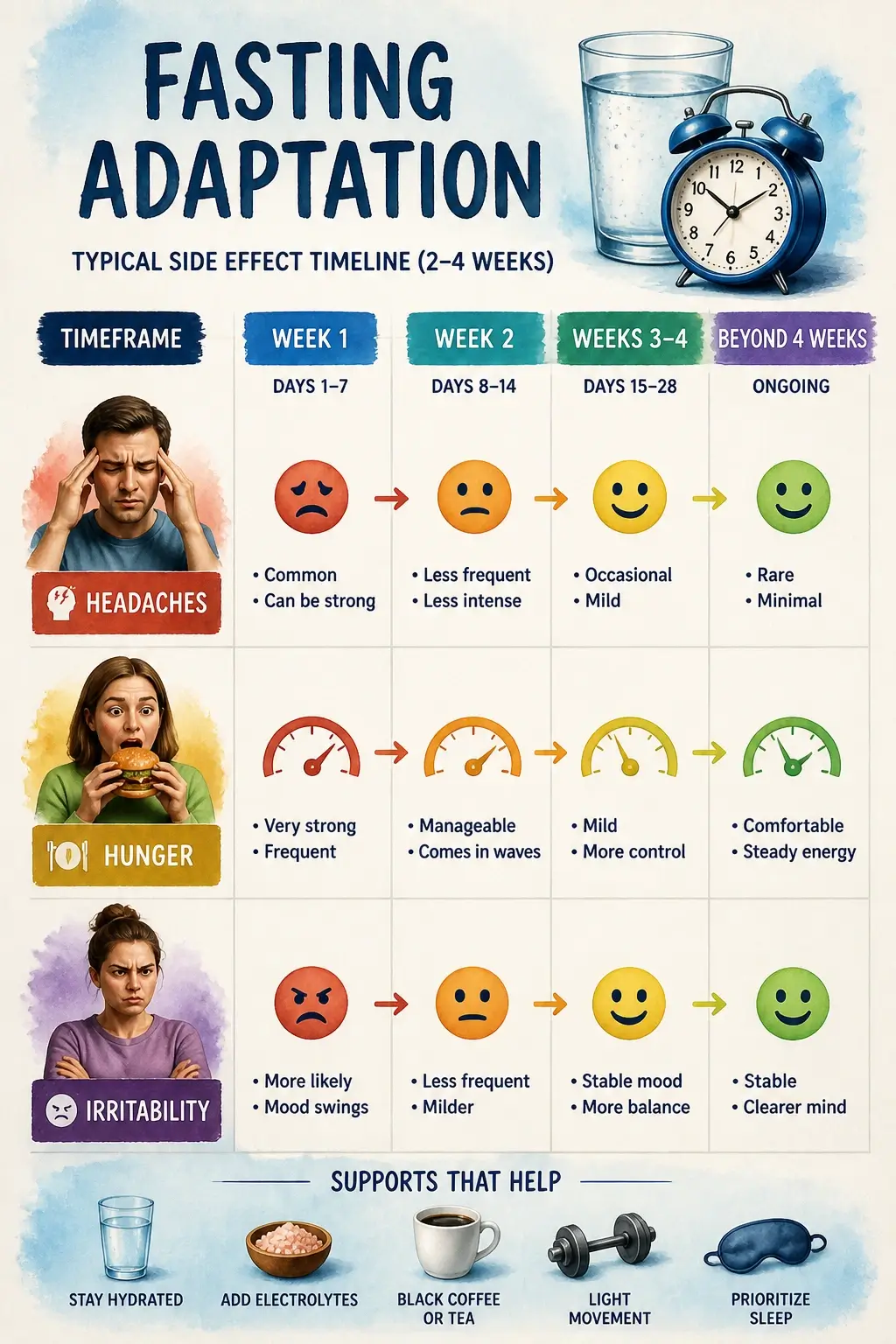
The transition side effects of starting intermittent fasting are real, common, and – importantly – temporary. Most people experience some combination of headaches, hunger pangs, irritability, lightheadedness, and occasional constipation in the first one to three weeks. This isn’t your body rejecting the approach; it’s your body recalibrating to a new eating rhythm after years of a different pattern.
The adjustment window is typically two to four weeks. After that, most people report that hunger during the fasting window decreases noticeably – not because they’re suppressing it, but because the hormonal signals that drive appetite (particularly ghrelin) adapt to the new schedule.
Here’s a visual summary of how those side effects typically unfold and resolve across the first month:
A few practical things that influence how you feel during this transition, beyond just willpower: sleep quality, stress levels, and what you eat during your feeding window all play a significant role. Someone eating nutrient-dense meals during their eating window will typically adapt faster than someone eating mostly processed food and calling it “clean fasting.”
And if symptoms don’t improve after four weeks – or if they worsen – stopping or adjusting isn’t failure. IF isn’t a moral test. Some bodies respond differently, and that’s legitimate data about your specific biology, not a character flaw.
Choosing the Fasting Schedule That Fits Your Life
No single intermittent fasting schedule is inherently superior – 12:12, 16:8, and 5:2 all produce results when followed consistently, and the method selection that matters most is the one that fits your actual daily life without making you miserable or developing an unhealthy preoccupation with food.
A Practical Comparison of 12:12, 16:8, and 5:2 Demands
The practical comparison between these three schedules comes down to three things: how much your daily routine has to change, how it holds up socially, and how much cognitive load it adds to your week. Here’s how they stack up side by side.
A straightforward comparison makes the trade-offs clearer before you commit to anything:
| Schedule | Daily Structure | Lifestyle Change Required | Social Ease | Best For |
|---|---|---|---|---|
| 12:12 | Eat 8am–8pm, fast overnight | Minimal – likely already close to this | Very easy | Beginners, anyone testing IF for the first time |
| 16:8 | Eat within 8-hour window (e.g., noon–8pm) | Moderate – skip breakfast or delay first meal | Moderate – lunch and dinner still normal | People not hungry in the morning, daily routine eaters |
| 5:2 | Normal eating 5 days; ~500–600 cal on 2 non-consecutive days | Low daily change, higher effort on 2 days | Good on normal days, harder on fast days | People who hate daily restrictions but can handle two planned low-cal days |
The 12:12 schedule demands almost nothing from you – if you already stop eating after dinner, you’re close to it. The 16:8 essentially skips a meal, most commonly breakfast, and works well for people who aren’t naturally hungry in the morning anyway. The 5:2 trades daily discipline for two harder days per week, which suits people with unpredictable daily schedules who need flexibility the other five days.
Tailoring Your Fasting Window to Your Biology
Tailored fasting accounts for more than your calendar – your circadian rhythm, your sex, and your age all influence how a given schedule will feel and how well it will work for you.
On circadian alignment: early eating windows – something like 8 a.m. to 4 p.m. – appear to work better with your body’s internal clock than late-day windows. Insulin sensitivity is naturally higher in the morning, which means your body handles carbohydrates more efficiently earlier in the day. Harvard Chan School’s “king-prince-pauper” meal timing principle – larger breakfast, moderate lunch, small early dinner – reflects this. If your schedule permits morning eating, it’s worth considering.
On gender: women may be more sensitive to calorie restriction and fasting-related stress than men. This isn’t a reason to avoid IF, but it is a reason to start gently. A 12:12 or a modified 5:2 with slightly higher calorie allowances on low-intake days is a more appropriate starting point than jumping straight to strict 16:8. Tracking cycle regularity, energy stability, and mood during the first month gives you real feedback that population-level studies can’t provide. The research on female-specific outcomes – menstrual regularity, fertility signals, cortisol patterns – is genuinely underdeveloped, which means your subjective experience is valid primary data while the science catches up.
On age: older adults may find that a strict 16-hour fast feels harder and produces less predictable results. A 12:12 or a 14:10 window is a completely legitimate and likely more comfortable starting point – not a compromise, just a better fit for how metabolic flexibility changes with age.
Dr. Ghada A. Soliman flags another layer of this that often goes unmentioned – the social and cultural dimension:
“If these strategies interfere with socialization, family time, dining on special occasions, cultural, ethnic, religious, or social eating patterns, they might not be sustainable or tolerable… our studies in mice add another note of caution… indicating that it [the 5:2 diet] may only be effective as a weight loss strategy in males.”
The practical framework here is simple: pick one schedule, run it for two to four weeks, and treat your body’s response as data. Energy stability, sleep quality, mood, and hunger patterns during the fasting window are all meaningful signals. Adjust based on what you observe, not on what sounds most impressive. The goal is a rhythm you can sustain – not a protocol you white-knuckle through.
Key Takeaways on Intermittent Fasting
- Intermittent fasting controls when you eat, not what you eat – the structure is entirely time-based, with no banned food groups.
- The metabolic switch from glucose to stored fat typically begins around 10–12 hours into a fast, when liver glycogen runs low and insulin drops.
- Autophagy is real and promising, but its human benefits remain largely preclinical – the fuel-switching mechanism is the better-established reason to fast.
- IF produces weight loss roughly equivalent to traditional calorie restriction; its main advantage is behavioral, not metabolic.
- A strict daily 16:8 schedule has drawn a cardiovascular risk signal in observational research – not a settled verdict, but worth knowing before defaulting to the most popular method.
- Women, older adults, and anyone with a metabolic condition may respond differently than general guidance suggests – self-monitoring is essential.
Frequently Asked Questions About Intermittent Fasting
Does fasting from 7pm to 7am actually count as intermittent fasting?
Yes – a 7pm to 7am window is a 12-hour fast, which is the gentlest and most accessible form of IF. It’s a legitimate starting point, and for some people with lower metabolic targets, it’s sufficient on its own.
What’s actually better for most beginners – a 12-hour or 16-hour fast?
For a true beginner, 12:12 is the smarter start because the transition side effects are minimal and adherence is much higher. The 16:8 produces modestly more metabolic effect on paper, but a 12-hour fast you stick to for months will outperform a 16-hour fast you abandon in week three.
Can I drink coffee or tea during the fasting window without breaking the fast?
Plain black coffee and unsweetened tea don’t trigger a meaningful insulin response, so they’re widely considered compatible with a clean fast. Adding cream, sugar, or flavored syrups breaks the fast metabolically – though a small splash of plain cream keeps insulin low enough that most fat-burning benefits are preserved for most people.
Will intermittent fasting slow my metabolism over time?
Short-term fasting doesn’t slow metabolism – metabolic rate may actually rise slightly in the first 48 hours due to norepinephrine release. Prolonged, severe caloric restriction is what triggers adaptive metabolic slowdown, and a daily 12–16 hour fast followed by normal eating doesn’t qualify.
Can women do intermittent fasting the same way men do?
Not necessarily. Women may be more sensitive to fasting-related hormonal stress, and some experience menstrual irregularity or energy disruption with strict schedules like 16:8 – even without falling into any formal medical contraindication. Starting at 12:12 and tracking cycle regularity, mood, and energy is a smarter approach than copying the standard protocol.
Is intermittent fasting safe for someone with type 2 diabetes?
It depends heavily on your medication regimen and how well your blood sugar is currently managed. Some people with type 2 diabetes see improved insulin sensitivity with IF, but those on insulin or certain oral medications face real hypoglycemia risk during fasting windows. This one genuinely requires a conversation with your doctor before you start.
Does the timing of your eating window matter – or is any 8-hour window equally effective?
Timing appears to matter. Earlier eating windows aligned with morning hours may improve insulin sensitivity and blood pressure more than late-day windows, because the body’s insulin response is naturally stronger in the morning. If your schedule permits, shifting your window earlier is worth trying.
What if I feel terrible after four weeks – should I push through or stop?
Stop or adjust. Transition side effects typically resolve within two to four weeks; if they haven’t, that’s your body giving you clear feedback. IF isn’t a test of character, and some people genuinely do better with a different approach – including simply eating smaller portions across a normal day.
Furthermore, biological sex plays a significant role in this customization, especially when considering intermittent fasting for women and its impact on hormonal balance.
References
- Does Timing Matter? A Narrative Review of Intermittent Fasting Variants and Their Effects on Bodyweight and Body Composition – ncbi.nlm.nih.gov
- Intermittent Fasting and Metabolic Health – mdpi.com (Nutrients)
- Neurotrophic effects of intermittent fasting, calorie restriction and exercise – frontiersin.org
- Cell Metabolism – System-wide Benefits of Intermeal Fasting by Autophagy – cell.com
- A Comprehensive Perspective on the Biological Effects of Intermittent Fasting and Periodic Short-Term Fasting – mdpi.com (Nutrients)
- Effectiveness of Intermittent Fasting and Time-Restricted Feeding Compared to Continuous Energy Restriction for Weight Loss – mdpi.com (Nutrients)
- Intermittent fasting and time-restricted eating role in dietary interventions and precision nutrition – frontiersin.org
- The 5:2 diet induces male-specific weight loss and sex-independent enhancement of lipid storage in mice – frontiersin.org (Frontiers in Nutrition)