
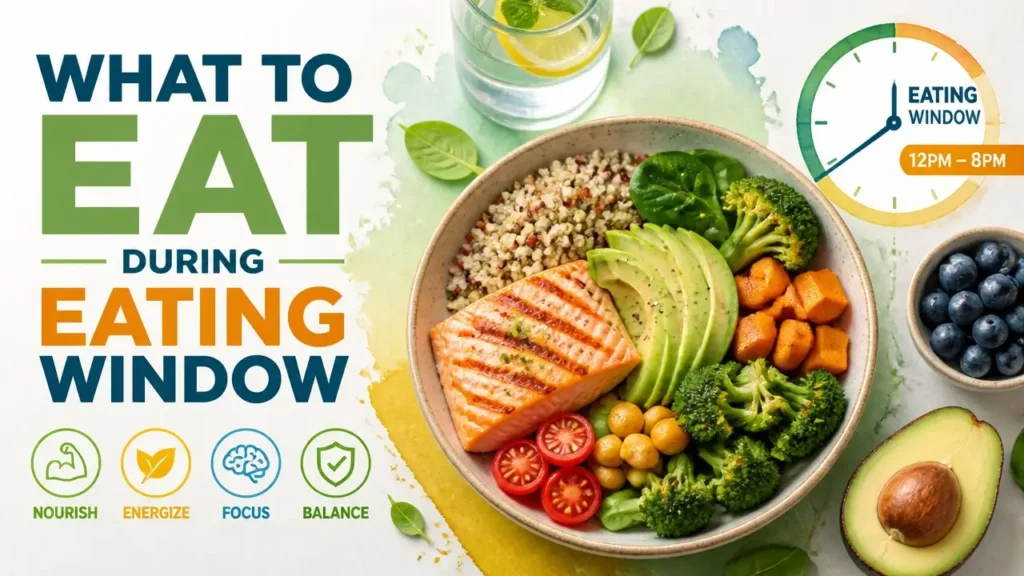
Your intermittent fasting eating window isn’t just a time slot – it’s the engine that drives everything you’re trying to accomplish with fasting. Get the food quality right, and hunger stays manageable, fat loss compounds, and the protocol becomes something you actually want to keep doing. Get it wrong, and no fasting schedule in the world will save you from the plateau.
Most intermediate fasters already know the clock. What they’re missing is the blueprint for what goes inside it – the specific macronutrient balance, meal structure, and hidden mistakes that separate people who thrive on IF from people who quietly quit.
Why Food Quality Makes or Breaks Your Intermittent Fasting Results
You may have read that intermittent fasting works simply because it helps you eat fewer calories. While that’s partially true, focusing only on caloric restriction overlooks why many fasters succeed long-term while others give up. Your intermittent fasting eating window compresses your entire day’s nutrition into a narrow band of hours – and that compression turns every meal into a high-stakes decision. When those meals are nutrient-dense, your body gets what it needs and runs smoothly. When they’re not, a chain reaction starts that makes the whole protocol miserable.
Here’s the core mechanism: a shorter eating window means fewer opportunities to hit your daily requirements for protein, micronutrients, and fiber. Miss those targets consistently, and your metabolism slows, your energy drops, and your hunger becomes relentless – not because fasting is failing you, but because your diet is running a nutrient deficit that the clock can’t fix.
The hormone piece is where this really gets practical. A healthy diet built around whole, minimally processed foods actively regulates ghrelin – the hormone that triggers hunger – and supports leptin, the signal that tells your brain you’re full. When those two hormones are calibrated, your fasting window feels almost automatic. When you eat refined, low-quality foods, insulin spikes hard, blood sugar crashes a few hours later, and ghrelin surges in response. You’re not hungry because fasting is hard. You’re hungry because your last meal set you up to fail.
Major health bodies now acknowledge that a significant portion of intermittent fasting’s weight-loss benefit is attributable to caloric restriction rather than a unique metabolic switch. That finding doesn’t diminish IF – it actually clarifies it. If the mechanism is largely caloric, then the quality of those calories becomes the decisive variable in body composition, hunger control, and long-term health outcomes. You can’t outrun a poor-quality diet by timing it differently.
The adherence data makes this concrete. According to a study published in PMC, dropout rates for alternate-day fasting reached 38% within one year. That’s a staggering failure rate for a protocol that, on paper, requires no calorie counting. The underreported driver behind that number is poor food quality during the eating window – it keeps hunger elevated, reduces meal satisfaction, and turns the fast into a daily endurance test rather than a manageable routine.
The real-world gap between a high-quality diet and a nutrient-poor one isn’t measured in pounds on a scale. It’s the difference between walking into hour 14 of your fast feeling clear-headed and walking into hour 10 feeling irritable, foggy, and raiding the pantry. Food quality is the compliance engine. Without it, you’re not practicing intermittent fasting – you’re just skipping breakfast and suffering for it.
The Macronutrient Blueprint: Protein, Fat, and Smart Carb Timing
Balanced macronutrients are the structural foundation of every effective intermittent fasting eating window – not keto, not carnivore, not any specific elimination protocol. The goal isn’t to cut an entire macronutrient group. It’s to understand what each one does inside a compressed eating window and sequence them in a way that keeps insulin stable, muscle intact, and hunger quiet.
Protein as the Non-Negotiable Anchor
High-quality dietary protein is your primary defense against the most common casualty of intermittent fasting: muscle loss. When you’re in a caloric deficit – which most fasters are, intentionally or not – your body will pull from lean tissue if protein intake is insufficient. The research here is unambiguous.
In a randomized controlled trial published in Medicine & Science in Sports & Exercise, resistance-trained athletes in a 40% caloric deficit for two weeks told the story clearly: the high-protein group (approximately 2.3 g/kg of body weight) lost only 0.3 kg of lean mass, while the control group at standard protein intake lost 1.6 kg – with comparable total weight loss. A 2024 meta-analysis in Nutrients examining 47 randomized controlled trials confirmed that higher protein intakes during weight loss consistently protect muscle mass, strength, and physical function across diverse adult populations. And a pooled analysis in Obesity found that simply increasing protein from 0.8 g/kg/day to 1.0 g/kg/day during caloric restriction halved lean body mass loss.
The practical takeaway: build every meal around a quality protein source. Grass-fed beef, wild-caught fish, eggs, pasture-raised poultry, and tempeh are all strong choices. Protein also has the highest satiety-per-calorie ratio of any macronutrient, which means it’s doing double duty – protecting muscle and keeping hunger hormones in check.
An academic clinical nutrition research panel studying physiological responses put it plainly:
“By contrast, IF protocols that are adequately planned and that include sufficient protein intake, appropriate total energy intake, and resistance training may preserve lean mass comparably to-or in some cases better than-continuous calorie restriction. Thus, muscle loss is not an inevitable consequence of IF, but rather a risk that emerges when fasting is poorly designed or combined with unintended underfeeding.” – MDPI Nutrients, 2026
The word “unintended” matters here. Most intermediates aren’t deliberately under-eating protein – they just aren’t tracking it, and the compressed window makes it easy to fall short without realizing it.
Healthy Fats and Complex Carbohydrates in the Right Order
Healthy fats – avocado, extra-virgin olive oil, nuts, seeds – are your sustained energy source. They slow digestion, prevent sharp insulin swings, and extend the comfortable fasting period by keeping blood sugar stable for hours after the meal ends. Think of them as the slow-release fuel that keeps the engine running between meals.
Complex carbohydrates aren’t the enemy, but they need to be earned through source selection and timing. Leafy greens, cruciferous vegetables, berries, sweet potatoes, and quinoa deliver fiber, micronutrients, and the kind of glucose release that feeds gut health without punishing your insulin response. White bread, pastries, and refined grains do the opposite – they spike insulin fast, crash blood sugar faster, and leave you hungrier than you started.
Carb timing is where most intermediates leave results on the table. Opening your eating window with a protein-and-fat-heavy first meal keeps insulin lower in the earlier part of the window, which maintains a fat-burning state deeper into the day. Saving most of your complex carbohydrates for the second meal – particularly if it falls post-workout – supports glycogen replenishment when your muscles are primed to absorb it without the same insulin cost.
The sequencing, then, looks like this: open the window with protein and fat, close it with a balanced meal that includes fibrous carbs and another serving of protein. That structure isn’t arbitrary – it’s designed to use each macronutrient at the moment in the window when it does the most good.
What Breaks a Fast (and What Doesn’t) – An Intermediate’s Guide
Physiological Criteria and Safe Substances for Maintaining a Fast
Physiological fasting criteria hinge on three triggers: significant caloric intake, a meaningful insulin spike, and mTOR activation – the cellular growth-signaling pathway that, when activated by amino acids or protein, shifts the body out of its repair and fat-mobilization state. If a substance clears all three without activating them, it’s generally considered safe during the fasting window. If it trips any one of them, you’ve technically broken the fast.
In practical terms, that means black coffee, unsweetened tea, plain water, and mineral-only electrolytes (sodium, potassium, magnesium – no sugar, no protein) sit safely in the “fast-intact” column. Adding heavy cream, coconut oil, or collagen peptides moves you out of that column because each contributes calories and, in the case of collagen, amino acids that activate mTOR. Artificial sweeteners occupy a gray zone – some evidence suggests they can trigger an insulin response in certain individuals even without caloric content, making them a variable worth eliminating if you’re not seeing expected results.
Cell biologists researching metabolic signaling and autophagy pathways describe the underlying mechanism this way:
“During starvation and caloric restriction, low nutrient availability induces autophagy to provide substrates for energy provision… Alternatively, nutrient availability activates anabolic pathways, such as insulin signaling, that directly attenuate autophagy.” – Frontiers in Cell and Developmental Biology, 2021
Here’s something worth saying out loud: much of the hard-line advice you’ll find online about autophagy disruption is extrapolated from animal studies. Human data on the precise caloric threshold that halts autophagy is virtually nonexistent. The fear that a single misstep will destroy your fast is largely influencer-driven speculation dressed up as established science. Don’t let it paralyze you.
Here’s a practical reference to anchor the decision-making:
| Substance | Calories | Insulin Response | Breaks Fast? |
|---|---|---|---|
| Black coffee | 0–5 kcal | Minimal | No |
| Unsweetened herbal/green tea | 0–2 kcal | None | No |
| Plain water | 0 kcal | None | No |
| Mineral electrolytes (no sugar) | 0 kcal | None | No |
| Heavy cream (1 tbsp) | ~50 kcal | Low-moderate | Yes |
| Coconut oil (1 tsp) | ~40 kcal | Low | Yes (calories) |
| Collagen peptides (1 scoop) | ~35–40 kcal + amino acids | Moderate + mTOR | Yes |
| BCAAs | ~10–20 kcal + leucine | Moderate + mTOR | Yes |
| Artificial sweeteners | 0 kcal | Variable | Possibly |
| Lemon water (squeeze only) | ~5 kcal | Negligible | No (trace) |
Goal-Dependent Strictness and Avoiding the Fasting Purity Trap
Goal-dependent strictness is the lens that actually makes these rules useful – because the right answer changes based on what you’re optimizing for. For straightforward weight loss, a splash of cream in your coffee is almost certainly negligible. It won’t meaningfully interrupt fat oxidation or caloric deficit. But if you’re specifically chasing gut rest, cellular repair, or the deeper autophagy benefits associated with a low-insulin, low-mTOR environment, then even trivial caloric inputs become relevant, because those processes appear to be sensitive to nutrient availability at the cellular level.
The problem is that most people aren’t clear on their primary goal, so they default to maximum strictness – and that’s where the fasting purity trap opens up. Obsessing over trace ingredients, panicking over a 5-calorie lemon squeeze, or refusing to take a necessary medication because it contains a small amount of filler – that’s orthorexic thinking, and it causes more harm than a teaspoon of cream ever would. The overarching principle is to maintain a low-insulin, low-mTOR environment for the majority of your fasting period, not to pursue an idealized version of a protocol that the science hasn’t fully defined yet.
If you want a deeper look at how Dr. Jason Fung frames the goal-dependent approach and the psychological risks of chasing fasting perfection, this conversation covers it well:
Structuring Your 16:8 Eating Window for Maximum Impact
The 16:8 eating window structure works best as a two-meal-plus-optional-snack framework – not a grazing pattern that keeps insulin trickling upward for hours. Constant eating, even within the window, prevents the insulin clearance that makes the fasting period productive. Two intentional meals with a defined gap between them is the architecture that keeps the metabolic benefits intact while giving you enough flexibility to live normally.
Here’s how to put it together in a way that actually works day to day.
One structural point that almost never makes it into mainstream IF advice: consistency in meal timing trains your ghrelin rhythms. Ghrelin is partially circadian – it rises and falls in patterns your body learns. When you eat at roughly the same times each day, ghrelin adapts to those windows, and hunger outside them diminishes over two to four weeks. Irregular timing prevents that adaptation and keeps hunger feeling unpredictable.
For a practical look at what this meal structure looks like across an 8-hour window:
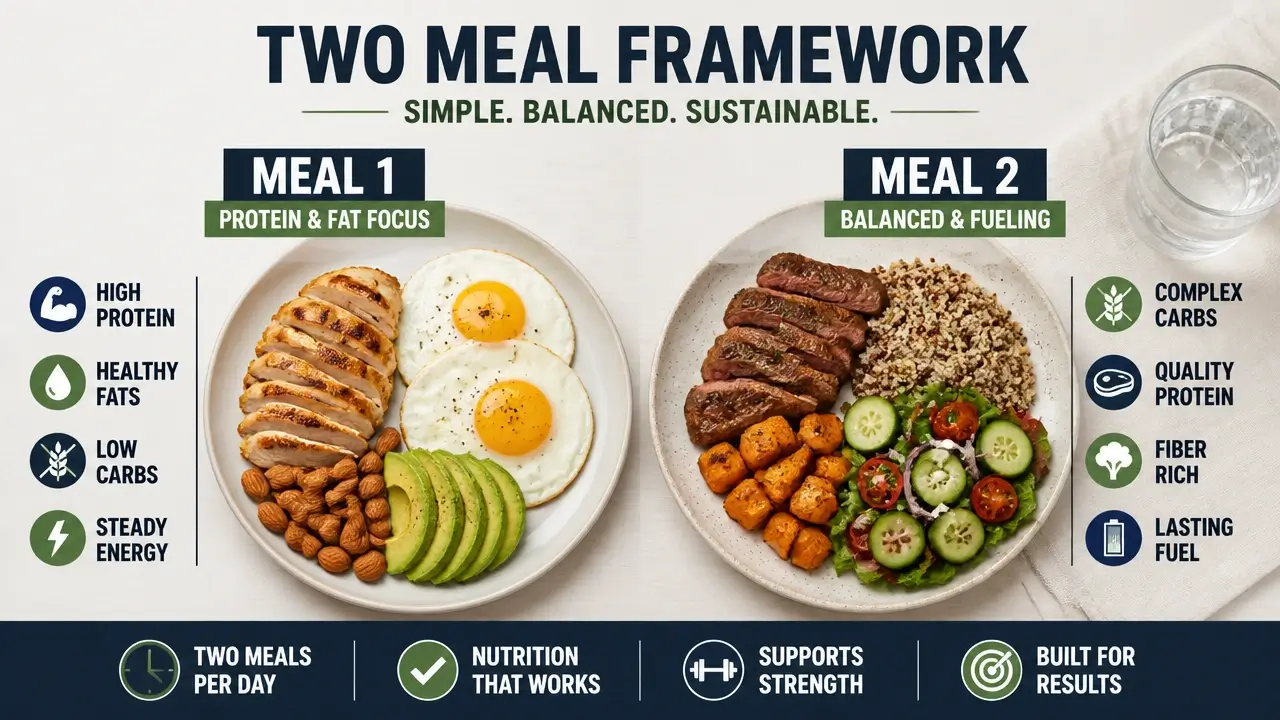
First meal (break-fast): Open with protein and healthy fats, minimal carbohydrates. This is the meal that sets your metabolic tone for the rest of the window. A couple of eggs cooked in olive oil, a piece of salmon, or a Greek yogurt with nuts and seeds – something that stabilizes blood sugar immediately and keeps insulin from spiking hard right out of the gate. The fat content slows digestion and extends satiety. The protein activates muscle protein synthesis early.
Second meal: This is where complex carbohydrates belong. Vegetables, a portion of sweet potato or quinoa, another serving of protein. If you train, positioning this meal post-workout maximizes glycogen replenishment. The fiber from vegetables supports gut health and slows glucose absorption, keeping the insulin response measured rather than sharp.
Optional snack: If hunger genuinely demands it between meals, a handful of nuts, a hard-boiled egg, or a small portion of full-fat cheese handles it without disrupting the structure. Keep it fat-and-protein-based, not carbohydrate-based, to avoid restarting the insulin cycle mid-window.
Electrolytes deserve a dedicated mention because they’re the most common overlooked cause of fasting headaches and fatigue – symptoms that get misattributed to “fasting flu” when they’re actually a mineral deficit. Salt your food generously with quality salt, include potassium-rich foods like avocado, leafy greens, and salmon in your meals, and if you experience muscle cramps, look at magnesium-rich seeds like pumpkin seeds before reaching for a supplement. These aren’t optional add-ons; they’re infrastructure.
Dr. Robert R. Wolfe, PhD, and his research team at the University of Arkansas for Medical Sciences, whose work focuses on human muscle metabolism, reinforce why the two-meal structure demands high protein per sitting:
“In conclusion, consuming 1.5 g/kg/d (~0.75 g/kg/meal) led to significantly greater whole-body net protein balance compared with intakes of 0.8 and 1.1 g/kg/d in middle-aged and older adults. The greater net protein balance with the consumption of 1.5 g/kg/d was achieved despite exceeding the amount of dietary protein (~0.4 g/kg/meal) reported to maximally stimulate MPS in a single meal. The practical aspect of this conclusion is that within a 2-meal eating pattern, a large amount of dietary protein is required per meal to achieve a positive whole-body net protein balance over 24 h.” – The Journal of Nutrition, 2024
That last sentence is worth sitting with. If you’re eating two meals a day, each meal needs to carry significantly more protein than you’d consume in a typical three-meal structure. Spreading your daily target evenly across two servings isn’t enough – you need to push each meal’s protein load higher to compensate for the reduced meal frequency.
3 Intermediate Mistakes That Undermine Your Results (and How to Fix Them)
These pitfalls are common because typical IF education focuses on when you eat, not on how to nourish yourself intelligently within that window. Intermediate fasting mistakes tend to be invisible – they don’t announce themselves. You just feel tired, the scale stops moving, and hunger becomes unreliable. Each of the three mistakes below has a specific mechanism, and once you see it, the fix becomes obvious.
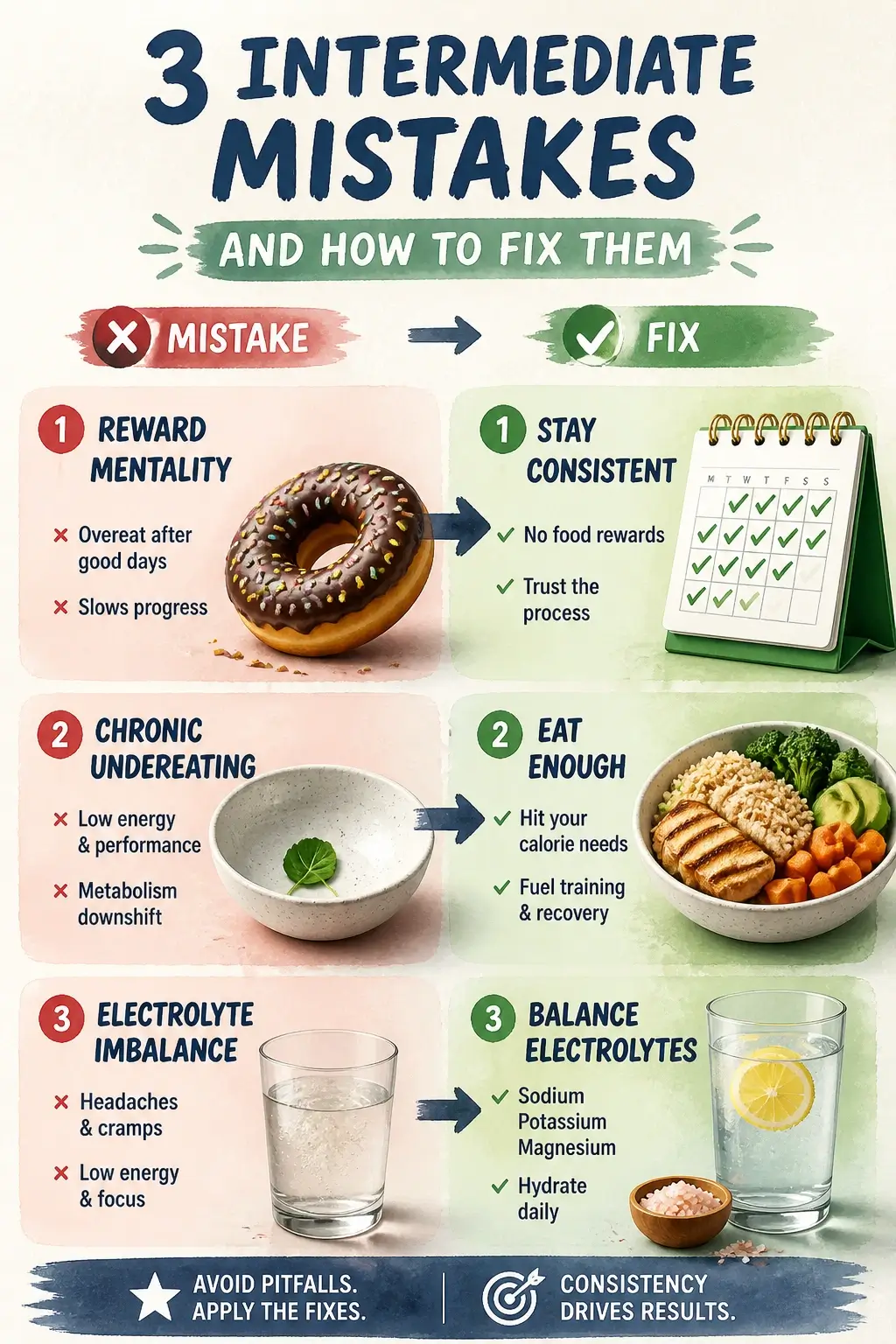
Here’s a visual overview before we break each one down:
Mistake 1: The Reward Mentality Sabotages Your Hormones
The reward mentality – treating the eating window as compensation for the hours you “suffered” through the fast – is the most psychologically understandable mistake on this list and the most metabolically damaging. It shows up as fast food, ultra-processed snacks, or sugary desserts justified by the logic that you’ve “earned” them. The problem is that ultra-processed foods spike inflammation, drive ghrelin upward, and blunt leptin signaling – exactly the hormonal environment that makes the next fast feel impossible.
A cardiovascular and metabolic health research group studying dietary behavior patterns described this pattern directly:
“This behavior, termed ‘reward-based eating,’ may degrade the overall diet quality by including more satisfying rather than nutritionally balanced options… poor dietary choices associated with reward-based eating may underpin the adverse effects of IF.” – Frontiers in Nutrition, 2025
The fix is reframing the eating window not as a reward but as a refueling protocol. The fast created a metabolic opportunity. The window is where you either cash in on it or cancel it out.
Mistake 2: Chronic Undereating Triggers Metabolic Adaptation
Chronic undereating happens when the compressed window leads to an unintentional caloric deficit that goes well below what the body needs to maintain muscle and metabolic rate. It’s not the same as a moderate deficit designed for fat loss. It’s aggressive restriction – often without realizing it – that signals the body to slow down rather than lean out.
The cascade looks like this: inadequate calories plus inadequate protein leads to muscle catabolism, which lowers your resting metabolic rate, which makes fat loss progressively harder even as you eat less. You end up working harder for diminishing returns. Fatigue sets in. The scale stalls. Most people blame the fast when the real culprit is the underfeeding.
The solution isn’t complex: loosely track your intake for two to three weeks to establish a baseline. You don’t need to log every meal forever – just long enough to confirm you’re hitting your protein target and consuming enough total energy to support your activity level. Most intermediates are surprised by how far below maintenance they’ve drifted.
While general timing rules provide a strong foundation, it is important to note that intermittent fasting for women requires additional considerations regarding hormonal balance and cycle-specific adjustments.
Mistake 3: Neglecting Electrolytes Mimics Fasting Failure
Electrolyte imbalance is the silent performance killer that gets misread as evidence that fasting “doesn’t work for you.” Headaches, afternoon fatigue, brain fog, muscle cramps – these are textbook signs of insufficient sodium, potassium, and magnesium, not signs of a broken metabolism. When you fast, insulin levels drop, and lower insulin causes your kidneys to excrete more sodium. That sodium loss pulls water with it, and potassium and magnesium follow.
The fix is whole-food-first: salt your meals with a quality mineral salt, build potassium into your diet through avocado, leafy greens, and salmon, and address magnesium through pumpkin seeds, dark chocolate, or legumes before considering supplementation. If symptoms persist despite dietary adjustments, a low-sugar electrolyte supplement taken during the eating window is a reasonable bridge – but food should always be the first line of defense.
The hunger hormone piece ties this all together. Ghrelin typically adapts within two to four weeks of consistent fasting – meaning early hunger is physiologically normal and not a sign that the protocol isn’t working. But persistent poor food choices can prevent that adaptation by keeping ghrelin chronically elevated. Fix the food quality, and the biology starts cooperating.
The real answer to “what to eat during your eating window” isn’t a list of approved foods. It’s a coherent system: food quality to control hunger, macronutrient balance to protect body composition, clear fasting boundaries to maintain metabolic state, a repeatable meal structure to train your hormones, and the awareness to avoid the hidden traps that quietly derail intermediates. That’s what turns intermittent fasting from a discipline of hunger into a sustainable health habit.
Key Takeaways on Intermittent Fasting Eating Window
- Food quality inside your eating window controls hunger hormones more than your fasting schedule does.
- Every meal in a compressed window must be nutrient-dense because fewer eating opportunities mean a higher deficiency risk.
- Protein should anchor every meal to protect muscle mass and extend satiety into the fasting period.
- Open your window with protein and fat; save complex carbohydrates for your second meal or post-workout.
- Black coffee, unsweetened tea, and mineral electrolytes preserve the fast; cream, BCAAs, and collagen do not.
- Electrolyte deficiency – not fasting itself – causes most headaches, cramps, and fatigue that intermediates misread as failure.
Frequently Asked Questions About Intermittent Fasting Eating Window
Can I eat whatever I want as long as I stay inside my eating window?
Technically you can, but it will likely stall your results. Insulin spikes from low-quality food during the window elevate ghrelin and make the next fast significantly harder, which is the primary reason adherence rates drop over time.
How much protein do I actually need per meal in a two-meal IF structure?
Research from Dr. Robert Wolfe’s team suggests targeting approximately 0.75 g per kilogram of body weight per meal when eating only twice a day – meaningfully higher than the per-meal amounts typically recommended in three-meal eating patterns.
Does lemon water break a fast?
A small squeeze of lemon in water – roughly 5 calories – has negligible insulin impact and is generally considered safe for weight-loss-focused fasting. If you’re specifically optimizing for autophagy, even trace calories are worth eliminating, though human data on that threshold remains limited.
Why am I so hungry in the first two weeks of intermittent fasting?
Ghrelin is partially circadian and needs two to four weeks to adapt to a new eating schedule. Early hunger is a normal physiological response, not a sign that fasting isn’t working – but poor food quality during the window can keep ghrelin elevated well past that adaptation window.
What’s the difference between fasting for weight loss and fasting for autophagy?
For weight loss, the primary lever is caloric deficit and food quality – small infractions like a splash of cream matter little. For autophagy, the goal is maintaining a low-insulin, low-mTOR state, which means even trace amino acids from collagen or BCAAs become relevant.
Is it better to work out during the fast or inside the eating window?
Either can work, but training near the end of the fasting window and eating your second meal post-workout is a practical way to support glycogen replenishment with carbohydrates at the moment muscles are most receptive to them.
What if I can only fit one real meal into my eating window?
One-meal-a-day (OMAD) patterns significantly increase the risk of protein inadequacy and micronutrient deficiency. If you’re eating one meal, protein needs per sitting rise sharply – and you’ll need to be deliberate about hitting nutritional targets in a single sitting, which most people underestimate.
Can intermittent fasting help lower A1C?
Some evidence suggests time-restricted eating can improve insulin sensitivity and reduce fasting glucose over time, which may contribute to lower A1C in people with prediabetes or type 2 diabetes – but this should always be managed in coordination with a healthcare provider, especially for anyone on glucose-lowering medications.
References
- Alternate-Day Fasting Adherence and Dropout Rates – pmc.ncbi.nlm.nih.gov
- Medicine & Science in Sports & Exercise – Increased protein intake reduces lean body mass loss during weight loss in athletes – pubmed.ncbi.nlm.nih.gov
- Nutrients – Enhanced protein intake on maintaining muscle mass, strength, and physical function – pubmed.ncbi.nlm.nih.gov
- Obesity – Higher protein intake during caloric restriction improves diet quality and lean mass retention – pmc.ncbi.nlm.nih.gov
- Frontiers in Cell and Developmental Biology – Nutrient availability, autophagy, and insulin signaling – frontiersin.org
- The Journal of Nutrition – Whole-body net protein balance and dietary protein intake in a two-meal pattern – jn.nutrition.org
- Frontiers in Nutrition – Reward-based eating and diet quality in intermittent fasting – frontiersin.org