
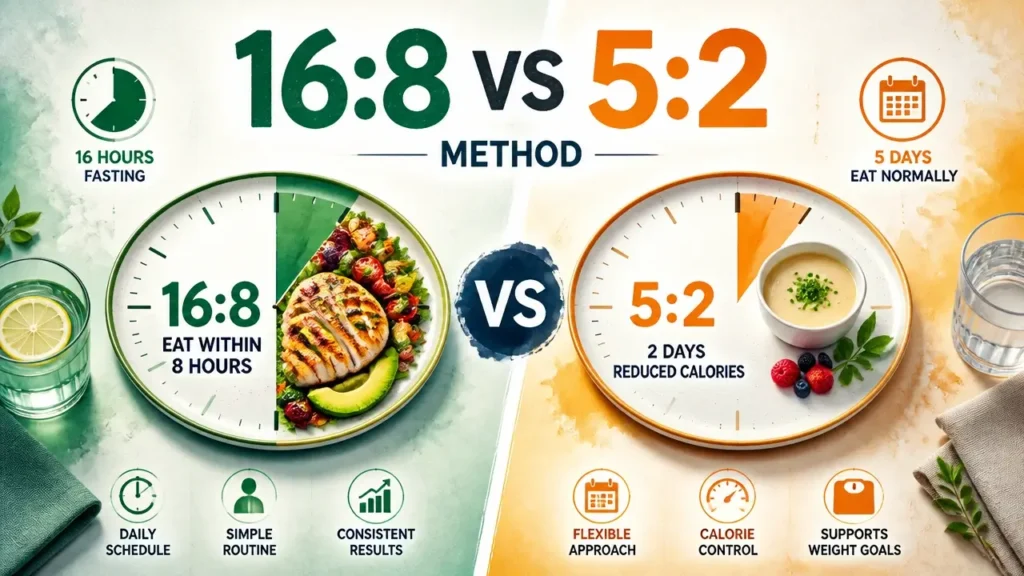
Intermittent fasting methods don’t fail because of bad biology – they fail because the wrong protocol meets the wrong life. The science is clear: 16:8 and 5:2 deliver nearly identical weight-loss outcomes. What they don’t deliver equally is fit.
One runs on a daily clock. The other runs on a weekly deficit. Understanding the physiological difference between those two mechanisms – circadian alignment versus intermittent calorie shock – is what lets you stop guessing and start choosing.
What You’re Really Choosing Between 16:8 and 5:2
The question most people bring to this comparison is “which one burns more fat?” It’s the wrong question – and answering it first would set you up for the same disappointment that follows every generic fasting guide.
Both 16:8 and 5:2 are legitimate intermittent fasting methods. Both create a caloric deficit. Both produce measurable weight loss over three to six months. The evidence on that point is settled enough that choosing between them based on metabolic superiority is a bit like choosing between two cars based on which has the better engine – when what you actually need to know is which one fits in your parking space.
The dimensions that actually matter here are five: daily routine feasibility, social-eating compatibility, muscle preservation, realistic timeline of results, and practical safety – including how each protocol interacts with medications you might already be taking. These are the axes this comparison runs on, because they’re the ones where 16:8 and 5:2 genuinely diverge.
Here’s the mechanical difference worth holding onto as you read: 16:8 creates its deficit through continuous daily time restriction – you compress every day’s eating into an 8-hour window, which naturally reduces intake without calorie math. 5:2 creates its deficit through intermittent calorie shocks – five days of normal eating, two days of near-fasting at 500–600 calories. Same destination, completely different route. And the route matters enormously for long-term habit formation.
Willpower is not a sustainable strategy for either method. The research on dietary adherence is consistent: compliance drops when a protocol constantly conflicts with your natural rhythms, your social calendar, or your medication schedule. The best protocol isn’t the hardest one – it’s the one that eventually stops requiring conscious effort.

How 16:8 Uses Your Body’s Clock to Trim Calories
Daily 16:8 intermittent fasting works by compressing all eating into an 8-hour window – typically something like noon to 8 p.m. – and fasting for the remaining 16 hours, most of which overlap with sleep. The protocol sounds almost too simple, which is partly why people underestimate the biology behind it.
The mechanism isn’t just “eat less by eating later.” It runs deeper, through your circadian system.
Every cell in your body carries molecular clock genes – BMAL1, CLOCK, PER, CRY – that regulate metabolic processes in 24-hour cycles. Your liver, muscle tissue, and pancreatic beta cells are all most sensitive to insulin in the biological morning, roughly the first half of your waking day. When you eat in alignment with that window, glucose is cleared from the blood efficiently, fat storage signals stay low, and your peripheral clocks stay synchronized.
Eat outside that window – particularly late at night – and you’re delivering fuel when the metabolic machinery is in sleep mode. Insulin sensitivity drops, nocturnal insulin spikes promote fat storage, and over time, those peripheral clock genes drift out of phase. A 2018 randomized trial published in Cell Metabolism found that men with prediabetes who restricted eating to an early 8-hour window showed marked improvements in insulin sensitivity – with no weight loss at all. The benefit came purely from circadian alignment, not calorie reduction.
A peer-reviewed review in PMC elaborates on why: early time-restricted eating synchronizes nutrient delivery with the body’s diurnal insulin peak, restoring the morning window of high glucose uptake and reducing the nocturnal insulin exposure that drives fat accumulation.
Dr. Satchidananda Panda, Professor at the Salk Institute for Biological Studies and one of the leading researchers on circadian rhythm biology and time-restricted feeding, has observed:
“reducing eating duration in humans also reduced their daily caloric intake by up to 20% (some of this reduction came from reduction in late-night alcohol and snacks). They lost up to 4% body weight in 16 weeks and retained this weight loss for up to 1 year.”
That spontaneous calorie reduction is one of 16:8’s most underappreciated features. You’re not counting anything – the window does the work by eliminating the late-night eating occasions where most excess intake accumulates.
One area where realistic expectations matter: autophagy. You’ll often see 16:8 marketed as a cellular “cleanup” protocol. The biology is real – fasting does trigger autophagy, the process by which cells recycle damaged components – but 16 hours initiates only early-stage autophagic activity. Think of it as maintenance-level cellular housekeeping, not a deep reset. Longer fasts (24–72 hours) are where the deeper autophagic response emerges. 16:8 is a consistent, mild stimulus, not a dramatic intervention.
On the daily experience side: most people find morning fasting manageable once the body has adapted to using fat as a fuel source, typically within one to two weeks. The friction point for 16:8 is the evening. A 9 p.m. family dinner, a work event that runs late, a spontaneous meal with friends – all of these fall outside a noon-to-8 window. You can shift the window earlier or later to accommodate your life, but the fixed daily structure means social meals require advance planning.
The Math of Restriction: How 5:2 Packs a Deficit into Just Two Days
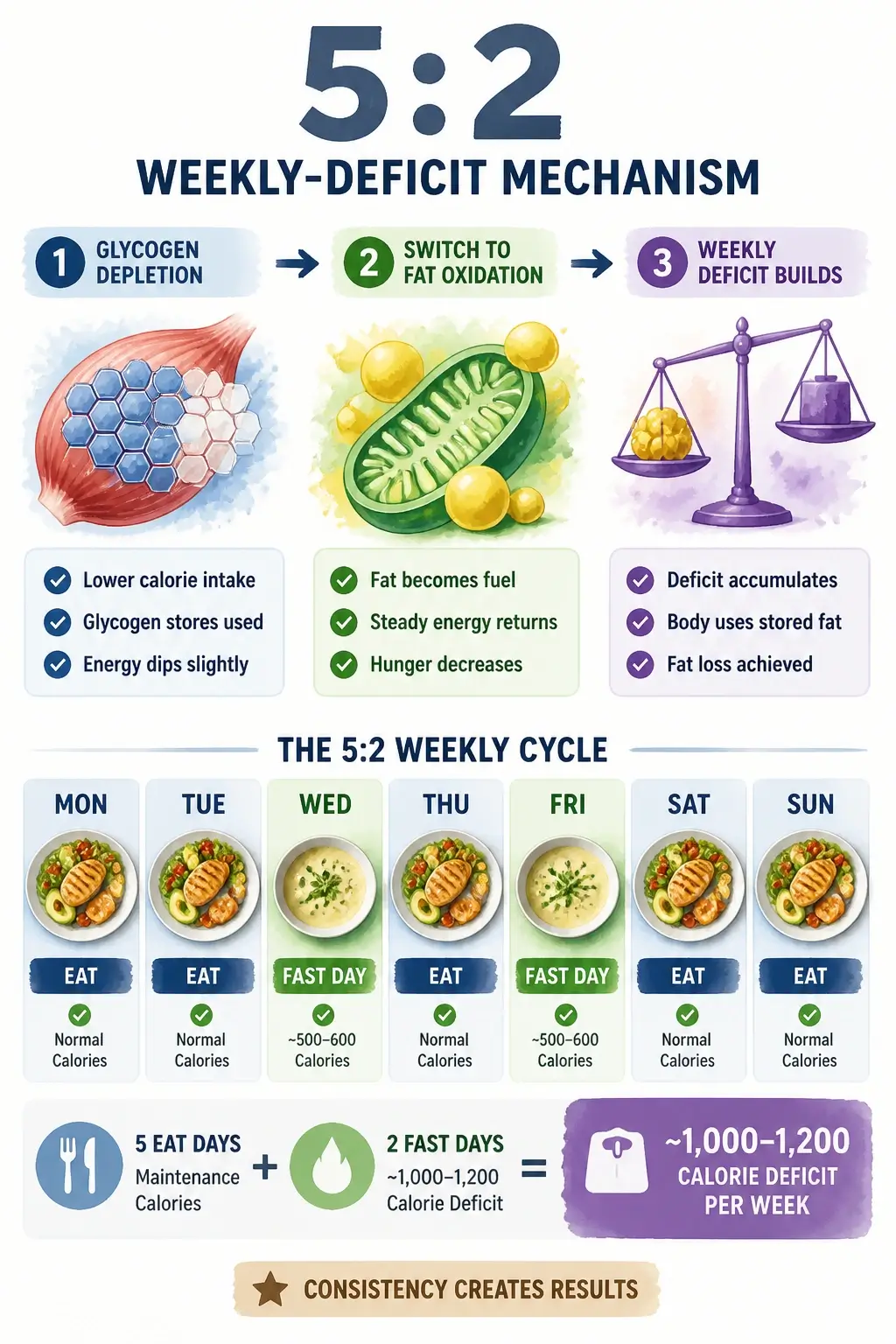
Five-to-two intermittent fasting runs on a completely different logic: eat normally for five days each week, then restrict to 500–600 calories on two non-consecutive days – a common pairing is Monday and Thursday, though the days are moveable.
The metabolic mechanism here is intermittent, sharp calorie restriction rather than daily time compression. On fast days, your body depletes liver glycogen stores within roughly 12–16 hours of low intake, then shifts its primary fuel source toward fat oxidation. This switch – from glucose-dependent to fat-dependent metabolism – is what people mean when they talk about metabolic flexibility: the capacity to move fluidly between fuel sources depending on availability. The 5:2 protocol trains that switch repeatedly, twice a week, which some researchers argue may produce meaningful improvements in metabolic flexibility over time.
The low-insulin environment on fast days also extends long enough to trigger a more sustained autophagic signal than the 16-hour window typically provides. Whether that translates to clinically meaningful cellular benefits in practice is still being studied, but the mechanism is real.
There’s a trade-off that doesn’t get enough attention in most 5:2 coverage: muscle catabolism risk. On a 500-calorie day, your total protein intake is severely limited. When the body is running a large acute energy deficit and protein is scarce, it can turn to muscle tissue for amino acids – a process called muscle protein breakdown (MPB). This isn’t inevitable, but it is a real risk if fast days are treated as pure restriction without any protein strategy. Spreading the 500 calories across small, protein-prioritized meals – even something as simple as two portions of Greek yogurt or eggs – helps blunt MPB by maintaining amino acid availability without meaningfully increasing calorie load. Ensuring adequate protein on normal days matters equally, because muscle protein synthesis (MPS) on those days needs to offset what fast days may have cost.
Social adaptability is genuinely one of 5:2’s strengths. Because restriction is concentrated into just two days, you can move those days around your calendar. A Thursday fast day can become a Tuesday if Thursday has a dinner reservation. That flexibility is real and valuable – but it requires actual planning. A fast day that accidentally lands on an unexpected celebration, a stressful work deadline, or a travel day is a fast day that often doesn’t happen.
The complexity trade-off is honest: 5:2 requires accurate calorie tracking on fast days. Five hundred calories is not intuitive – it’s specific. For some people, that precision feels manageable and even grounding. For others, it activates an obsessive relationship with food numbers that spills over into normal days. That’s not a character flaw; it’s a real psychological pattern worth anticipating before you commit.
Where 16:8 and 5:2 Collide on What Actually Matters
Many people approaching this comparison carry a quiet assumption: that 5:2’s larger acute deficit must mean faster fat loss. The most robust scientific evidence doesn’t support that assumption – and clearing it up is what makes the rest of this comparison useful.
A meta-analysis of 24 randomized controlled trials found that intermittent fasting protocols – including daily time-restricted eating and 5:2-style alternate-day approaches – produce weight loss that is statistically equivalent, with a mean difference of just 0.26 kg and a p-value of 0.37. That’s not a rounding error. That’s a null result. The perceived speed advantage of 5:2 is an artefact of larger acute deficits on fast days – the scale drops sharply after a fast day, mostly reflecting glycogen and water loss, not accelerated fat oxidation. Over months, the curves converge.
What this means practically: schedule compatibility, not metabolic edge, is the variable you’re actually optimizing for. Here’s where the two protocols genuinely diverge.
Daily Sustainability and Social-Eating Compatibility
Daily sustainability in 16:8 comes from its structural simplicity. Once the eating window becomes automatic – once you stop thinking about it as a rule and it just becomes when you eat – the protocol requires almost no mental energy. That’s the real power of habit formation: the behavior disappears into routine. Most consistent 16:8 practitioners report that within a few weeks, morning hunger largely resolves and the window feels natural rather than imposed.
5:2’s sustainability profile is different. Normal days provide genuine psychological relief – the knowledge that tomorrow is a regular eating day makes today’s restriction feel temporary and tolerable. But that relief is also 5:2’s vulnerability. Fast-day fatigue – the cumulative dread of two low-calorie days per week – tends to build over months. Compliance data and community reports both suggest that 5:2 adherence declines more steeply after the three-to-four month mark than 16:8’s does, particularly when fast days feel punitive rather than just different.
On social eating, the calculus flips. 16:8’s fixed daily window is a real constraint in social contexts. A noon-to-8 window means you’re skipping breakfast with colleagues, declining the 9 p.m. tapas reservation, or eating alone while others are still ordering. Community experience backs this up: 16:8 users consistently report feeling “left out” at evening events unless they’ve shifted their window or made peace with breaking it occasionally. Users like u/Ompriscion on Reddit’s fasting communities reflect a pattern seen repeatedly – social eaters gravitate toward 5:2 precisely because only two days carry restriction, leaving five days fully open for meals with family, travel, and unplanned dinners. At the same time, one user who switched from 5:2 to 16:8 reported finding the daily structure “much easier” after the adaptation phase – suggesting that for people with predictable schedules, the daily rhythm eventually becomes the path of least resistance.
Here’s a video that walks through the practical experience of both protocols side by side:
Muscle Retention, Results Timeline, and the Weight-Loss Equivalence Evidence
Muscle retention under 16:8 is relatively well-protected when protein intake inside the 8-hour window is sufficient. The fast is never long enough to meaningfully deplete amino acid availability in muscle tissue – the body’s priority under a 16-hour fast is mobilizing fat stores, not cannibalizing lean mass. Studies on resistance-trained individuals using 16:8 generally show lean mass preservation comparable to non-fasting controls, provided total daily protein hits appropriate targets.
5:2’s muscle retention picture is more variable and depends almost entirely on protein planning on fast days. Dr. Stefan M. Pasiakos, Chief of the Military Nutrition Division at the US Army Research Institute of Environmental Medicine, puts the physiological stakes directly:
“If the acute effects of IF lead to detrimental long-term outcomes for muscle, whole-day, and alternate-day fasting would have the greatest consequential effect on muscle mass and remodeling. This is due to the prolonged period with greater MPB and lower MPS compounded by the greater energy deficient state likely to occur relative to TRE.”
The mechanism is straightforward: longer, deeper fasting periods extend the window in which muscle protein breakdown exceeds muscle protein synthesis. That imbalance isn’t irreversible, but it accumulates if fast days are treated as pure restriction without any attention to protein timing. The practical fix is simple – anchor your 500 calories to protein-dense foods rather than treating it as a carbohydrate-sparing exercise.
On results timeline, both protocols produce comparable weight loss over three to six months. 5:2 may show steeper scale drops in the days immediately following fast days – mostly glycogen and water – which can feel motivating but doesn’t reflect faster fat loss. 16:8 produces steadier, less dramatic week-to-week changes. Neither is a speed hack. Expecting one to dramatically outpace the other is how people end up abandoning a protocol that was actually working.
Common Failure Points and Medication Safety
Knowing where each protocol breaks down is more useful than knowing where it works well. The failure modes are predictable and specific.
For 16:8: the adaptation phase brings genuine morning hunger, particularly in the first one to two weeks before the body shifts toward fat oxidation as a default fuel. Evening restriction can feel depriving in social contexts. And there’s a compensatory eating trap – the eating window becomes a permission structure, and some people unconsciously increase intake during those 8 hours to offset the restriction, partially or fully negating the deficit.
For 5:2: extreme hunger and cognitive fog on fast days are the most commonly reported barriers. Some people find that the “reward” psychology of normal days tips into overconsumption – fast days create a sense of earned license that inflates weekend intake. And the two-day-per-week structure, which feels manageable in week one, can feel increasingly punitive by month three when the novelty has worn off and the fast days haven’t gotten easier.
The following table synthesizes the failure points, medication considerations, and the cardiovascular caution that most comparisons omit:
| Dimension | 16:8 | 5:2 |
|---|---|---|
| Primary failure point | Morning hunger (adaptation), evening social friction, compensatory overeating in window | Fast-day hunger/brain fog, overconsumption on normal days, cumulative fast-day fatigue |
| Medication safety | More adaptable – early window (e.g., 7 a.m.–3 p.m.) preserves breakfast-with-meds timing | Higher conflict risk – 500-calorie days may not support medication-with-food requirements |
| Cardiovascular caution | One Mayo Clinic statement flags potential elevated heart-disease risk with 16-hour fasting; not corroborated by other sources – warrants caution for those with CV concerns | No equivalent caution flagged; may be preferable for CV-risk readers until 16:8 data clarifies |
| Calorie tracking required | No – time-based only | Yes – mandatory on fast days |
| Adaptability to schedule changes | Low – fixed daily window resists irregular days | High – fast days can be moved around the calendar |
The medication safety dimension deserves particular emphasis because it’s the most underaddressed practical barrier in fasting guidance. Reddit communities and patient forums reveal a consistent pattern: people taking medications that require food – to protect the stomach lining, to ensure absorption, or simply because the prescription says “take with food” – experiment with workarounds like taking meds with black coffee or skipping the morning dose entirely, without clinical supervision. That’s a real risk. 16:8 with an early window that includes a breakfast-adjacent meal is generally the more adaptable option for medication-dependent users, but “generally” isn’t a clinical protocol. If you’re managing a condition that requires timed medication with food, this is a conversation to have with your prescriber before starting either method.
The Mayo Clinic’s cardiovascular caution is worth naming clearly: there is an unreferenced suggestion that the specific 16-hour fasting window may be associated with elevated heart-disease risk compared with other time-restricted eating cycles. No other major source currently corroborates this finding, and the mechanism behind the claim hasn’t been publicly detailed. It doesn’t disqualify 16:8 – but it does mean that presenting 16:8 as the universal safe default, particularly for readers with existing cardiovascular concerns, isn’t warranted yet. If heart health is a primary consideration, the more conservative choice at this moment is 5:2 or a shorter daily fasting window, pending further data.
The Lifestyle-Based Choice: Pick the Protocol That Fits Your Calendar
Protocol selection in intermittent fasting ultimately comes down to a single question: which method disappears into your life? Not which one demands the most of you – which one eventually stops requiring you to think about it.
Since weight-loss outcomes across intermittent fasting methods are statistically indistinguishable, the only variable you actually control is fit. The biology will do its job either way. What determines whether you’re still doing this in six months is whether the protocol structure aligns with the life you already lead.
Here’s a direct decision path based on the evidence and real-world experience:
If your schedule is predictable and you can protect a consistent eating window: 16:8 is the stronger starting point. The daily habit forms quickly, calorie counting is unnecessary, and the circadian alignment benefits add a metabolic layer that goes beyond simple restriction. Shift the window to match your natural meal timing – if you’re a morning eater, try 7 a.m. to 3 p.m.; if evenings are your social anchor, noon to 8 p.m. works.
If your week is irregular, you travel often, or you prefer two intense days in exchange for five unrestricted ones: 5:2 will feel more forgiving. The flexibility to move fast days around your calendar is a genuine structural advantage. Protect your protein on fast days and treat the calorie tracking as a two-day commitment, not a daily burden.
If you’re a shift worker or have rotating hours: 5:2 wins clearly. A fixed daily eating window becomes nearly impossible when your sleep-wake cycle shifts week to week. Two moveable low-calorie days adapt to changing rosters in a way that daily time restriction simply can’t.
If you’re a social eater: 5:2’s five unrestricted days make it far easier to stay present at dinners, events, and unplanned meals without constant negotiation. Move fast days to your quietest calendar days and treat the five open days as genuinely open.
If simplicity is your priority: 16:8 is the cleaner system. No calorie math, no planning – just a clock. For people who find food tracking mentally taxing, this is a significant quality-of-life difference.
If you’re medication-dependent: 16:8 with an early window that includes a morning meal is the safer structural baseline, because it preserves the ability to take food-required medications on schedule. That said, no standardized clinical protocol exists for either method in this context. Medical guidance is non-negotiable before starting.
If cardiovascular risk is a concern: Given the unresolved Mayo Clinic caution about 16:8 and heart-disease risk, 5:2 or a shorter daily fasting window is the more conservative choice until the data clarifies.
If you’re looking for a middle path: A hybrid approach has emerged in fasting communities – combining daily 16:8 with one 500-calorie fast day per week, rather than two. This increases the weekly deficit without the full intensity of 5:2. It’s experimental, not clinically validated, and carries a real risk of under-eating when layered on top of daily restriction. If this appeals to you, a registered dietitian is the right person to help you structure it safely.
Dr. Krista A. Varady, Professor of Nutrition at the University of Illinois Chicago and a leading researcher on fasting adherence, frames the psychological mechanism behind 5:2’s appeal:
“It has been suggested that dieting on intermittent days leads to positive cognitive side effects (e.g. improved mood, increased willpower) both because energy restriction is required only intermittently and because individuals find it easy to comply with a diet that permits ‘normal’ eating on non-fasting days.”
That observation applies equally in reverse: when a protocol’s structure aligns with how you naturally live, compliance stops feeling like discipline and starts feeling like default. That’s the actual goal.
A practical next step: pick one method, run it for two weeks, and track three things – your energy levels, your hunger patterns, and how many times the protocol conflicted with your social or medication schedule. Two weeks is enough data to know whether you’re fighting the protocol or settling into it. Adjust the window or fast-day placement before you declare it a failure. The biology is patient. The structure is the variable.
Key Takeaways on Intermittent Fasting Methods
- A meta-analysis of 24 RCTs found 16:8 and 5:2 produce equivalent weight loss – just 0.26 kg mean difference – so metabolic superiority is not a valid selection criterion.
- 16:8 works through daily circadian alignment, improving insulin sensitivity and reducing intake without calorie counting, but its fixed window creates social friction.
- 5:2 works through intermittent calorie shocks that deplete glycogen and trigger fat oxidation, but fast days carry real muscle catabolism risk without deliberate protein planning.
- Medication-dependent users face an underexplored conflict on 5:2’s near-fasting days; 16:8 with an early window is generally more adaptable, but medical guidance is required regardless.
- One unverified Mayo Clinic statement flags a potential heart-disease risk association with 16:8; readers with cardiovascular concerns should consider 5:2 or a shorter fasting window until evidence clarifies.
- The only reliable success metric for either protocol is long-term adherence – choose the method that fits your calendar, not the one that demands the most willpower.
Frequently Asked Questions About Intermittent Fasting Methods
Is 16:8 actually better than 5:2, or is that just marketing?
Neither is metabolically superior – the evidence from 24 randomized controlled trials shows weight loss outcomes are statistically equivalent. The “better” protocol is whichever one you can sustain without constant friction against your schedule and social life.
Can intermittent fasting make high cortisol worse?
It can, particularly with aggressive protocols. Prolonged fasting is a physiological stressor that activates the HPA axis and raises cortisol, which can be counterproductive if your baseline cortisol is already elevated from poor sleep, chronic stress, or under-eating. If you’re dealing with high cortisol, a shorter daily fasting window – or skipping fasting entirely until other stressors are addressed – is the more conservative approach.
Is it safe to fast while taking tirzepatide or similar GLP-1 medications?
Combining fasting with GLP-1 receptor agonists like tirzepatide raises real concerns about under-eating, since these medications already suppress appetite significantly. Layering a fasting protocol on top can push daily intake below what’s needed to preserve muscle mass and micronutrient status. This is a conversation your prescriber needs to be part of before you start.
Does intermittent fasting affect muscle differently in women than men?
The current evidence suggests women may be more sensitive to prolonged energy restriction – some research points to greater hormonal disruption, particularly around reproductive hormones, with aggressive fasting protocols. A more conservative starting window (14:10 rather than 16:8, for example) is often recommended for women new to fasting, with gradual extension based on individual response.
What if I break my fast accidentally – does the whole day count as wasted?
No. A single unplanned meal outside your window doesn’t erase the deficit or the metabolic signal from the hours you did fast. The body doesn’t reset to zero. Resume your normal protocol at the next meal and treat it as data about where your friction points are, not as failure.
Can I do 16:8 and 5:2 at the same time?
Some people combine them – fasting daily within a 16:8 window and adding one or two 500-calorie days per week. This hybrid increases the weekly deficit but also increases the risk of under-eating, particularly for people who are active or have higher protein needs. It’s not a validated clinical protocol, and it warrants dietitian input before implementation.
Does fasting help or hurt erectile dysfunction?
There’s no direct clinical evidence that intermittent fasting treats erectile dysfunction. Indirectly, fasting-related improvements in insulin sensitivity, cardiovascular markers, and body composition may support vascular health over time – and vascular health is a key driver of erectile function. But fasting is not a treatment, and ED with a known physiological cause warrants medical evaluation regardless of diet.
How do I know if my fasting protocol is working before the scale moves?
Energy stability, reduced mid-morning hunger, improved sleep quality, and less post-meal fatigue are early biological signals that your metabolism is adapting – often appearing before significant weight change. Track these alongside the scale for a more complete picture of whether the protocol is actually fitting your physiology.
References
- Early Time-Restricted Feeding Improves Insulin Sensitivity, Blood Pressure, and Oxidative Stress Even without Weight Loss in Men with Prediabetes – cell.com
- Time-Restricted Eating: Benefits, Mechanisms, and Challenges in Translation – pmc.ncbi.nlm.nih.gov
- Circadian Rhythm and Time-Restricted Feeding (Dr. Satchidananda Panda) – sciencedirect.com
- Intermittent Fasting and Muscle: A Review of the Evidence (Dr. Stefan M. Pasiakos) – frontiersin.org
- Meta-Analysis of 24 RCTs on Intermittent Fasting Weight-Loss Equivalence – pmc.ncbi.nlm.nih.gov
- Behavioral Psychology and Adherence in Intermittent Fasting Models (Dr. Krista A. Varady) – sciencedirect.com