

Consistent expense tracking gives you the one thing no budget can function without: an accurate picture of your current spending habits. Without it, you’re building a financial plan on guesswork – and guesswork doesn’t survive contact with a real month.
The good news is that this process doesn’t require special software, a finance degree, or radical lifestyle changes. It requires a method, your bank statements, and about thirty days of observation before you touch a single spending decision.
Why Spending Awareness Comes Before Budgeting
Tracking expenses means writing down every dollar you spend so you can see your habits clearly – and it has to happen before budgeting, not alongside it. A budget is a plan for where money should go. But if you don’t know where it currently goes, that plan is guesswork.
Think of it this way: if you discovered your checking account was $400 shorter than you expected at the end of the month, could you name where it went? Most people can account for the big, obvious items – rent, car payment, groceries. The gap usually lives in the smaller, repeated, invisible spending: the subscriptions you forgot you had, the convenience purchases that don’t feel like decisions, the cash that evaporates.
The first month of tracking is not about cutting anything. It’s pure observation. You’re building a baseline – a factual record of how money actually moves through your life. That record is the foundation every useful budget is built on.
To get started, you need two things: access to your bank and credit card statements from the past month, and a tool to record what you find. The next section helps you pick that tool. By the end of this four-step walk-through, you’ll have a system that runs on its own without requiring daily willpower.
The psychological mechanism behind this matters. Dr. Ben Harkin, Lead Researcher and Psychology Expert on Financial Mismanagement, found exactly this in his research:
“Conform to our expectations prompting contemplation… improved the estimates of expenditure… contemplation resulted in participants providing larger and more detailed accounts of their expenditure, and increased the agreement between staff and clients for the number of expenditure items provided”
The act of recording isn’t just administrative – it changes what you notice. Tracking expenses doesn’t just give you better data; it develops a more accurate internal model of what things actually cost.
Step 1: Pick the Tracking Method That Fits Your Life
Three practical tracking methods exist for beginners, and the right one isn’t the most popular – it’s the one you’ll actually use for thirty consecutive days.
Manual (Spreadsheet) You type your expenses into a free Google Sheets or Excel template yourself. No bank linking required.
- Pro: Full control over categories, no privacy concerns, works for anyone skeptical of connecting financial accounts to third-party apps.
- Con: Requires discipline to log regularly. If you miss a week, catching up is tedious.
App-Based Tracking Tools like YNAB or Empower connect directly to your accounts and import transactions automatically.
- Pro: Reduces manual entry significantly, especially useful if you have multiple accounts.
- Con: Apps frequently miscategorize transactions – “Amazon” might land in Entertainment when it was a household supply. You still need to review and correct weekly, or the data becomes unreliable.
Bank Auto-Categorization Most banks now automatically sort your transactions into spending groups inside their own app or web portal.
- Pro: Zero setup. The data is already there when you log in.
- Con: Bank categories are broad and occasionally wrong. You get a view, not a system. It’s a starting point, not a complete solution.
One honest note on apps: they’re recommended heavily based on download counts and user ratings, not on published evidence that they improve financial outcomes. A high App Store rating means people like the interface – it doesn’t mean it made them better with money. Choose based on what matches your follow-through style, not what’s trending.
Whichever method you choose, commit to it for a full thirty days before switching. Method-hopping is one of the most common reasons beginners never get a complete month of data.
If the idea of logging every expense still feels like too much – or if you’ve tried apps before and abandoned them – there’s a method that removes the daily logging requirement entirely. Long-term trackers sometimes use a daily cash envelope limit: pay rent and fixed bills digitally, then withdraw a fixed daily cash allowance (say, $20 for discretionary spending). When the cash runs out, spending stops. No app, no spreadsheet, no logging. The physical scarcity of cash does the enforcement automatically, which is why this low-tech approach often has higher adherence than digital tracking for people who struggle with consistency.
For a visual walkthrough of how cash envelope budgeting works in practice, this beginner-friendly video covers the mechanics from scratch:
The research on mobile banking also points to something worth noting about app-based tracking. Dr. Chuang, Expert in Digital Banking and Customer Experience, observed:
“One notable advantage of mobile banking over web banking lies in its ability to provide an enhanced streaming role. While using a m-banking application, users are less likely to switch between different applications, leading to a more focused and immersive experience… m-banking offers a user-friendly and seamless interface that enables customers to access a broad range of services quickly and easily”
The implication for tracking: if you’re already in the habit of checking your banking app daily, layering your expense review onto that existing behavior is a lower-friction entry point than learning a separate tool from scratch.
Step 2: Gather Your Numbers and Set Up Your Tracker
Tracker setup begins with a single, concrete task: pull the previous full month of transactions from every account you use – checking account, credit cards, and any cash withdrawals from ATMs.
Digital transactions are straightforward. Log into each account, download or screenshot your statement, and you have the raw data. Cash is the harder part. Physical spending leaves no automatic trail, which is why it’s the category most beginners undercount. The fix is simple: keep receipts and photograph them before you leave the store, or open your phone’s notes app and type the amount and merchant the moment you hand over cash. The memory fades faster than you think.
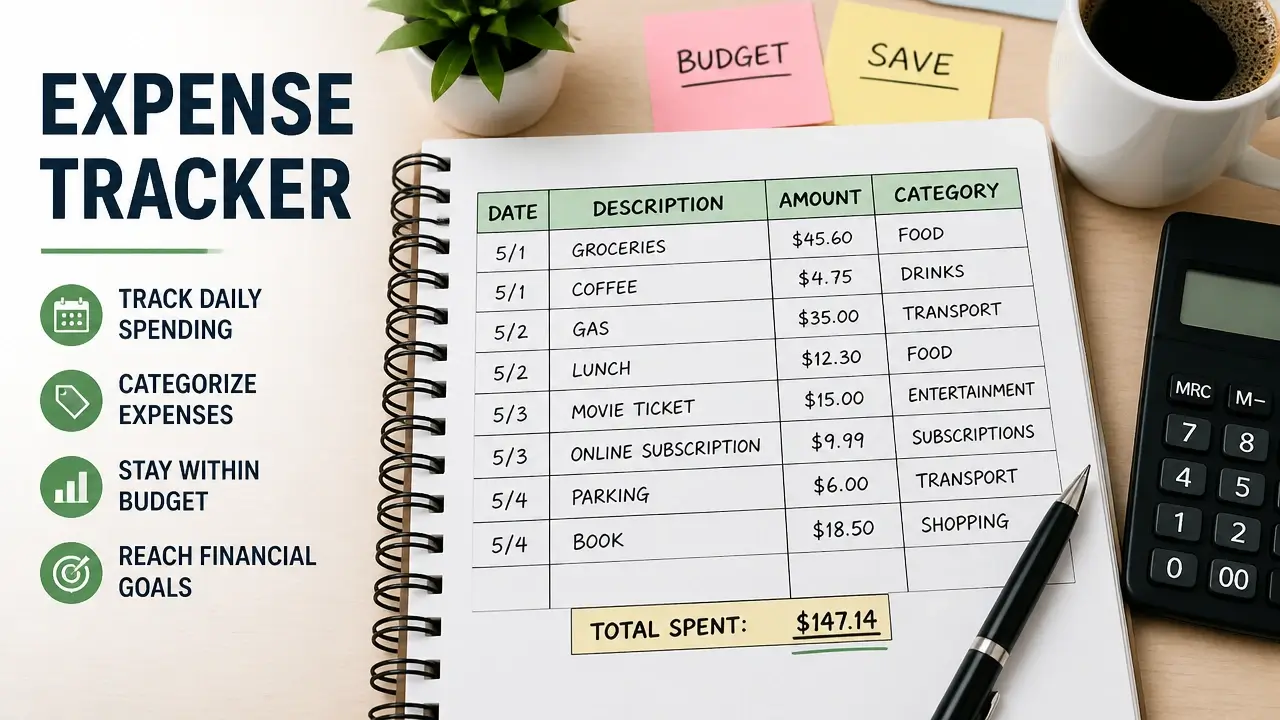
Once you have the data, set up your tracker with four columns: Date, Description, Amount, Category. That’s it. In a spreadsheet, this is a new tab with four headers. In an app, these fields exist by default. In a notebook, rule four columns across the page.
Here’s what a completed row looks like in practice:
| Date | Description | Amount | Category |
|---|---|---|---|
| June 3 | Starbucks | $6.50 | Food |
| June 4 | Shell Gas Station | $52.00 | Transportation |
| June 5 | Netflix | $15.49 | Subscriptions |
The goal for this step is to enter the entire previous month’s data in one sitting. Block thirty to sixty minutes, make a coffee, and treat it as a one-time setup task. This session gives you your baseline – the factual snapshot of what one month actually looked like before you changed anything.
Here’s a reference template showing what a clean tracker setup looks like before you start entering data:
The research on self-reported cost diaries supports the feasibility of this approach. Researchers in Cost-Effectiveness and Self-Reporting Methodologies found in the Journal of Clinical Epidemiology that:
“Of the chronic… patients, 85% completed at least one diary booklet (4 weeks)… This cost diary allows for the estimation of direct and indirect costs… We have examined the feasibility, data collection period, and aspects of construct validity”
Eighty-five percent completion over four weeks – for a chronic patient population managing complex medical expenses – suggests that when the recording system is simple enough, most people follow through. A four-column table is about as simple as it gets.
Step 3: Categorize Your Spending Without Overcomplicating
Spending categories are the lens that turns a list of transactions into a readable picture – but the lens only works if it’s simple enough to use every time you sit down.
Start with two master groups: Essential (housing, utilities, basic groceries, insurance – the bills that exist whether you like it or not) and Flexible (eating out, entertainment, shopping, subscriptions you could cancel). Under those two groups, aim for no more than four to six sub-categories total. A practical starting set: Housing, Transportation, Food, Utilities, Fun, Subscriptions.
The goal isn’t accounting precision. It’s finding the spending leaks – the places in your Flexible category where money drains faster than you realized. That’s where the useful information lives.
As you log each transaction, assign it a category before moving to the next one. Don’t batch-categorize at the end – you’ll lose context and start guessing.
Research from the Journal of Economic Behavior & Organization on budgetary categories confirms how universal this approach is among people who actually stick with budgeting:
“Third, nearly all individuals who budget do so by tracking their spending within distinct categories of consumption… We find that over 90 percent of individuals who budget report doing so using budgetary categories… individuals fail to treat funds as fully fungible across such budgetary categories”
The categories create psychological containers. Money in “Fun” feels different from money in “Housing,” even when the dollar amount is identical – and that friction is exactly what makes tracking useful.
Here’s where most beginners go wrong: they believe more categories means more control. In practice, people who stick with tracking for more than three months consistently report using only three to five high-level categories. Ten or more categories creates analysis paralysis – you spend more time deciding where a transaction belongs than you do learning from the data. If you feel stuck, merge everything into just three buckets: Needs, Wants, and Debt/Savings. You can always break them down later once the logging habit is solid.
Step 4: Build a Weekly Routine You’ll Actually Keep
A tracking system that only gets used when you feel motivated isn’t a system – it’s a project. The difference between people who track for three months and people who track for three years is a repeating structure that runs on schedule, not on willpower.
The routine has three layers, each calibrated to a realistic time investment. The structural prerequisites – a buffer account and a way to handle variable income – are what keep that routine standing when life stops being predictable.
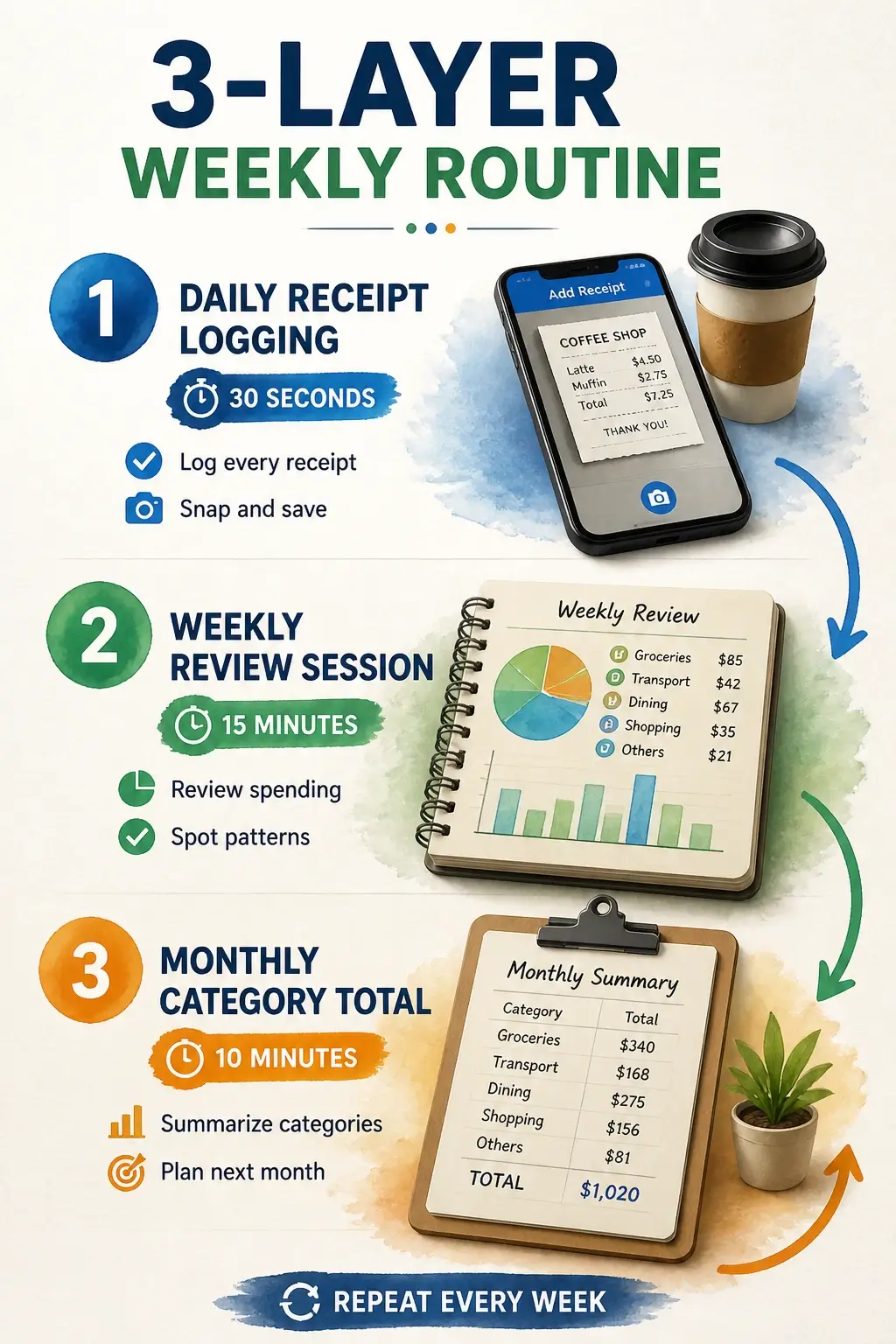
The Three-Layer Weekly Routine for Consistent Expense Tracking
The weekly tracking routine works in three tiers – daily, weekly, and monthly – and each layer does a different job.
Daily (30 seconds): Save every receipt or jot a cash purchase in your phone notes immediately after spending. You’re not categorizing yet – just capturing the raw data before it disappears.
Weekly (15 minutes): Every Sunday, open your tracker and log the week’s transactions from your statements and notes. Match each one to a category. This is the non-negotiable anchor of the whole system. Missing one week is recoverable. Missing two consecutive weeks is where most people quietly quit.
Monthly (10 minutes): Total each category. Look at the numbers without judgment. You’re not making decisions yet – you’re reading the data.
Set a recurring phone or calendar alert for the same time every Sunday. The specific time matters less than the consistency. If you use a bank’s auto-categorization feature, still do the weekly review – banks mislabel transactions regularly, and a miscategorized expense silently corrupts your data over time.
For a visual summary of how the three layers fit together:
Research on low-burden self-reporting methods reinforces why the weekly cadence works better than daily full-entry systems. Nutritional and Epidemiological Methodology Experts studying low-income household expenditure found in Frontiers in Nutrition:
“To capitalize on the detailed information possible… while reducing participant burden, a simple version of the annotated food receipt method… was developed… Participants are not required to transcribe all purchase information… instead, they annotate items… directly on the receipts. All receipts were to be mailed… on a weekly basis”
The weekly batch approach – capture daily, process once a week – consistently outperforms daily full-entry systems on adherence. The daily step is light enough to be automatic. The weekly step is infrequent enough to feel manageable.
Structural Prerequisites: Buffer Accounts and Rolling Income Averages
A solid routine only works if your system doesn’t break every time life isn’t perfectly predictable – which is always.
The buffer account is the prerequisite that experienced trackers rely on but guides rarely mention. Keep a separate savings account with a small standing balance – even $200 to $500 to start. When an unexpected expense hits (a car repair, an irregular annual bill), you pay it from the buffer, not from your tracked spending money. This absorbs the shock without disrupting your categories or your weekly routine. You rebuild the buffer gradually over the following weeks.
For anyone with variable income – freelancers, people who earn tips or commissions, anyone whose monthly take-home fluctuates – traditional monthly budgeting creates a structural problem. A month where you earned $4,000 looks nothing like a month where you earned $2,200, and forcing a fixed budget onto both creates constant recalibration.
The fix is to track a rolling three-month average of your income and use that figure as your spending ceiling, not the actual income from any single month. This smooths the feast-and-famine cycle. In a high-income month, the surplus rebuilds your buffer. In a low-income month, you’re spending against the average rather than panicking. The tracking routine stays the same regardless of what came in.
The 4 Biggest Tracking Mistakes and How to Fix Them
Even with a clear system, most beginners hit the same four walls – and most of those walls are predictable enough to clear before you reach them.
Dr. Sean A. Munson, Expert in Human-Centered Design and Self-Tracking Routines, identified the root cause precisely:
“failure to elicit goals can lead to ineffective tracking routines, breakdowns in collaboration… increased burdens, and even designs that encourage behaviors counter to a person’s goals. We urge researchers and designers to start with people’s goals, then provide scaffolding to support selection and configuration of tools to meet those goals”
The tracking mistakes below aren’t character flaws – they’re design mismatches between a generic system and a specific life. Here’s how to close the gap.
The Three Most Common Beginner Tracking Mistakes
Beginner tracking mistakes cluster around three predictable patterns, and each one has a mechanical fix that doesn’t require more discipline.
Forgetting cash transactions. Cash disappears from memory within hours. The fix isn’t better recall – it’s capturing the transaction before you leave the store. Either take a photo of the receipt or open your phone notes and type the amount and merchant immediately. The moment you step outside, the detail starts fading.
Aiming for perfection. Missing a $5 coffee won’t ruin your finances or your data. The beginner instinct is to feel that an incomplete log is a failed log – and that feeling is what causes people to stop entirely. The fix: if you forget a transaction, make your best guess on the amount and category, log it, and move on. In the first three months, consistency matters far more than precision. An approximate record you maintain is worth ten times more than a perfect record you abandon.
Judging too early. Cutting spending in week one based on incomplete data is like reading two chapters of a book and writing the review. You don’t have enough information yet. The first full month is observation only – you’re building the baseline, not changing behavior. The changes come after you’ve seen the complete picture.
Advanced Pitfalls: Inconsistency, Category Overload, Spousal Non-Participation, and Variable Income
Advanced tracking pitfalls tend to show up in the second and third month, once the initial motivation has worn off and real life starts applying pressure.
The “I forgot to log” death spiral. If you cannot sustain a consistent logging habit, stop fighting the habit and change the structure instead. Return to the daily cash envelope method from Step 1. Pre-fund a fixed daily cash limit for discretionary spending. When the cash is gone, spending stops. There’s nothing to log because the physical cash does the accounting for you.
Category overload. Creating fifteen categories feels thorough. It’s actually a trap. The more categories you have, the more every logging session becomes a decision session – and decision fatigue is what kills the weekly routine. Drop to three buckets: Needs, Wants, and Savings/Debt for the first two months. This alone is enough to prevent abandonment. Add detail later, when the habit is automatic.
Spousal or partner non-participation. If one person tracks and the other doesn’t, shared expenses become a black hole. The practical fix: set up a joint buffer account for shared household costs (groceries, utilities, rent), and give each partner a single dedicated credit card for their personal discretionary spending. Each person tracks only their own card. Shared expenses are funded from the joint account, which you review together once a month. The system doesn’t require both people to have the same tracking habits – it just requires that shared money flows through one visible place.
Variable income mismatch. A fixed monthly budget assumes a fixed monthly income. For anyone whose income fluctuates, that assumption breaks the system. Use the three-month rolling income average and the buffer account described in Step 4. Your spending ceiling is the average, not last month’s actual deposit. Surplus months rebuild the buffer. Lean months draw from it. The tracking routine runs unchanged either way.
Here’s the benchmark that tells you the system is working: after three months, if you haven’t overdrafted, you can name where your money goes, and logging feels automatic rather than effortful – you’re done building the foundation. That’s the ground a real, functional budget is built on.
Key Takeaways on Tracking Expenses
- Tracking expenses must come before budgeting – you can’t plan where money should go until you know where it currently goes.
- The first month is observation only; no spending cuts, no judgment, just building an accurate baseline.
- The best tracking method is the one you’ll sustain for 30 days, not the most popular app.
- A four-column tracker – Date, Description, Amount, Category – is all the structure you need to start.
- Limiting yourself to three to five spending categories prevents the analysis paralysis that causes most beginners to quit.
- A buffer account and a rolling income average are the two structural tools that keep your routine intact when life is unpredictable.
Frequently Asked Questions About Tracking Expenses
What’s the best way to track expenses if I spend mostly cash?
The most reliable method for cash-heavy spenders is to photograph every receipt before leaving the store, or type the amount and merchant into a phone note immediately after paying. Cash disappears from memory faster than any other transaction type, so the capture has to happen on the spot, not at the end of the day.
What is the 50/30/20 spending rule, and how does it relate to tracking?
The 50/30/20 rule suggests allocating 50% of after-tax income to needs, 30% to wants, and 20% to savings or debt repayment. It’s a budgeting framework, not a tracking system – you need at least one month of tracked spending data before you can honestly assess whether your current split matches those targets.
How long before tracking expenses actually changes my behavior?
Most people notice a shift in spending awareness within two to four weeks of consistent tracking, simply because the act of recording makes invisible habits visible. Meaningful behavior change – actually adjusting what you spend – typically follows in months two and three, once you have enough data to make decisions from.
Do I need to track every single transaction, or can I round up?
You don’t need to track every transaction with perfect precision in the early months. A reasonable estimate logged consistently is more useful than an exact record that you abandon because it feels like too much work. Consistency matters far more than accuracy during the first 90 days.
What if my partner refuses to participate in expense tracking?
You don’t need full household participation to make tracking work. Set up a joint account for shared expenses so that shared money flows through one visible place, and give each person a single card for their own discretionary spending. Each person tracks only their own card – the shared picture emerges from the joint account without requiring identical habits.
Can I track expenses if my income changes every month?
Yes, but don’t use a fixed monthly budget as your ceiling. Instead, calculate a rolling three-month average of your income and use that figure as your spending limit. Pair it with a buffer account to absorb the low months. The tracking routine itself stays the same regardless of what came in.
Is there a point where tracking expenses becomes unnecessary?
Tracking becomes less effortful over time, but it doesn’t become unnecessary. Most people who maintain financial stability long-term don’t stop tracking – they simplify it to a quick weekly review because the habit is automatic. The goal isn’t to track forever intensively; it’s to reach a point where the process takes almost no conscious effort.
What’s the difference between tracking expenses and making a budget?
Tracking is descriptive – it records what actually happened with your money. A budget is prescriptive – it sets targets for what should happen. Tracking comes first because a budget built without real spending data is based on assumptions, and assumptions rarely survive contact with a real month.
References
- Harkin, B. et al. – Frontiers in Psychology
- Chuang, L. et al. – Journal of Retailing and Consumer Services
- Feasibility of Cost Diaries in Chronic Patients – Journal of Clinical Epidemiology
- Budgetary Categories and Consumer Spending – Journal of Economic Behavior & Organization
- Annotated Food Receipt Method, Weekly Self-Reporting – Frontiers in Nutrition
- Munson, S.A. – Frontiers in Digital Health