

Disciplined zero-based budgeting works by giving every dollar you earn a specific job before you spend a single cent – rent, groceries, savings, debt payments, all of it – so that your income minus your planned outflows lands at exactly zero. Not zero in your bank account. Zero dollars left without a purpose.
Most budgeting systems let money drift. This one doesn’t. Once you understand the underlying mechanism, you can evaluate any budgeting tool or method on your own terms – and decide whether the control it delivers is worth the effort it demands.
Zero-Based Budgeting Is Not What You Think It Is
Zero-based budgeting is a monthly budgeting method where your total income minus every dollar you plan to spend, save, and invest equals exactly zero – not because your account is empty, but because no dollar is left without a purpose. That single distinction is the one most beginners get wrong, and getting it wrong is enough to make the whole system feel intimidating before you’ve written down a single number.
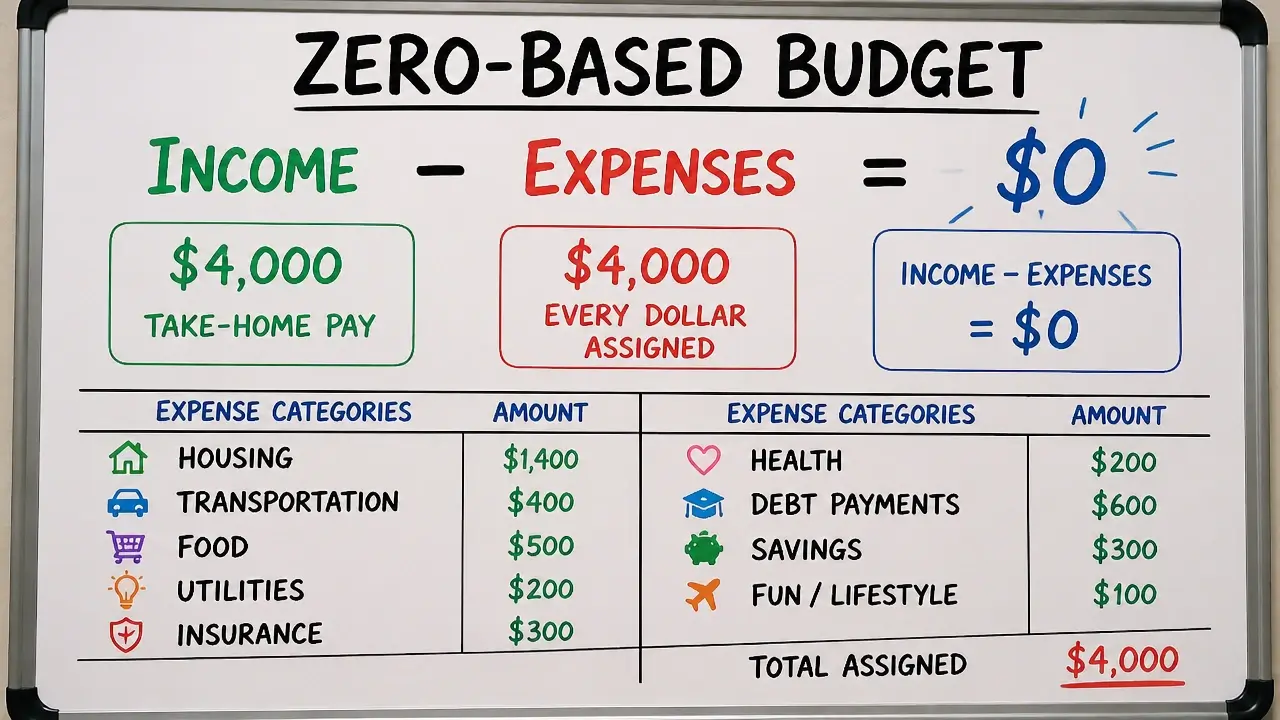
Here’s the misconception worth clearing immediately: a zero balance on your budget does not mean zero dollars in your checking account. You are not draining your bank. You are assigning every incoming dollar to a specific job before the month begins. Some dollars pay rent. Some pay down debt. Some go into an emergency fund. Some cover groceries. The point is that every single dollar has a named destination – and when you add up all those destinations, they equal your total income. That’s it. That’s the whole mechanism.
The mental model that makes this click is simple: think of yourself as the employer, and your dollars as employees. A good employer doesn’t let workers stand around with nothing to do. Every dollar on your payroll gets assigned a task. Rent gets $1,200. Groceries get $400. The vacation fund gets $150. The emergency fund gets $200. When every employee has a job description, nothing gets wasted on tasks you didn’t actually choose.
What separates zero-based budgeting from the system most people picture when they hear the word “budget” is the monthly reset. Traditional budgeting often rolls last month’s numbers forward – you had $400 for groceries before, so you have $400 again. Leftover money from one category bleeds into the next month without a deliberate decision. Zero-based budgeting doesn’t allow that. Every month, you start from scratch. Last month’s allocations are a reference point, not a template. You look at this month’s income, this month’s expected bills, and this month’s priorities – and you build a new plan from the ground up.
That reset is what makes the system feel like more work. It is more work. But it’s also why it produces different results.
Here’s what a basic zero-based budget looks like on paper:
The Five-Step Monthly Cycle That Makes It Work
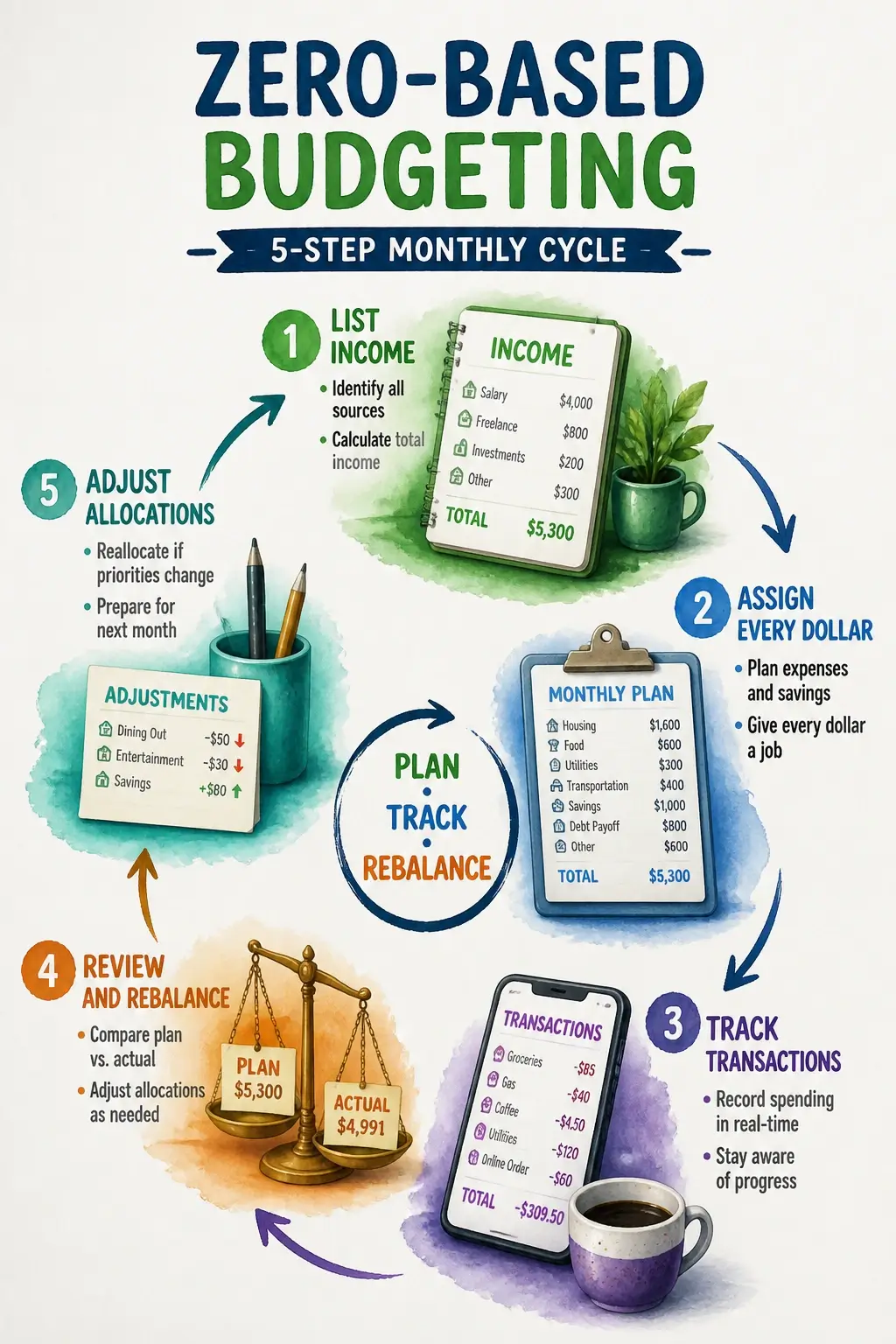
The monthly zero-based budgeting process starts with one number – your total take-home pay from all sources – and systematically assigns every dollar until nothing remains unallocated, touching savings goals and debt payments along the way before you’ve spent a cent. The cycle has five steps, and the order matters.
Step 1: Write down your total take-home pay. This is your after-tax, after-deduction income from every source – salary, freelance work, side income. If your income varies, use a conservative estimate. You can always add surplus dollars later; you can’t un-spend a shortfall.
Step 2: List every expected expense by category. Fixed expenses first – rent or mortgage, car payment, insurance, subscriptions. Then variable categories – groceries, utilities, gas, dining out, entertainment. Don’t filter yet. Just list.
Step 3: Treat savings goals and debt payments as non-negotiable expenses. This is the step that changes behavior more than any other. Most people save what’s left after everything else. Zero-based budgeting flips that. Your emergency fund contribution, your retirement account deposit, your extra debt payment – these are line items, same as rent. They get assigned before discretionary spending, not after. When saving is treated like a bill you owe yourself, it stops being optional.
Step 4: Adjust allocations until income minus all planned outflows equals zero. Add up everything you’ve assigned. If the total is less than your income, you have unallocated dollars – give them a job. If the total exceeds your income, you need to trim. Move through categories from lowest priority to highest until the math balances.
Step 5: Track every transaction throughout the month. A zero-based budget built on Sunday is only useful if you check it on Wednesday. Every purchase gets logged against its category. When a category runs low, you either stop spending in it or consciously move money from somewhere else – a deliberate choice, not a passive drift.
To make this concrete: a $3,500 monthly take-home pay might be divided as follows – rent $1,200, groceries $400, utilities $250, car payment $300, savings $350, extra debt payment $200, entertainment $150, gas $150, clothing $100, personal care $100, dining out $100, emergency fund contribution $200 – totaling $3,500. Every dollar accounted for. Nothing left to wander.
Here’s how the full cycle looks as a system:
What no blog about this process explicitly names is the feedback loop hiding inside step 5. Each month you track transactions forces you to confront where your dollars actually went versus where you planned for them to go. That confrontation creates awareness. And awareness – not willpower – is what actually changes spending behavior over subsequent months. This is why practitioners report the system gets easier after month three. It’s not that your budget numbers get more accurate, though they do. It’s that repeated exposure to your own spending patterns rewires what feels normal.
Jesse Mecham, the founder of You Need A Budget and architect of one of the most widely used zero-based budgeting systems in the world, puts it directly:
“Zero-based budgeting is an active budgeting process. It forces you to make decisions before you spend a single cent. Because you are allocating current or expected income step-by-step down to zero, you cannot passively default to spending; you must intentionally choose where every dollar is directed.”
That word – passively – is the key. Most financial friction happens when people spend by default. Zero-based budgeting makes default spending structurally impossible, because every category already has a ceiling before the month begins.
Who Zero-Based Budgeting Actually Serves Well
Zero-based budgeting is not a universal solution, and the financial goal you’re chasing matters as much as your personality when deciding whether this system fits your life. The honest answer is that it works exceptionally well for some people in some situations – and creates genuine friction for others, with no moral weight attached to either outcome.
When the Effort Pays Off
Predictable monthly income, a specific financial target, and genuine willingness to spend 30 to 60 minutes per week tracking transactions – those three factors together describe the ideal zero-based budgeting candidate. The system is built for someone who wants precise control, not approximate guidance.
The situations where zero-based budgeting delivers the clearest return on effort are moments of financial change or financial urgency. A new job that changes your income. A marriage that merges two spending patterns. A new baby that reshapes every category. Aggressive debt reduction where you need to squeeze every available dollar toward payoff. Saving for a near-term goal – a house down payment, a car, a wedding – where the target is specific and the timeline is real. Recovering from a stretch where money felt out of control and you genuinely don’t know where it went.
In all of these situations, the monthly rebuild isn’t a burden – it’s the point. The act of sitting down and deliberately assigning every dollar is what makes the system work. Freelancers with variable income can also benefit, provided they build their budget around a conservative income floor and treat any surplus as a category to fill, not money to spend.
Where the System Creates More Problems Than It Solves
High expense variability is where zero-based budgeting’s rigid structure starts to work against the user rather than for them. The system assumes you can predict your monthly outflows with enough accuracy to assign every dollar a job. When your bills don’t cooperate – when utilities swing by season, when rent includes variable water and sewage charges, when car repairs arrive unannounced – forcing those numbers into a zero-balance framework creates distress that no amount of budgeting discipline resolves.
The tradeoff is real and worth naming plainly: zero-based budgeting exchanges convenience and mental ease for precise control and accelerated goal progress. A percentage-based system like 50/30/20 asks less of you each month and tolerates more variability. Zero-based budgeting asks more and delivers more – but only if your financial situation allows you to actually use what it delivers. Neither choice is superior. They serve different people at different stages.
A JPMorgan Chase Institute analysis of real household transaction data found that 89% of U.S. households experience month-to-month income volatility exceeding 5%, and that mid-income families regularly see expense spikes of more than 30% above their baseline month – medical bills, car repairs, clustered annual payments arriving at once. For those households, the assumption that monthly outflows are stable enough to zero out is not just optimistic; it’s structurally wrong. The system doesn’t fail them – the guidance around how to adapt it does.
Research synthesized by the Pew Charitable Trusts and TD Bank Group on income volatility and financial planning makes the practical consequence clear:
“While zero-based budgeting is incredibly efficient for predictable income, it can introduce real friction and stress for households experiencing highly volatile incomes or variable, unpredictable bills. When you have no buffer and your income fluctuates, trying to force every dollar into a rigid zero-based plan can make you feel like you are constantly failing.”
That feeling of constant failure is a system-fit problem, not a personal discipline problem. Recognizing the difference is what separates a useful financial tool from a source of ongoing stress.
The Real Downsides No One Warns You About
Zero-based budgeting’s most frequently cited challenges – the time burden, the learning curve, the psychological weight – are real, and understanding them before you start is the difference between building a durable habit and abandoning the system after six weeks. These are not reasons to avoid the method. They are the specific friction points you’ll need strategies to manage.
The time commitment is not optional. Zero-based budgeting requires you to rebuild your budget from scratch each month and log every transaction throughout. This is not a set-it-and-forget-it system. People who find detailed financial administration mentally exhausting will burn out – not because they lack discipline, but because the system’s value comes precisely from the attention it demands. If you’re unwilling to spend 30 to 60 minutes per week on money admin, a simpler system will serve you better long-term than an abandoned zero-based one.
The scarcity mindset is a documented side effect. Some users report that assigning every dollar to a category creates a feeling of restriction even when they’ve budgeted generously for discretionary spending. Reddit communities describe this as “moving Monopoly money around” – the sensation that every purchase requires mental permission even when the budget fully allows it. This is a real psychological response, not a sign that the budget is wrong. It tends to fade after two to three months once the system starts feeling like a tool rather than a constraint.
The first three months are a calibration period, not a test you pass or fail. Most beginners significantly underestimate at least one or two variable categories in their first budget. Groceries run over. Gas costs more than expected. The budget doesn’t hit zero cleanly – it requires mid-month adjustments. This is not failure. This is the feedback loop working exactly as designed. The goal of month one is building the tracking habit, not perfect allocation accuracy.
The buffer problem is where expert advice diverges sharply from practical reality. Standard guidance from sources like Ramsey Solutions recommends keeping $100 to $300 in your checking account as an overdraft cushion. That number assumes near-zero expense variability – a condition that research on household utility costs confirms does not apply to most households. Practitioners who actually live with fluctuating bills converge on $500 to $1,000 minimum, or 10 to 15% of monthly income, as a working buffer. For a household earning $4,000 per month, that’s $400 to $600 – roughly double the expert ceiling. This is not a flaw in zero-based budgeting itself. It’s a gap between published guidance and the financial reality most households actually face.
The ceiling risk is the mechanical error no beginner is warned about. If you budget the maximum possible amount for every variable category simultaneously – worst-case groceries, worst-case utilities, worst-case gas – you may create a budget that looks balanced on paper but exceeds your actual income when all the worst-case scenarios land in the same month. Before finalizing any zero-based budget, sum your worst-case allocations across all categories and verify the total stays below your take-home pay. If it doesn’t, you need to trim lower-priority categories. The math has to work in the worst case, not just the average case.
Dr. Frank P. Buffa, whose research spans financial operations and decision sciences, describes this tension precisely:
“The empirical data shows that participating in detailed household financial management activities like category-level budgeting is consistently associated with higher immediate levels of psychological stress and cognitive load, driven by the significant time commitment and the discomfort of facing financial realities. However, this friction is the exact mechanism that delivers long-term well-being and prevents overspending.”
The friction is not a bug. But you should know it’s coming.
Zero-Based Budgeting vs. the 50/30/20 Rule
Two budget styles dominate the personal finance conversation – zero-based budgeting, which assigns every dollar to a named purpose, and the 50/30/20 rule, which divides income into three broad percentage buckets – and the difference between them is not complexity for its own sake but a fundamental choice about how much control you want over where your dollars go. Understanding the structural distinction is what lets you pick the right tool rather than the popular one.
The 50/30/20 rule works like this: 50% of your after-tax income goes to needs (housing, utilities, food, transportation), 30% goes to wants (dining out, entertainment, subscriptions, travel), and 20% goes to savings and debt repayment. The categories are intentionally broad. The system asks you to stay inside the guardrails, not to track every line item.
The contrast with zero-based budgeting is direct. Under 50/30/20, leftover money within a category sits unassigned – if you spend only $800 on needs in a $1,750 needs bucket, the remaining $950 doesn’t automatically go anywhere purposeful. Under zero-based budgeting, that surplus gets explicitly redirected before the month begins. Nothing drifts.
Here’s how the same $3,500 monthly take-home pay looks under each system:
Under 50/30/20: $1,750 to needs, $1,050 to wants, $700 to savings and debt – three numbers, no further specificity required.
Under zero-based budgeting: rent $1,200, groceries $400, utilities $250, car payment $300, emergency fund $200, vacation savings $150, extra debt payment $200, entertainment $150, dining out $100, gas $150, clothing $100, personal care $100, subscriptions $50, buffer $150 – fourteen named categories, every dollar accounted for, savings split by purpose rather than lumped into a generic 20%.
That difference in specificity is the mechanism. The 50/30/20 rule tells you what you should spend in broad buckets but doesn’t prevent category-specific leaks within them. Zero-based budgeting forces micro-level accountability – which is why it tends to accelerate goal progress but demands more administrative effort to sustain.
The table below maps both systems across the dimensions that matter most for a practical decision:
| Dimension | Zero-Based Budgeting | 50/30/20 Rule |
|---|---|---|
| Core mechanism | Dollar allocation – every dollar assigned a specific job | Percentage guardrails – income divided into three broad buckets |
| Level of detail | Category-level (14+ named categories) | Bucket-level (3 categories) |
| Best-fit user | Pursuing aggressive goals; needs accountability | Wants simplicity; trusts themselves within broad limits |
| Monthly time commitment | 2–4 hours (rebuild + weekly tracking) | 30–60 minutes (periodic check-in) |
| Flexibility for variable expenses | Low – requires workarounds for fluctuating bills | High – wide buckets absorb variability naturally |
| Savings specificity | Named by purpose (emergency fund, vacation, etc.) | Lumped into generic 20% savings/debt category |
| Learning curve | Steep – 2–3 month calibration period | Shallow – usable immediately |
The Government Finance Officers Association’s Financial Planning Analysis Team draws the structural line clearly:
“Unlike percentage-based models like the 50/30/20 rule, which prioritize convenience and broad-bracket categorization, zero-based budgeting delivers absolute control. Percentage budgets tell you what you should spend in broad buckets, but they fail to prevent category-specific leaks. ZBB forces micro-level accountability, though it requires significantly more administrative effort.”
One practical note worth holding onto: these systems are not mutually exclusive. Some practitioners use 50/30/20 as a sanity check on their zero-based allocations – if their ZBB budget has 60% going to needs, that’s a signal to investigate. Others start with 50/30/20 for six months and migrate to zero-based budgeting once they have a specific financial target demanding tighter control. The tool serves the goal. The goal doesn’t serve the tool.
How to Start Your First Zero-Based Budget This Weekend
The zero-based budgeting workflow you actually build this weekend is more useful than the perfect system you plan to build next month – and the starting point is simpler than most guides make it sound. Pick the format that matches how you already work, gather two hours, and follow the sequence below.
Three Pathways Based on How You Work
The app person wants guided structure and automatic transaction tracking. Two tools dominate this space:
- YNAB (You Need A Budget) – purpose-built for zero-based budgeting, with a methodology that matches the five-step cycle exactly. The learning curve is real – expect to spend an hour on the tutorials before your first budget feels natural. Worth it if you want the system to do the heavy lifting on categorization and reporting.
- EveryDollar – simpler interface, Ramsey-aligned, free tier available for manual entry. Less feature-rich than YNAB but easier to start in one sitting.
The spreadsheet person wants manual control without vendor lock-in or subscription fees. A Google Sheets or Excel template with three columns – Expected Income, Planned Allocation, and Actual Spending – is all the infrastructure you need. Dr. Michael Bommer, whose research focuses on optimized financial planning and planning-budgeting-control systems, confirms this directly:
“For those who prefer spreadsheets over apps to avoid recurring subscription fees, a basic Microsoft Excel or Google Sheets template with columns for ‘Expected Income’, ‘Planned Allocation’, and ‘Actual Spending’ is highly effective. It keeps the cognitive load low while retaining the core mathematical discipline of bringing the unassigned balance to exactly zero.”
Free templates are widely available. Search “zero-based budget Google Sheets template” and pick one with a running balance that shows how many dollars remain unallocated as you fill in categories.
The tactile person wants something physical and visceral. The cash envelope system works: withdraw your budgeted amount for each variable category in cash at the start of the month, place it in labeled envelopes, and stop spending when an envelope is empty. It’s impossible to overspend a category when there’s literally no money left in the envelope. No app required.
If you’d like to see the spreadsheet approach built in real time before you start your own, this walkthrough covers the full setup from scratch:
The Weekend Action Plan
Saturday morning: Write down your total take-home pay for the coming month. Then list every fixed bill – rent, car payment, insurance, subscriptions, loan minimums. These numbers don’t change. Get them on paper first.
Saturday afternoon: Pull up the last three months of bank statements and estimate your variable categories – groceries, gas, utilities, dining out, entertainment, clothing. Don’t use what you wish you spent. Use what you actually spent, averaged across three months. This is your baseline.
Sunday: Assign every dollar. Add savings as a named line item – not “savings” but “emergency fund,” “vacation,” “new car,” whatever the actual purpose is. Adjust until income minus all allocations equals zero. If you have leftover dollars, give them a job. If your total exceeds your income, trim from the lowest-priority categories until the math balances.
The Variable-Expense Workaround Beginners Actually Need
The practical issue that derails most first budgets is variable categories that refuse to cooperate with a fixed plan. Utilities swing by season. Gas costs vary by week. Groceries rarely land on the exact number you estimated.
The practitioner-validated fix is straightforward: budget the highest expected amount for each variable category, not the average. If your electric bill ranges from $90 to $150, budget $150. When the actual bill comes in at $110, the remaining $40 stays in that category and accumulates as a self-funding buffer for the months when costs spike. This solves both the mechanical problem (variable bills breaking your zero balance) and the psychological problem (feeling like you’re failing when reality doesn’t match the plan).
Before you finalize your first budget, do one final check: add up your worst-case allocations for every variable category simultaneously and confirm the total doesn’t exceed your take-home pay. If it does, trim lower-priority categories. The math has to work in the worst case, not just on an average month.
What to Expect in Month One
Your first budget will be wrong. Some categories will run out early. Others will have money left over. This is calibration, not failure. The goal of month one is not a perfect zero – it’s building the habit of checking your budget before you spend and adjusting when reality diverges from the plan.
By month three, your budget numbers will be closer. By month four or five, the tracking habit will feel automatic rather than effortful. That’s when the behavioral shift Mecham describes – the inability to spend passively – becomes your default mode rather than a conscious practice.
Zero-based budgeting is a tool. If it helps you direct money toward what matters to you, it’s working. If it creates constant stress without visible progress, a different system may serve you better – and recognizing that is not a failure. It’s a well-calibrated financial decision.
Key Takeaways on Zero-Based Budgeting
- Zero-based budgeting means every dollar of income has a named purpose before the month begins, not that your bank account reaches zero.
- The five-step monthly cycle ends with every dollar assigned – savings and debt payments are treated as non-negotiable expenses, not afterthoughts.
- The system works best for people with predictable income, specific financial goals, and willingness to track transactions weekly.
- Households with high expense variability need a buffer of $500 to $1,000 minimum – not the $100 to $300 most expert sources recommend.
- Zero-based budgeting and the 50/30/20 rule serve different needs: one delivers precision and accountability, the other delivers simplicity and flexibility.
- Month one is a calibration period, not a performance test – the behavioral shift the system produces typically takes two to three months to feel natural.
Frequently Asked Questions About Zero-Based Budgeting
What exactly does “zero” mean in zero-based budgeting?
Zero refers to the unassigned dollar balance at the end of your planning process – not your bank account balance. Every dollar of income gets a named job, so when you subtract all planned outflows from your income, nothing is left without a purpose.
What happens if I spend more than I budgeted in one category?
You move money from a lower-priority category to cover the overage – a deliberate transfer, not a failure. This conscious reallocation is actually the system working correctly; it forces you to decide what you’re willing to give up rather than letting the overage disappear silently.
Can you use zero-based budgeting with irregular or freelance income?
Yes, but you build the budget around a conservative income floor – your lowest expected monthly take-home – and treat any income above that as a surplus to allocate once it arrives. This prevents you from committing dollars that haven’t materialized yet.
Does zero-based budgeting work for couples or households with two spenders?
It works, but only if both people check and update the same budget in real time. The system breaks down when one partner spends against a category the other has already depleted – coordination and a shared tracking tool aren’t optional, they’re structural requirements.
How is zero-based budgeting different from just tracking your spending?
Tracking records what already happened. Zero-based budgeting assigns dollars before anything happens. Tracking tells you where money went; zero-based budgeting decides where money goes – the direction of causality is the entire difference.
What should I do with money left over at the end of the month?
Give it a job before the next month starts. Redirect it to your emergency fund, accelerate a debt payment, or create a new savings category. Leaving it unassigned defeats the core mechanism of the system.
Is zero-based budgeting worth it if I’m already saving 20% of my income?
Possibly not, unless you have a specific goal that demands tighter control than a percentage-based system provides. If your current system is working and you’re hitting your targets, adding the administrative overhead of zero-based budgeting may cost more in time and stress than it returns in precision.
How long does it take to build a zero-based budget each month?
The first month takes two to four hours spread across a weekend. Once your categories are established and your estimates are calibrated, subsequent months typically take 30 to 60 minutes to rebuild, plus 10 to 15 minutes per week for transaction tracking.
References
- YNAB Financial Methodology Guides – ynab.com
- Household Cash Flow Management: Aligning Income and Expenses – householdfinanceauthority.com
- The Role of Income Volatility and Perceived Locus of Control in Financial Planning Decisions – frontiersin.org
- Journal of Economic Behavior & Organization – sciencedirect.com
- Journal of Financial Counseling and Planning / Managing Household Finances – mdpi.com
- Computers, Environment and Urban Systems (ZBB Comparison Models) – sciencedirect.com
- Average Utilities Cost for an Apartment – leaserunner.com
- Government Finance Officers Association Financial Planning Resources – gfoa.org
- MDPI Financial Planning (Individual Budgeting Models) – mdpi.com