
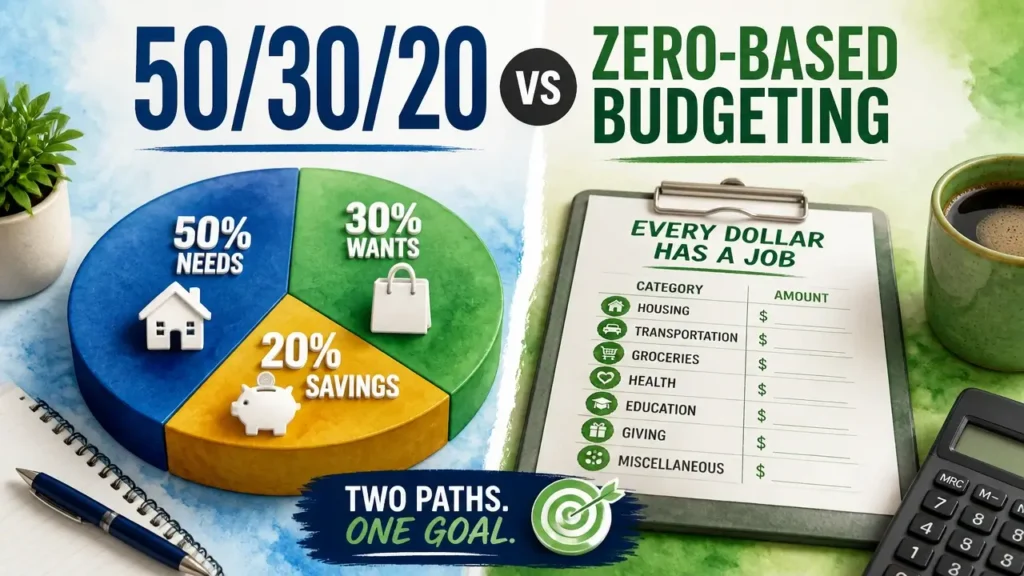
Competing budgeting methods like the 50/30/20 rule and zero-based budgeting aren’t separated by complexity – they’re separated by the kind of control they hand you. One allocates your after-tax income into three broad buckets and steps back. The other assigns every single dollar a job before the month begins.
The gap between them isn’t a matter of one being better. It’s a matter of which structural logic matches how you actually live, earn, and think about money. Get that match right, and either system works. Get it wrong, and even the “perfect” method collapses inside 60 days.
To make these systems stick, finding a tool that aligns with your personality is key, and exploring the best budgeting apps for beginners can help you build that consistency early on.
Two Budgeting Philosophies: Compass vs. Engine
Structured budgeting methods divide cleanly into two operational categories, and the 50/30/20 rule and zero-based budgeting sit at opposite ends of that spectrum. The 50/30/20 rule splits your after-tax income into three fixed buckets – Needs at 50%, Wants at 30%, and Savings plus debt repayment at 20% – functioning as a macro guideline rather than a transaction-by-transaction tracker. Zero-based budgeting works the opposite way: you assign every dollar of income a specific job until income minus all outflows equals zero, making it a micro-level, transaction-aware system from day one.
The most useful thing to understand early is that these aren’t competing philosophies where one must win. One is a compass that tells you whether you’re roughly on course. The other is zero-based budgeting, which tells you exactly what every part is doing at any moment. Some people need a compass. Some need an engine. Many, eventually, need both working in tandem.
Before going further, there’s a classification error that quietly breaks the 50/30/20 rule for a lot of intermediate budgeters: minimum debt payments – the required monthly floor on a student loan or credit card – count as Needs, not Savings. Extra principal payments above that minimum count as Savings. Getting this wrong inflates your Needs bucket and shrinks your Savings allocation without you ever noticing, and the ratio appears to hold while your actual savings rate quietly erodes.
There’s also a structural reality check that applies before you even start. If you live in a high-cost city and housing alone consumes 40–45% of your net income, the 50% Needs cap is already under pressure before you’ve paid for utilities, groceries, or transportation. At that point, the 50/30/20 split becomes a 60/20/20 by necessity – or some other custom ratio. The rule doesn’t break, but its simplicity advantage does.
Zero-based budgeting has a distinct superpower that’s often undersold: sinking funds. Instead of being blindsided by a $900 car insurance renewal in October, you divide that annual bill by 12 and park $75 into a dedicated category every month. Irregular, non-monthly expenses get smoothed into predictable monthly allocations. This is what gives ZBB genuine visibility into your actual cost of living – not just the bills that hit on the same date each month.
The rest of this article compares these two budgeting methods across four specific dimensions: time investment, flexibility for irregular expenses, best income type, and psychological fit. By the end, you’ll have a framework for building the version that fits your current life – not a verdict on which method is universally superior.
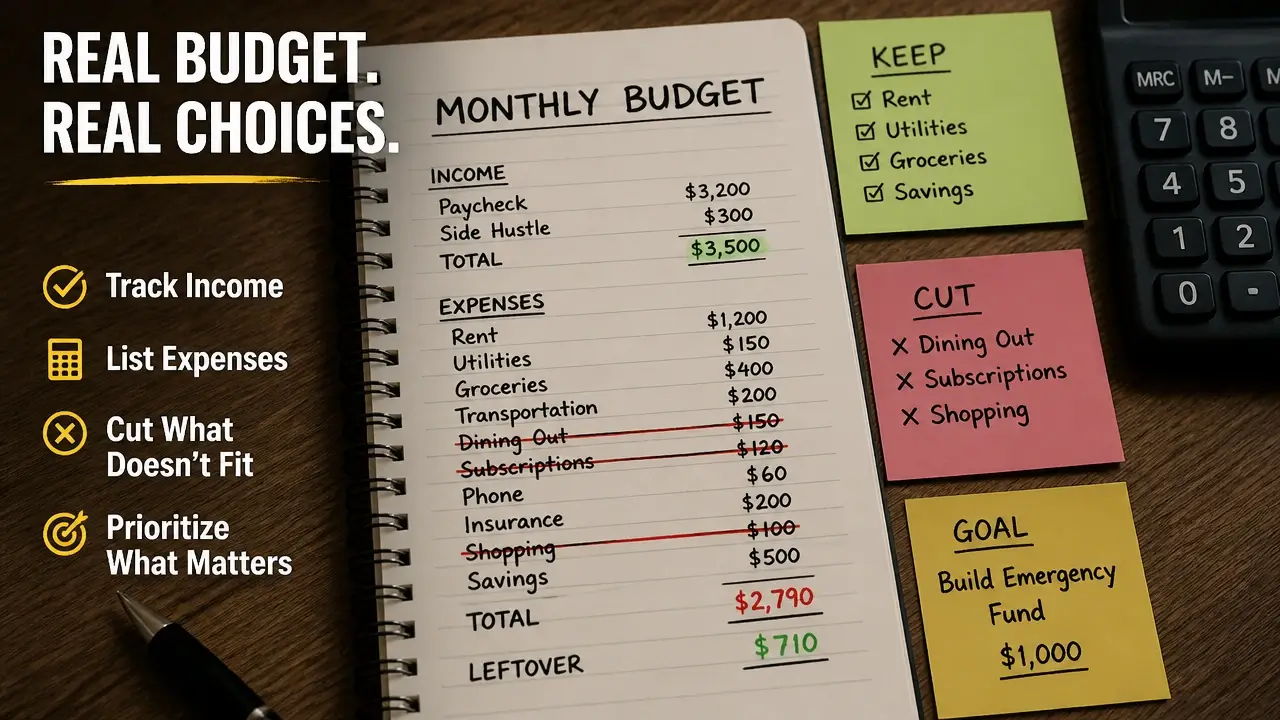
Here’s what the planning process looks like in practice before any system takes hold:
Head-to-Head: Time, Flexibility, Income, and the Psychology of Tracking
The four dimensions that actually determine whether a budgeting method survives contact with real life aren’t discussed in most comparisons. Most guides stop at definitions. What follows is where the structural differences become personal – and where the hidden failure modes live.
Time Commitment and Irregular Expense Handling
Time investment is the first place the two budgeting methods diverge in ways that compound over months. The 50/30/20 rule is administratively light: check three buckets once a month, adjust if something looks off, move on. Realistically, that’s 10 minutes a month for someone with a stable income and predictable bills. Zero-based budgeting requires categorizing every transaction, reconciling to zero before the month starts, and revisiting the plan mid-month when reality deviates from the projection. Budgeters who use ZBB seriously report spending 30–60 minutes per week on the system – not as a complaint, but as a feature they’ve accepted.
The flexibility dimension reveals a structural asymmetry. ZBB’s sinking funds category system handles irregular expenses with precision: a dedicated allocation for car registration, annual subscriptions, holiday spending, and medical deductibles means those costs are already funded before they arrive. The 50/30/20 rule, operating at the level of three broad buckets, leaves irregular bills invisible inside the Needs or Wants category until they appear. When a $600 dental bill hits in a month where the Wants bucket is already spent, the reactive move is to raid Savings – which is exactly the behavior the rule was supposed to prevent.
The high-cost-of-living distortion matters here too. When housing pressure forces the Needs bucket to 55–60% of net income, the Wants and Savings buckets compress proportionally. At that point, the 50/30/20’s simplicity advantage – the thing that made it appealing – disappears, because you’re now manually overriding the ratios anyway. You’ve kept the framework but lost the ease.
Here’s how the two methods compare across these practical dimensions:
| Dimension | 50/30/20 Rule | Zero-Based Budgeting |
|---|---|---|
| Time commitment | ~10 min/month | 30–60 min/week |
| Setup complexity | Low – three buckets | High – full category mapping |
| Irregular expense handling | Reactive (bucket raiding) | Proactive (sinking funds) |
| HCOL distortion effect | Breaks ratio, erases simplicity advantage | Unaffected – works on actual dollars |
| Mid-month adjustment | Rarely needed | Built into the process |
Income Stability, Psychological Fit, and Hidden Failure Modes
Income stability functions as a hard gate, not a soft preference, when choosing between these budgeting methods. The 50/30/20 rule’s percentage structure assumes a predictable monthly take-home – it’s built around the idea that 50% of this month’s income looks roughly like 50% of last month’s income. When income is variable – freelance work, commission-based sales, gig economy earnings, or seasonal employment – those percentages become meaningless until the month is over and you can calculate what they represented. You’d be planning in percentages against a number you don’t yet know.
Zero-based budgeting solves this structurally. You budget only the dollars already in your account, paycheck by paycheck. You don’t project a monthly total and divide it – you allocate what arrived, cover fixed obligations first, and distribute the remainder. This makes ZBB functionally compatible with variable income in a way the 50/30/20 rule simply isn’t.
The psychological dimension is where most budgeting advice gets soft and vague. Here’s the actual tension: ZBB delivers a sense of total control that detail-oriented personalities find genuinely satisfying. Seeing every dollar assigned and accounted for is not a chore for this type – it’s the point. The 50/30/20 rule provides freedom from micro-decisions, which is what simplicity-seeking personalities actually need. Checking three numbers once a month and confirming they’re in range is not laziness – it’s a sustainable budgeting method for someone who finds granular tracking exhausting.
But each method carries a specific failure mode that most guides don’t name directly.
For 50/30/20, the failure mode is Wants Creep: the broad bucket structure makes it easy to reclassify a gym membership upgrade, a streaming service addition, or a slightly nicer grocery habit as a Need rather than a Want. There’s no line-item accountability to catch it. Over months, the Needs bucket silently expands, the Wants bucket fills with actual wants that have been relabeled, and the 20% Savings allocation gets squeezed without any single decision triggering the alarm.
For ZBB, the failure mode is what behavioral evidence calls the granularity paradox. The very feature experts promote as ZBB’s strength – deep category specificity – is its most common failure trigger. When users create separate tracking categories for coffee, lunch, snacks, work meals, and entertainment, cognitive overload sets in. A study published in Royal Society Open Science provides empirical grounding for this: extended sequences of financial decisions measurably deplete mental resources, causing a decline in optimal financial choices as decision fatigue accumulates. Participants exposed to sequential financial decisions showed significantly poorer outcomes as fatigue increased. This is precisely the mechanism at work when someone builds a 40-category ZBB spreadsheet, maintains it faithfully for six weeks, then abandons it entirely on a Tuesday in month three. The tool didn’t fail – the category count exceeded the user’s sustainable cognitive load.
There’s also a myth embedded in the 50/30/20 framework that deserves direct attention: the 20% savings target is widely treated as a sufficient long-term savings rate. It isn’t – not for everyone. For someone targeting early retirement, aggressive debt payoff, or living in a high-cost market, 20% is a floor, not a destination. Practitioners working toward FIRE objectives or rapid debt elimination typically operate at 30–50% savings rates. The 20% figure is a heuristic designed for accessibility, not a data-backed benchmark for financial independence. Treating it as a ceiling will quietly cap progress for anyone with ambitious goals – and the psychological comfort of hitting the “20% target” can mask the fact that the target itself was never calibrated to their actual objective.
The trade-offs are clear on paper. But the real determinant of whether either system survives isn’t the spreadsheet – it’s the person sitting down with it.
Matching Budgeting Method to Money Personality
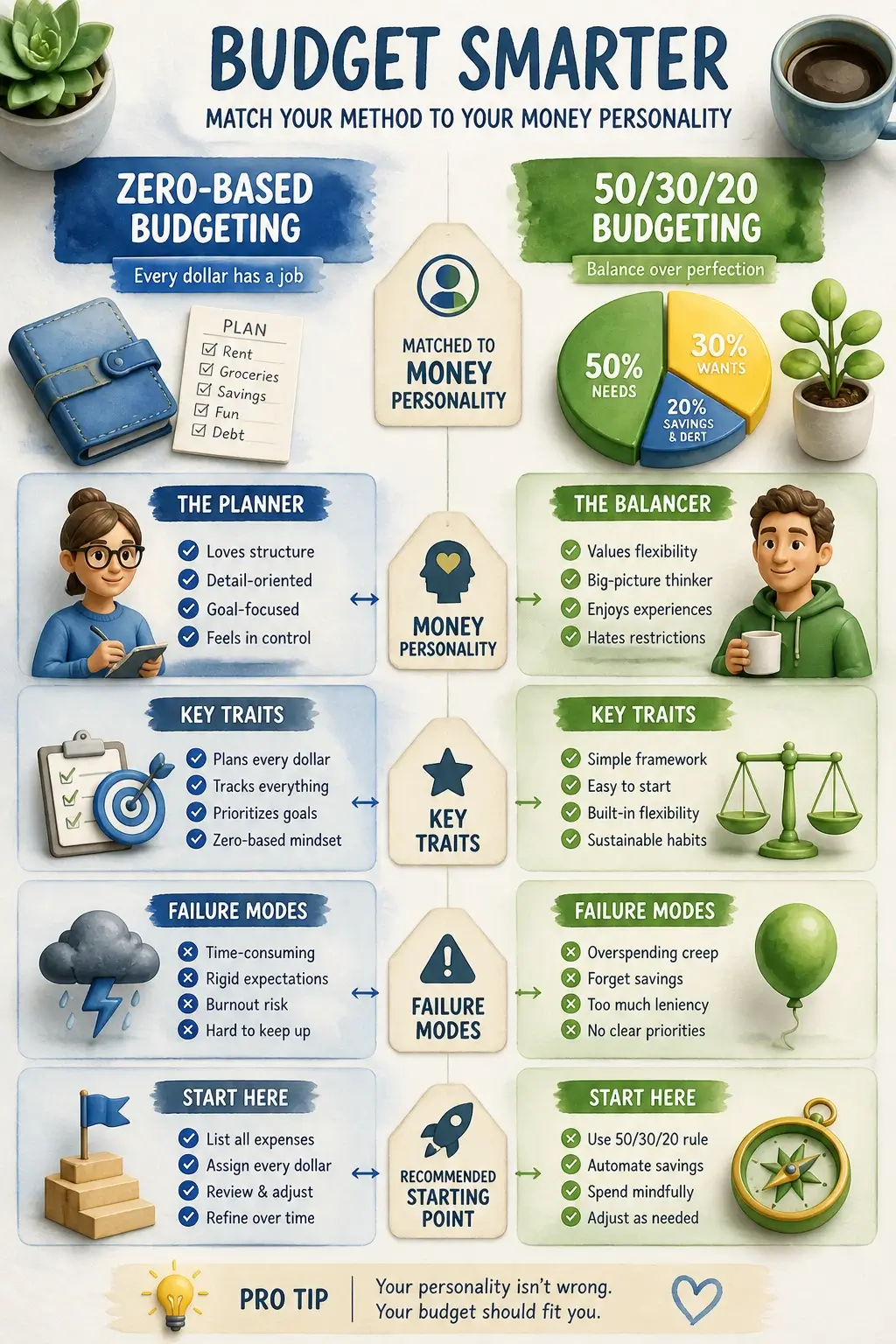
Concrete budgeting personas cut through the abstract comparison in a way that four-dimension analysis can’t quite finish. Most budgeting advice hands you a comparison table and leaves you to self-diagnose. What follows is more direct: two primary profiles, an honest acknowledgment of the middle ground, and a second layer of analysis – life stage – that traditional comparisons almost never address.
The Detail-Oriented Optimizer and the Simplicity-Seeking Stabilizer
The Detail-Oriented Optimizer is the natural home for zero-based budgeting. This is someone who gets genuine satisfaction from tracking, who wants to know the specific job of every dollar, and who typically has either variable income, aggressive debt payoff goals, or savings targets that demand precise allocation. The control that ZBB provides isn’t a burden for this personality – it’s the mechanism that makes financial progress feel real and verifiable. If you’ve ever built a detailed spreadsheet for something that didn’t require one, or found yourself wanting to know exactly which category a $23 expense belongs to, ZBB is your system. Start there.
The Simplicity-Seeking Stabilizer runs on a different fuel. This is someone with a stable monthly paycheck, limited bandwidth for budget maintenance, and a primary goal of maintaining lifestyle balance rather than hyper-optimizing every allocation. The 50/30/20 rule fits because it requires almost no active management once the initial structure is set. The recommendation here is equally direct: start with 50/30/20. If your housing costs push the Needs bucket past 50%, adjust the ratio manually – 60/20/20 or whatever the math requires – and keep the framework. The simplicity advantage survives a ratio adjustment; it doesn’t survive abandonment.
The Hybrid Path, Savings Rate Reality, and Life-Stage Transitions
Many intermediate budgeters don’t map cleanly onto either profile, and that’s not a failure of self-awareness – it’s an accurate read of the situation. Most people land somewhere between the two, and the honest answer is that they’ll likely end up with a hybrid system. The next section builds that hybrid explicitly.
Before getting there, a savings rate reality check for anyone whose persona leans toward the Simplicity-Seeking Stabilizer: if your financial goals are aggressive – FIRE, paying off six figures of student debt in five years, building a down payment in a high-cost city – the 20% savings allocation will feel like treading water within a year. That’s not a character flaw; it’s a mismatch between the tool and the objective. This persona may need to evolve toward ZBB or a hybrid within 12–18 months of starting, not because 50/30/20 is broken, but because the savings rate ceiling it implies doesn’t match the goal.
Income irregularity functions as a hard gate here, not a preference. If your monthly take-home varies by more than 10% from one month to the next, ZBB isn’t just a better fit – it’s operationally required. The 50/30/20 percentages become backward-looking math once the month ends, not forward-looking allocation before it starts. For freelancers, commission earners, and gig workers, this isn’t a close call.
There’s a second layer that changes the entire picture and that most comparison guides ignore entirely: life stage. Your definition of “needs” and your capacity for detailed tracking shift substantially when your living situation changes – and the budgeting method that fit perfectly at one stage can feel broken at the next.
Someone living with parents, carrying low fixed expenses, can often direct 40–50% of income toward savings, making the 50/30/20’s 20% target feel conservative and ZBB’s granularity feel empowering rather than exhausting. That same person, six months after signing a lease in a high-cost city where rent alone consumes 40% of take-home, may find ZBB’s maintenance load suddenly overwhelming and the 50/30/20 ratio structurally broken. The method didn’t change. The life did.
This plays out across every major transition: dual-income couples merging finances, new parents absorbing childcare costs, near-retirees shifting from accumulation to drawdown planning. Each transition changes both the psychological fit and the flexibility requirements. The implication is practical: don’t abandon a method because it stopped working after a major life change. Diagnose whether the method is wrong or whether the parameters just need recalibration.
Research on financial norm development supports this generational and contextual dimension. Dr. Izani Ibrahim and Dr. James C. Wetherbe, writing on parental financial socialization and institutional context, observed:
“Younger generations often prioritize flexibility and experiences, contrasting with older generations’ focus on stability and long-term savings… parental modeling, communication, psychology, socio-cultural, and institutional context are key mechanisms in the development of financial norms and competencies.”
The mechanism here is worth unpacking: the budgeting method you’re drawn to isn’t formed in a vacuum. It’s shaped by the financial norms you absorbed, the income stability you’ve experienced, and the life stage you’re currently navigating. This doesn’t mean personality is destiny – it means your starting point for method selection should include honest self-assessment of those contextual factors, not just a preference for simplicity or detail.
The Decision Framework: Build Your Personal System
The goal isn’t to pick a winner. The goal is to run a short diagnostic on your current reality and assemble a system that matches it – with explicit permission to rebuild it when your reality shifts.
Here’s that diagnostic, compressed to three questions you can answer in about 60 seconds.
Question 1 – Time: Can you commit at least 30 minutes per week to budgeting before each month starts? If yes, you’re operationally compatible with ZBB. If no, you’re pointing toward 50/30/20 or a simplified hybrid.
Question 2 – Income: Is your monthly take-home predictable within roughly 10%? If no, ZBB is mandatory at the operational layer – not a preference. If yes, either method is structurally viable.
Question 3 – Psychology: Does knowing exactly where every dollar went give you a sense of calm and control, or does it make you feel suffocated and surveilled? Calm points to ZBB. Suffocated points to 50/30/20 or a low-category hybrid.
Three questions. Your answers point to a starting configuration. Now here’s how to build it.
The most common intermediate system – and the one that survives the longest in practice – is the pay-yourself-first hybrid. The structure is straightforward: use 50/30/20 as a high-level blueprint to set your savings rate and define your needs ceiling. Automate those transfers immediately after payday, before you make a single discretionary decision. Then run a simplified ZBB on the remaining spending money. Savings are protected by automation. Spending is governed by zero-sum discipline. The two methods aren’t competing – they’re handling different layers of the same system.
For variable income, the hybrid reconfigures slightly: budget per paycheck using only the dollars already in your account. Cover fixed obligations first – housing, utilities, minimum debt payments. Allocate the remainder to discretionary categories. Ignore the percentages during the month; run a ratio check annually to confirm your savings rate is tracking toward your goal. The percentage framework becomes a yearly audit, not a monthly constraint.
One practitioner-developed solution to the granularity paradox is worth building into any ZBB layer you construct: the Everything-Else bucket. The workflow is: (1) allocate a fixed amount to savings and retirement as a non-negotiable first move; (2) assign dollars to essential fixed categories – housing, utilities, minimum debt payments; (3) create one single “everything-else” bucket for all remaining discretionary spending; (4) verify that income minus all allocations equals zero. You maintain the zero-sum accountability that makes ZBB powerful while eliminating the micro-category explosion that causes burnout. One catch-all bucket for discretionary spending is not a compromise – it’s a cognitive load decision that keeps the system running.
The automation layer makes all of this durable. Instead of relying on willpower to manually move money after payday, configure your employer’s direct deposit to split funds automatically: a fixed percentage to retirement, a fixed amount to an emergency fund, a fixed allocation to a sinking fund account, with the remainder going to checking for day-to-day spending. The specific percentages are personal. The principle is universal: automation removes the most common failure point in both methods – the moment between receiving income and actually executing the savings step. When that step is manual, it requires a decision. Decisions require cognitive energy. Cognitive energy is finite. Automate the step, and the decision disappears.
The framework is designed to be revisited, not set once and forgotten. Specific triggers should prompt a rebuild: your housing cost changes by more than 15% of income, you combine finances with a partner, or your primary savings goal shifts significantly – starting a family, targeting early retirement, absorbing a major income change. These aren’t reasons to abandon the system. They’re the moments when the parameters need recalibration.
Here’s a practical walkthrough of how the pay-yourself-first principle gets built into an actual budgeting workflow:
Key Takeaways on Budgeting Methods
- The 50/30/20 rule is a macro compass; zero-based budgeting is a transaction-level engine – they operate on different structural logic, not different quality levels.
- Minimum debt payments belong in the Needs bucket under 50/30/20; extra principal payments belong in Savings – misclassifying this silently breaks the ratio.
- Variable income makes ZBB functionally mandatory, not just preferable, because 50/30/20 percentages require a predictable monthly base to mean anything.
- The granularity paradox is ZBB’s most common failure mode: too many micro-categories trigger decision fatigue and system abandonment, not laziness.
- The 20% savings target in 50/30/20 is an accessibility heuristic, not a benchmark – aggressive savers and FIRE-oriented budgeters typically require 30–50% savings rates.
- Life-stage transitions – moving out, merging finances, shifting income type – change both psychological fit and flexibility needs, making periodic system recalibration more important than initial method selection.
Frequently Asked Questions About Budgeting Methods
Can you use the 50/30/20 rule and zero-based budgeting at the same time?
Yes, and many intermediate budgeters do exactly this. The most durable hybrid uses 50/30/20 to set the high-level savings rate and automates those transfers, then applies a simplified zero-based structure to the remaining discretionary money.
What is the 70/10/10/10 budget rule?
The 70/10/10/10 rule allocates 70% of income to living expenses, 10% to savings, 10% to investments, and 10% to giving or debt repayment. It’s a macro guideline like 50/30/20, but trades the Wants category for an explicit giving or charitable allocation – useful if tithing or philanthropy is a financial priority.
What is the 40/40/20 rule in finance?
The 40/40/20 rule directs 40% of income to necessities, 40% to financial goals like savings and debt payoff, and 20% to discretionary spending. It’s a more aggressive savings-oriented variant of the percentage-based approach, better suited to someone with moderate fixed expenses and ambitious financial targets.
What is the 60/40 rule in budgeting?
In a budgeting context, a 60/40 split typically means 60% of income covers all expenses – needs and wants combined – while 40% goes toward savings and financial goals. It’s not a standardized framework like 50/30/20, but it appears as a custom ratio when someone in a lower cost-of-living area wants to maximize their savings rate.
What is the 3/6/9 rule in finance?
The 3/6/9 rule is an emergency fund guideline, not a budgeting allocation method. It suggests holding three months of expenses if you’re single with stable income, six months if you have dependents or variable income, and nine months if you’re self-employed or in a volatile industry. It’s a sizing rule, not a spending framework.
What happens to zero-based budgeting when you have an unexpectedly high expense mid-month?
You reallocate. ZBB doesn’t require perfection – it requires that the reallocation is explicit. If a $400 car repair appears, you pull from a sinking fund if one exists, or consciously reduce another category by $400 and document the change. The discipline is in making the trade-off visible, not in preventing the expense from happening.
Is the 50/30/20 rule still useful if housing costs more than 50% of my income?
The ratio breaks but the framework doesn’t have to. Adjust to whatever reflects your actual fixed-cost reality – 60/20/20 or 65/15/20 – and treat the Savings floor as non-negotiable regardless of the housing pressure. The percentage targets are guidelines; the underlying principle of protecting savings first is structural.
How do you know when it’s time to switch budgeting methods?
Three clear triggers: your housing cost changes by more than 15% of income, you combine finances with a partner, or your primary financial goal shifts significantly. These events change both your fixed expense structure and your psychological relationship with money, which are the two variables that determine method fit.
References
- Quantifying the cost of decision fatigue: suboptimal risk decisions in finance – pmc.ncbi.nlm.nih.gov
- Financial Socialization and Developmental Financial Behaviors – mdpi.com
- How to Create a Pay Yourself First Budget – youtube.com