
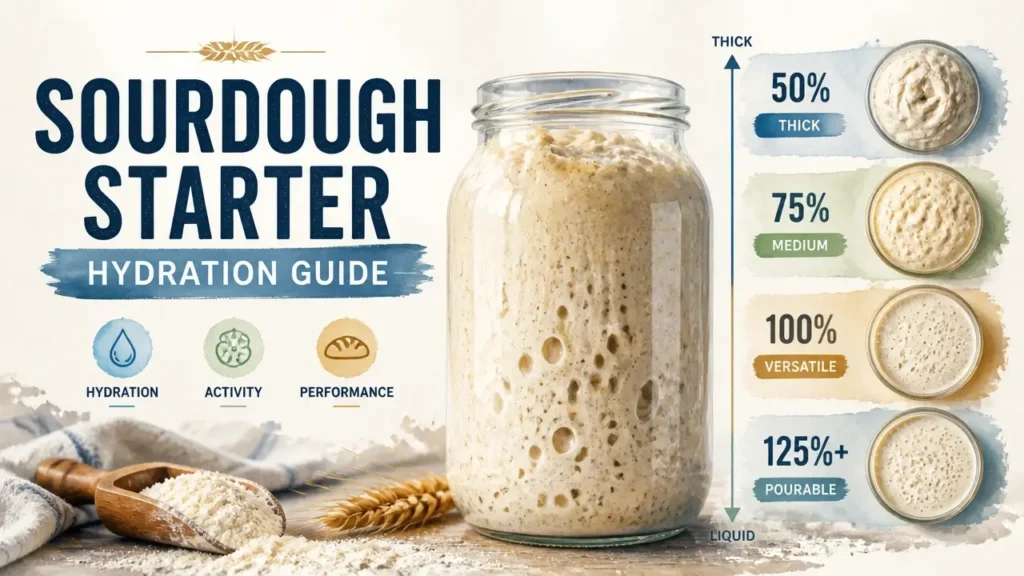
Precisely controlled sourdough starter hydration determines whether your bread develops a mild, open crumb or a tangy, structured loaf – and the difference lives entirely in a ratio of grams. Most bakers treat it as a fixed setting when it’s actually the most adjustable lever in their process.
Understanding why water-to-flour ratios reshape microbial populations, gluten networks, and fermentation timelines gives you real decision-making power. This guide walks through the mechanics, the math, and the mistakes – so you can use hydration as a tool, not a mystery.
What Starter Hydration Actually Means
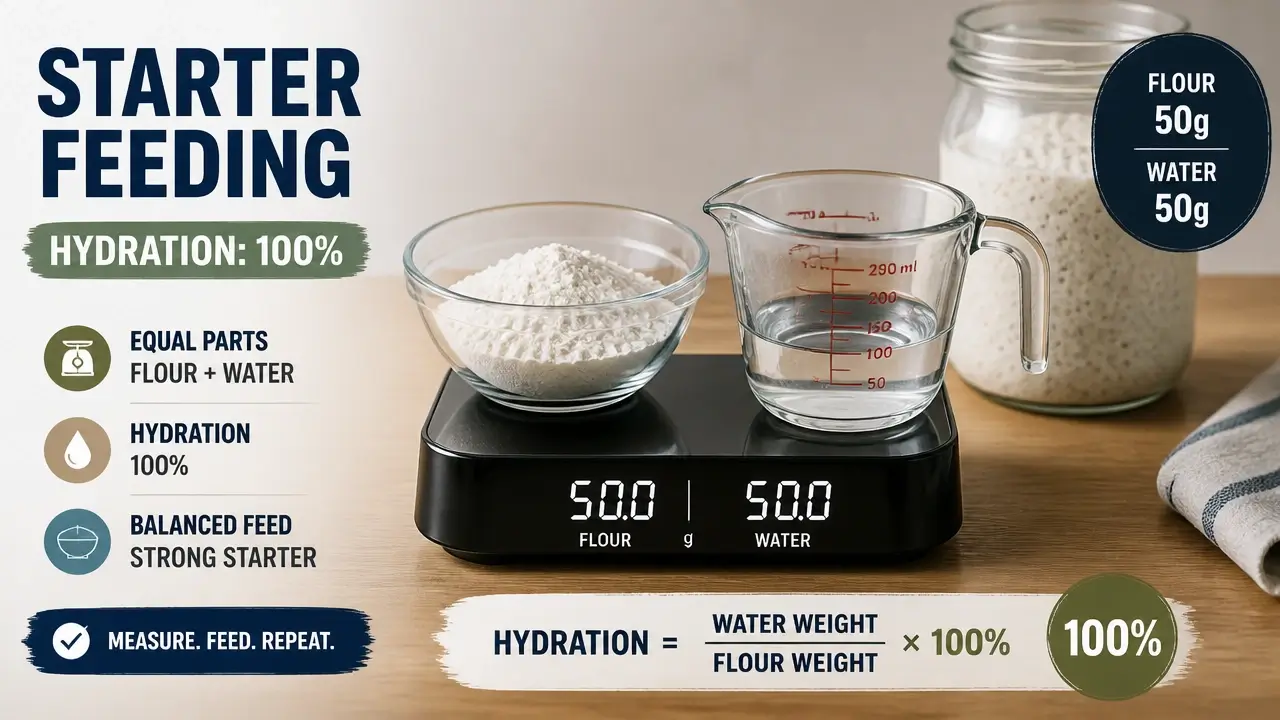
Starter hydration is the weight of water divided by the weight of flour in your starter, multiplied by 100 – and that single formula is the foundation of every intentional decision you’ll make from here. In baker’s math, flour always sits at 100%, and every other ingredient is expressed relative to it. Water is no different.
So if you feed your starter 50 g of water and 50 g of flour, you have a 100% hydration starter. The math: (50 ÷ 50) × 100 = 100%. Feed it 40 g of water and 60 g of flour, and you’re at 67%. The percentage isn’t arbitrary – it tells you exactly how wet the microbial environment inside your starter actually is.
The formula, written plainly:
Hydration % = (grams of water ÷ grams of flour) × 100
A digital scale is non-negotiable here. Volume measurements – cups, tablespoons – vary too much with flour density to give you repeatable results. You need grams.
Calculating an Existing Starter’s Hydration
If you inherited a starter or haven’t been tracking ratios carefully, you can still calculate where you stand. Think back to your last feeding: how many grams of water and flour did you add? Plug those into the formula. If you genuinely don’t know, the easiest fix is to reset with a fresh feeding at your target ratio and track from there.
To hit a target hydration, work backward from the formula. Want 75% hydration with 100 g of flour? You need 75 g of water. Want to feed at a 1:2:2 ratio (starter:flour:water) at 100% hydration? That’s equal weights of flour and water – straightforward.
One thing to keep straight: starter hydration is internal to the starter itself. It’s separate from your final dough hydration. But here’s the catch – when you add starter to a dough, you’re adding both water and flour. A 200 g addition of 100% hydration starter brings 100 g of flour and 100 g of water into your formula. Ignore that, and your dough hydration math is quietly wrong from the start. We’ll come back to that in the troubleshooting section.
Here’s a visual reference for what this calculation looks like in practice:
Liquid vs. Stiff Starter: Fermentation, Flavour, and Structure
Starter consistency – whether you’re working with a pourable batter or a firm, kneadable ball – isn’t just a texture preference. It’s a biological decision that shapes which microorganisms thrive, how fast fermentation runs, and what acids your bread develops.
Here’s the fork in the road: high water activity (think 100% hydration) speeds up wild yeast and lactic acid bacteria, producing a fast, active starter with mild, yogurt-like acidity. Low water activity (think 65% hydration) slows the whole system down and shifts the balance toward acetic acid bacteria, which produce the sharp, vinegary notes associated with a deeply complex sourdough.
The table below maps these differences across the variables that matter most to a working baker.
| Feature | Liquid Starter (≈100%) | Stiff Starter (≈65%) |
|---|---|---|
| Fermentation Speed | Fast | Slow |
| Dominant Microorganism | Lactic acid bacteria + wild yeast | Acetic acid bacteria |
| Flavour Profile | Lactic-forward (mild, creamy) | Acetic-forward (sharp, complex) |
| Gluten Degradation | Higher – enzymes are more active | Lower – enzymes are inhibited |
| Dough Structure | More extensible, open crumb | Stronger, tighter crumb |
| Maintenance Frequency | More frequent room-temp feedings | More resilient to fridge storage |
| Neglect Tolerance | Lower | Higher |
How Water Activity Shifts the Microbial Balance
The mechanism behind this split comes down to water activity – a measure of how much free water is available for biological processes. Lactic acid bacteria thrive in wetter environments; they metabolize sugars quickly and produce lactic acid as their primary byproduct. Acetic acid bacteria prefer drier, oxygen-limited conditions, where they produce acetic acid more slowly.
This is why a liquid starter produces a lactic-forward loaf and a stiff starter produces an acetic-forward one. It’s not magic – it’s microbial ecology responding to its environment.
The Gluten and Enzyme Connection
Here’s something that surprises a lot of bakers: the wetter your starter, the faster it degrades gluten. Proteases and amylases – the enzymes naturally present in flour – are more active at higher hydrations. A very wet starter can break down gluten networks quickly, which gives you a soft, extensible dough but reduces structural integrity if fermentation runs long.
A stiff starter inhibits those same enzymes. The lower water activity slows their activity, which preserves gluten strength and supports a more structured, even crumb. This is one reason why stiff starters are common in high-hydration whole-grain breads – the stiffer levain compensates for the weaker gluten structure of whole-grain flours.
One important nuance: these microbial shifts aren’t permanent or absolute. The community adapts fluidly to its environment, and that environment is reversible. As the food microbiology research team studying sourdough stability notes:
“were probably affected by the maltose depletion in liquid condition”
This matters because it means the transition between lactic-forward and acetic-forward behavior isn’t a fixed identity – it’s a response to available nutrients and water. A baker who pairs hydration changes with adjustments to feeding frequency and fermentation temperature has far more control over flavor than someone who simply labels their starter “liquid” or “stiff” and leaves it at that.
When to Use 100% vs. 65% Hydration
Hydration selection comes down to three levers: the flavor you want, the schedule you’re working with, and how you want the dough to handle. Get those three aligned, and the choice becomes straightforward.
Matching Hydration to Flavour and Schedule
A 100% hydration starter is your go-to for mild, lactic-forward bread on a faster timeline. The active fermentation environment moves quickly, which means you can often build, ferment, and bake within a single day. It integrates easily into doughs and produces a more extensible, open crumb – the kind of structure you’d want in a classic artisan white or a light whole-wheat loaf.
A 65% hydration starter works the other direction. Its slower, acetic-forward fermentation builds deeper flavor over time, making it the right choice for a multi-day whole-grain boule where complexity and structure are the goal. The tighter microbial environment means it’s also more forgiving in the fridge – you can feed it and park it for several days without it going sideways.
The research backs this up. Food scientists studying grain-based biotechnologies found that the wetter fermentation environment:
“decreases the resistance to extension, reduces the elasticity of the dough, and increases the degree of softening, obtaining a [higher gas] retention capacity (a greater number of alveoli of a larger size), a firmer crust”
That’s the open crumb and firm crust characteristic of a well-made liquid-levain loaf, explained at the structural level.
Recipe Compatibility and the One Rule Most Bakers Miss
Most published recipes assume a 100% hydration starter. If you substitute a 65% stiff starter without adjusting, you’ll be adding less water and more flour to the dough than the recipe expects – and your dough will feel noticeably stiffer than intended.
The fix is simple in principle: calculate how much water and flour your starter contributes (more on this in the troubleshooting section), then adjust the recipe’s water to compensate. It takes one extra step, but it keeps your dough hydration where the recipe intended.
The broader point: this isn’t a one-or-the-other commitment. Many experienced bakers maintain a single starter and shift its hydration when a project calls for it. You’re not choosing a permanent identity – you’re choosing a tool for the bake in front of you.
How to Convert Your Starter’s Hydration Without Killing It
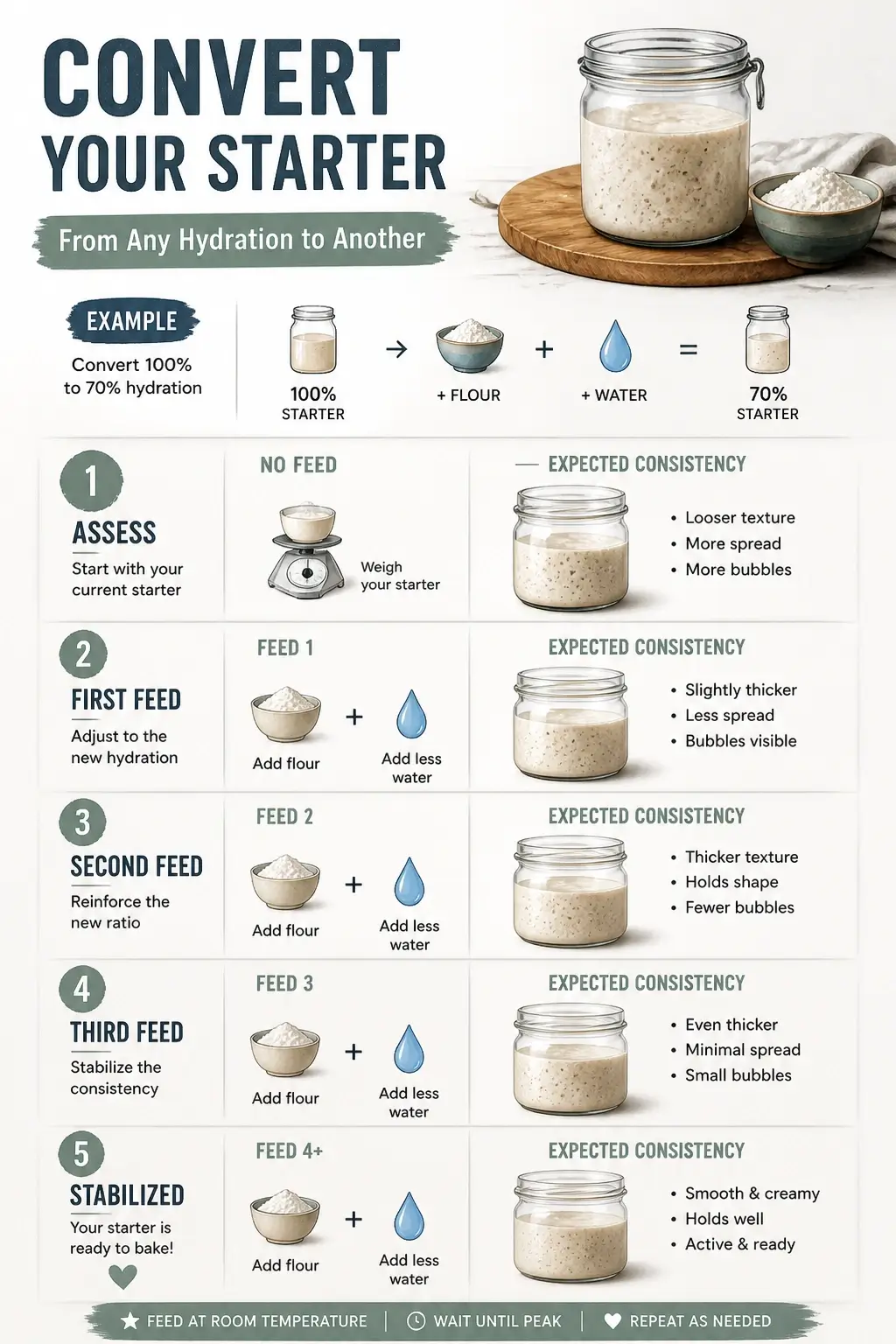
Converting your starter from 100% to 65% – or back – is a straightforward feeding transition, not a risky operation. The starter won’t die. Its microbial population will shift to match the new water activity, and within two to three feeding cycles, it will behave as if it’s always been at the new hydration.
Here’s the protocol:
Step 1: Take a small amount of your existing starter – 20 to 50 g is plenty. Discard the rest, or use it in a recipe.
Step 2: Feed it at your target hydration. Going from 100% to 65%? Use more flour relative to water. For example: 20 g starter + 60 g flour + 39 g water = 65% hydration (39 ÷ 60 × 100 = 65%).
Step 3: Repeat that same feeding ratio for two to three cycles. By the third feeding, the microbial community will have fully adapted to the new environment.
Step 4: Discard excess at each feeding. You don’t need to hoard backups – the culture is resilient.
The math for going the other direction – 65% back to 100% – works the same way in reverse. If you’re feeding 60 g of flour, you need 60 g of water to land at 100%.
Here’s a visual walkthrough of the full conversion process:
The Irreversibility Myth
There’s a persistent claim in some corners of the sourdough community that converting a liquid starter to stiff is a one-way street – that you’ll lose something essential and can never get it back. This is biologically unsupported. Microbial populations respond to water activity. Revert the water activity, and the population reverts with it.
Molecular biologists mapping sourdough microbiomes confirm the underlying principle:
“a mature starter can be stored indefinitely… A dormant starter can be rejuvenated by feeding it regularly with a fresh water–flour mixture”
If a dormant starter can be fully revived, a healthy one can certainly be converted. The core character of your starter – the microbial strains that have adapted to your flour and environment – survives the transition. What changes is the balance between those strains, and that balance is responsive to what you feed it.
The Flour Factor: Why Your Hydration Must Match Your Flour
Flour absorption is the hidden variable that makes a carefully calculated hydration percentage behave completely differently from one bag of flour to the next. If your starter is consistently too stiff or too runny despite hitting your target number, the flour is almost certainly the culprit – not your math.
The reason comes down to how flour’s physical and chemical composition determines how much water it can actually hold. That number isn’t fixed across flour types – it shifts by 5–15% depending on protein content, grind size, and bran load.
Flour Protein, Grind, and Bran: How Absorption Shifts Effective Hydration
Flour protein content is the primary driver of water absorption capacity. Gluten proteins – glutenin and gliadin – absorb roughly twice their dry weight in water, and each 1% increase in total protein raises water absorption by approximately 1.5–2%, as research published in PMC demonstrates. A strong bread flour at 13% protein will drink significantly more water than a soft pastry flour at 8%.
Grind size and bran content layer on top of that. Whole-grain rye flour is the clearest example: its coarse grind and high bran load mean that 100% hydration produces a stiff, barely-wet mass – not the pourable batter you’d get from white bread flour at the same percentage. The bran particles act like tiny sponges, absorbing water that would otherwise be available to the yeast and bacteria. Research on wheat flour hydration capacity confirms that bran load and protein content together explain this 5–15% variation in effective hydration.
The practical upshot: when you switch flours, observe the starter’s actual texture and adjust your water – don’t blindly trust the percentage.
Adjusting Hydration for Flour Type and Climate: A Practical Decision Framework
Flour type classifications give you a useful starting point for setting hydration ranges, but they’re a starting point – not a fixed answer. Here’s a working framework based on protein ranges:
- Protein 8–9% (soft pastry flour): Keep starter hydration near 60–65%. These flours saturate quickly and produce slack doughs at higher percentages.
- Protein 10–11% (all-purpose flour): 65–70% hydration. The most common range for everyday baking.
- Protein 12–14% (strong bread flour): 70–80% hydration. Higher protein means more gluten to hydrate – these flours can handle the extra water and benefit from it.
- Whole-grain flours (rye, whole wheat): Hydration can push above 80% due to bran thirst. Note that whole-grain flours also ferment faster because of their higher enzyme loads – so hydration and timing adjustments often need to happen together.
One variable that almost no published guide addresses: climate humidity. Flour absorbs moisture from the air, which means the same bag of flour behaves differently in a dry desert kitchen versus a humid coastal one. Treat the ranges above as your baseline, then adjust 5% upward in dry climates and 5% downward in humid ones based on how your starter actually looks and feels. Your hands and eyes are the final calibration tool.
Troubleshooting the Hydration Mistakes Even Experienced Bakers Make
Getting the hydration percentage right is step one. The next layer is recognizing the problems that look like hydration failures but are actually something else – and the one math error that silently corrupts every dough formula when you miss it.
Fixing Hooch and Weak Oven Spring: Hidden Hydration Errors
Hooch – that gray or dark liquid pooling on top of your starter – is one of the most misread signals in sourdough. It looks like a hydration problem. It isn’t. Hooch is a sign that your starter has burned through its available food and the yeast has started producing alcohol as a byproduct. The fix is feeding frequency and ratio, not water adjustment. Before you change a single gram of water, try increasing your feeding ratio to 1:3:3 (starter:flour:water) and see if the hooch disappears within a couple of cycles. It almost always does.
Weak oven spring is a different problem, but hydration is actually a real factor here. An over-hydrated starter – above 100% – accelerates fermentation significantly. If you’re using that starter in a dough without accounting for the faster activity, you can easily over-proof your bulk fermentation without realizing it. The dough looks fine going into the oven and then barely moves. Dropping your starter hydration to the 80–100% range gives you a wider bulk fermentation window and more predictable timing.
Thirsty Flours and the Float Test: Avoiding Common Misdiagnoses
Rye and whole-wheat starters are a common source of confusion because they can look stiff even when you’ve fed them at 100% hydration. The bran is absorbing water that doesn’t show up in the texture. The instinct is to add more water – but that’s the wrong move. Trust your measured ratio. If you’ve fed 50 g water to 50 g flour, you have a 100% hydration starter regardless of how it looks. Adjust the percentage only if you’ve decided to change your target hydration intentionally.
The float test deserves a direct correction: it doesn’t tell you whether your starter is ready to bake with. It only tells you that CO₂ is trapped in the starter – and an over-proofed starter will float just as readily as a perfectly ripe one. Relying on the float test has caused more wasted bakes than it’s prevented.
Here’s a more reliable set of readiness cues: the starter has roughly doubled in size, the surface shows active bubbles, the smell is pleasantly sour and yeasty rather than sharp or alcoholic, and when you spoon it, you can see the open, webby structure inside. Those four signals together are far more informative than whether it floats.
The Math Error That Quietly Wrecks Your Dough
Here’s the mistake that trips up even experienced bakers who’ve gotten everything else right: forgetting to account for the flour and water inside the starter when building the final dough formula.
A 100% hydration starter is half water, half flour by weight. If your recipe calls for 270 g of starter, you’re adding 135 g of flour and 135 g of water to your dough – before you’ve touched the recipe’s listed flour and water amounts. Ignore that, and you’re systematically off by a meaningful margin.
Let’s make it concrete. Say your recipe calls for 500 g flour, 375 g water, and 270 g of 100% hydration starter. The starter contributes 135 g flour and 135 g water. Your actual flour total is 500 + 135 = 635 g. Your actual water total is 375 + 135 = 510 g. True dough hydration: (510 ÷ 635) × 100 = 80.3%.
If you’d ignored the starter’s contribution and calculated (375 ÷ 500) × 100, you’d think your dough was 75% hydration. That 5% gap is enough to produce a noticeably different crumb and a gummy interior that you’d spend weeks trying to troubleshoot through technique.
Subtract the starter’s flour and water from your totals before you build the formula. It takes thirty seconds and fixes one of the most persistent sources of inconsistent results.
Key Takeaways on Sourdough Starter Hydration
- Starter hydration is water weight divided by flour weight, multiplied by 100 – a digital scale makes this calculation reliable and repeatable.
- Liquid starters favor lactic acid bacteria and produce mild, open-crumb bread; stiff starters shift toward acetic acid bacteria and build sharper, more complex flavor.
- Converting a starter between hydration levels takes two to three feeding cycles and does not damage the culture – the irreversibility claim is a myth.
- Flour protein, bran content, and grind size shift effective water absorption by 5–15%, meaning the same hydration percentage behaves differently across flour types.
- Hooch signals underfeeding, not a hydration error – increase your feeding ratio before adjusting water content.
- A 270 g addition of 100% hydration starter contributes 135 g of flour and 135 g of water to your dough formula; ignoring this creates a systematic hydration error.
Frequently Asked Questions About Sourdough Starter Hydration
What is the ideal hydration level for a sourdough starter?
There’s no single ideal – it depends on your flour, your flavor goals, and your schedule. Most bakers land between 70% and 100%, with 100% being the most common default because it’s easy to measure and works with the majority of published recipes.
Is 65% or 75% hydration sourdough better for a beginner?
75% is generally more forgiving to work with because it’s easier to handle than very high hydration doughs while still producing good crumb structure. 65% is excellent for flavor complexity but requires adjusting recipe water if the recipe assumes a 100% hydration starter.
Can I use the same starter for every type of sourdough bread?
Yes, and the most practical approach is maintaining one starter and adjusting its hydration temporarily for specific projects rather than keeping multiple starters going simultaneously.
Why does my starter smell like alcohol or nail polish remover?
That sharp, solvent smell means your starter has exhausted its food supply and fermentation has pushed past the sweet spot into alcohol production. Feed it at a higher ratio – try 1:5:5 – and the smell should normalize within one or two cycles.
Does refrigerating my starter change its hydration?
No, refrigeration doesn’t change the ratio of water to flour – it just slows microbial activity. The hydration percentage stays the same; only the fermentation pace drops. When you pull it out and feed it at room temperature, it picks back up where it left off.
How do I know if my starter hydration is causing my dense crumb?
Check two things first: whether you’re accounting for the starter’s water and flour in your dough formula, and whether your bulk fermentation timing is calibrated to your starter’s actual activity level. Dense crumb is usually over-proofing or under-proofing before it’s a hydration problem.
Does whole-grain rye starter need a different hydration than white flour starter?
Yes. Rye’s high bran content absorbs significantly more water, so a rye starter at 100% hydration will look and behave more like an 80% white-flour starter. If you’re switching to rye, either increase your water percentage or expect a stiffer texture at your usual ratio.
What’s the biggest mistake bakers make with sourdough starter hydration?
The most costly mistake is ignoring the starter’s flour and water contribution when calculating final dough hydration. It silently throws off the entire formula and is the most common cause of gummy crumb that technique adjustments alone can’t fix.
References
- Measurement of hydration capacity of wheat flour – ScienceDirect
- Water Absorption Capacity Determines the Functionality of Vital Wheat Gluten – PMC / National Institutes of Health