
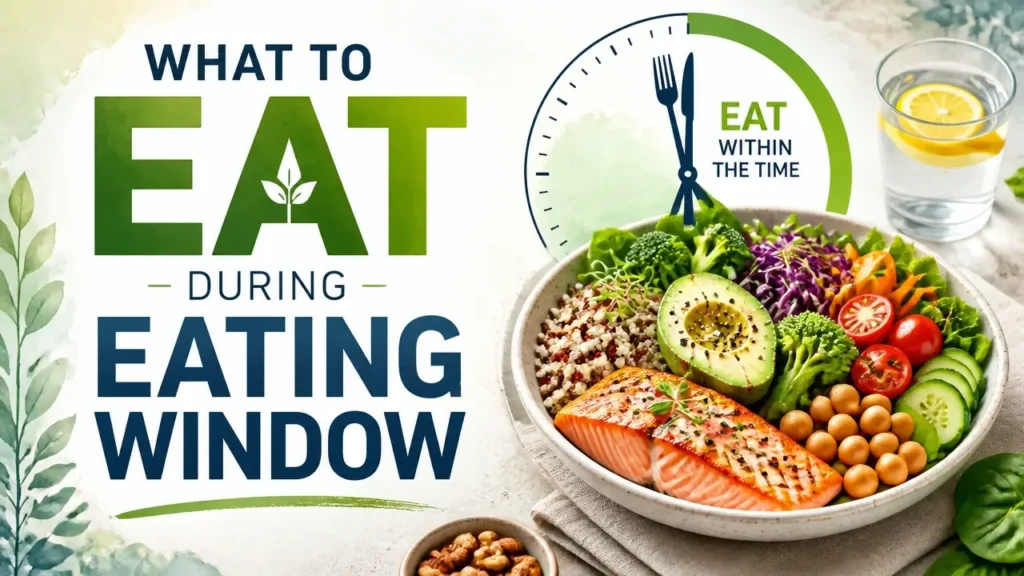
The intermittent fasting eating window is one of the most misunderstood levers in modern nutrition – not because the science is hidden, but because most popular guides stop at the clock. They tell you when to eat and call it a day. The physiology disagrees.
After 12–16 hours without food, your body is running a different operating system: insulin is low, cells are primed for repair, and fat oxidation is elevated. What you put in next either extends that advantage or collapses it. This is the part of the IF story worth understanding.
The Metabolic Window: Why Food Quality Decides Results
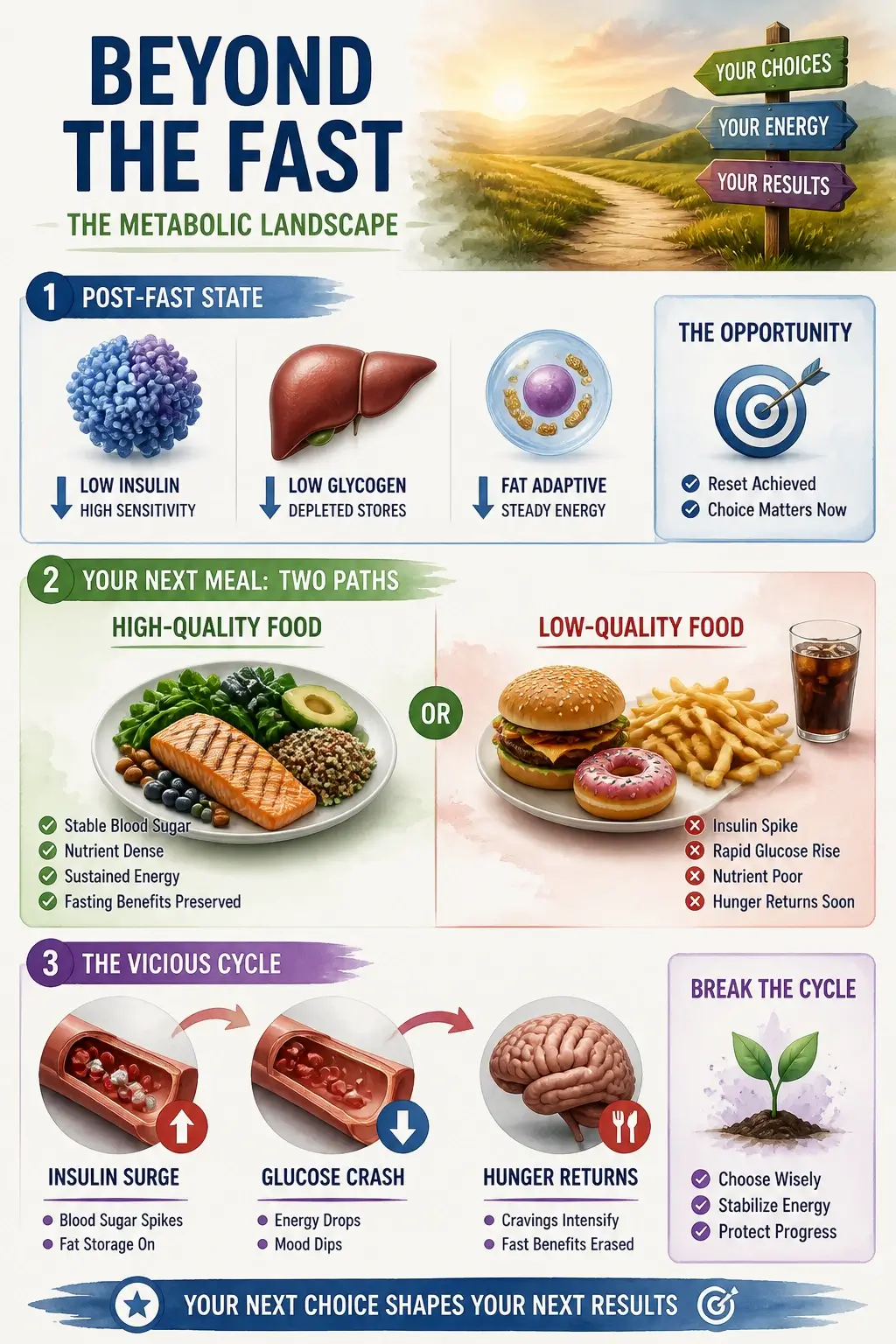
The post-fast metabolic state is one of the most nutrient-sensitive environments your fasted state creates on its own. After 12–16 hours without food, muscle and liver glycogen are substantially depleted, insulin has dropped to a low baseline, and your cells have become acutely more insulin-sensitive – meaning they’re primed to absorb and use whatever you give them next with unusual efficiency.
That heightened sensitivity is the prize. It’s also a trap if you’re not paying attention.
When you break the fast with high-quality protein, healthy fats, and fiber-rich carbohydrates, the body partitions those nutrients into exactly the right places: muscle repair, cellular regeneration, and stable energy. But break it with a refined carbohydrate, a sweetened drink, or a sugar-dominant meal, and that same insulin sensitivity amplifies the response in the wrong direction – you get an exaggerated insulin surge, a rapid blood glucose rush, and then the inevitable crash. And that crash doesn’t just make you feel foggy. It triggers intense hunger signals that can undo hours of disciplined fasting in a single sitting.
This is where the popular version of intermittent fasting – “just skip breakfast and eat whatever you want” – quietly fails people. The fast depletes glycogen and lowers insulin. The eating window is where you either bank that metabolic advantage or spend it carelessly. The body doesn’t distinguish between a thoughtful faster and a careless one during the fast. It makes that distinction the moment you eat.
There’s also a real debate worth naming here. Some institutions, including historically Johns Hopkins, have framed IF as primarily a timing strategy – suggesting that when you eat matters more than what you eat. But Cleveland Clinic, Harvard, Healthline, and Dietitians Australia all explicitly recommend strict diet quality alongside the eating window, pointing to Mediterranean-style whole-food patterns and a clear limit on ultra-processed products. The split isn’t trivial. If intermittent fasting works purely through calorie restriction, food composition is less critical. But if the unique metabolic effects of fasting – autophagy activation, ketone elevation, insulin re-sensitization – are the real prize, then what you eat inside the window determines whether those effects actually translate into the body changes you’re after.
The institutions that ignore food quality are selling half the story. Here’s the full one.
Understanding the nuances of intermittent fasting is crucial, particularly for specific demographics, such as those discussed in Intermittent Fasting for Women, which highlights the importance of considering individual hormonal needs when implementing fasting regimes.
Here’s a visual summary of how the post-fast metabolic landscape shifts depending on what you eat first:
What Breaks a Fast: The Purity Line
The fasted state has one defining characteristic: insulin is low enough that fat oxidation and cellular cleanup – autophagy – can continue uninterrupted. That’s the entire mechanism. Which means the question of what breaks a fast isn’t philosophical. It’s hormonal. Anything that produces a meaningful insulin rise ends the fast, regardless of how small or “healthy” the source seems.
The safe zone is narrower than most people assume. Water, black coffee, plain tea – green, black, or herbal without added fruit pieces or flavored syrups – and unflavored zero-calorie electrolytes all remain permissible. They don’t trigger a meaningful insulin response, and they don’t redirect the body away from fat oxidation.
Everything else is worth questioning. A splash of milk in your coffee. A teaspoon of MCT oil. Bone broth. Collagen powder. A chewable vitamin. Each of these introduces either calories or bioactive compounds that can signal the body to shift metabolic gears. Even small caloric additions are enough to flip the switch – the threshold isn’t high when insulin is already at its floor.
The grey zone that generates the most debate is zero-calorie sweeteners. The intuition that “no calories means no insulin response” is reasonable but incomplete. Research published in the American Journal of Clinical Nutrition found that a subset of adults identified as “cephalic phase responders” showed a statistically significant increase in serum insulin within two minutes of sucralose ingestion – despite the complete absence of calories. The mechanism is the cephalic-phase insulin response (CPIR): the body detects sweet taste perception through oral receptors and begins preparing for incoming glucose before any actually arrives. No calories required.
This doesn’t mean zero-calorie sweeteners break every fast for every person. But it does mean that if your progress has stalled and you’re consuming artificially sweetened coffee or gum during your fasting hours, that’s the first variable to eliminate. The purest fast avoids them entirely.
Fasting is binary in a way that’s worth sitting with. “Mostly fasted” isn’t a metabolic state – it’s a story we tell ourselves. The moment the body detects usable energy or a hormonal cue that mimics incoming fuel, the hormonal architecture of the fasted period begins to dismantle. The good news is that understanding the mechanism makes the boundary easy to respect.
Macronutrient Blueprint: Protein, Fat, and Carb Timing
Macronutrient composition inside the intermittent fasting eating window is where most intermediate fasters leave results on the table. Not because they’re eating badly – but because “eating clean” without a structural framework still leaves protein too low, fat misunderstood, and carbohydrates timed in ways that undermine the very stability the fast created.
Protein: the non-negotiable anchor
The target that consistently appears across sports nutrition research is 1.6–2.2 grams of protein per kilogram of body weight per day. That range isn’t arbitrary – it maps directly to the threshold required to maximally stimulate muscle protein synthesis and prevent lean mass loss during a caloric deficit. Inside a compressed eating window, the distribution of that protein matters as much as the total. Cramming it into a single large meal is less effective than spreading it across two to three distinct meals, because muscle protein synthesis has a ceiling per feeding – roughly 30–40 grams of high-quality protein – beyond which additional intake doesn’t add proportional benefit in that same sitting.
International Society of Sports Nutrition (ISSN), one of the leading authorities in sports nutrition research and guidelines, puts it directly:
“Within this range, strength-trained athletes typically benefit from intakes of 1.6–2.2 g/kg/day to maximize hypertrophy and strength, with requirements reaching ~3.1 g/kg/day (based on fat-free mass) during periods of caloric restriction.”
That last clause matters for anyone in a fasting-based deficit. Caloric restriction raises the protein floor, not lowers it. Strength training amplifies the return on that investment.
Dietary fat: the satiety architecture
Fat’s role inside the eating window is frequently misunderstood – it’s not a macronutrient to minimize, it’s a structural tool. Dietary fat slows gastric emptying and directly triggers satiety hormones CCK and GLP-1, which signal fullness to the brain and suppress the hunger that makes fasting difficult. Avocado, extra-virgin olive oil, nuts, seeds, and fatty fish aren’t just “healthy fats” in the generic wellness sense – they’re the mechanism by which a two-meal eating window feels genuinely satisfying rather than like an endurance test.
Carbohydrates: timing is the variable
Complex carbohydrates – sweet potatoes, quinoa, steel-cut oats, lentils – are not the enemy inside an intermittent fasting eating window. The question is when. Fiber-rich carbohydrates consumed earlier in the window or timed around a workout replenish glycogen steadily without creating the blood-sugar rollercoaster that follows refined grains or added sugars. The glycemic load and fiber content of the carbohydrate source determines how much insulin is released and how quickly – which is why a cup of lentils and a white-flour roll are not interchangeable decisions inside this window.
The adherence reality
Even the best macro strategy fails if the eating window becomes unsustainable. ZOE’s analysis of dropout rates found that 38% of participants assigned to alternate-day fasting left the study within one year, compared with 29% on a standard calorie-restricted diet. The implication for a daily 16:8 practitioner is direct: extreme restriction without adequate satiety is a dropout mechanism, not a discipline failure. A window built around high-protein, high-fat, fiber-rich meals is the most evidence-aligned approach to making intermittent fasting a pattern you can maintain for years – not just weeks.
Micronutrient Density: The Hidden Risk of Short Eating Windows
Compressed eating windows create a structural problem that even experienced, health-conscious fasters rarely account for: you can eat “clean” whole foods inside an 8-hour window and still systematically under-consume critical micronutrients – not because your food choices are poor, but because volume and variety are mechanically limited by time.
This isn’t a theoretical concern. The micronutrients most vulnerable to compression are the ones with the highest dietary stakes.
- Iron deficiency is the most common nutritional deficiency globally, and an 8-hour window that doesn’t deliberately include red meat, legumes, or iron-fortified foods – paired with a vitamin C source to enhance absorption – creates a consistent daily shortfall. Over weeks and months, that shortfall shows up as fatigue, reduced exercise performance, and impaired recovery. Women of reproductive age face a compounded risk.
- Vitamin B12 deficiency is nearly invisible in the short term and clinically significant over time. B12 is found almost exclusively in animal products, which means anyone practicing IF on a plant-forward or vegetarian diet needs to be deliberate – supplementation or fortified foods aren’t optional, they’re the mechanism of prevention.
- Vitamin D deficiency is the most widespread micronutrient gap in modern populations regardless of diet pattern, but a compressed window that doesn’t include fatty fish, egg yolks, or fortified dairy several times per week fails to move the needle. Sunlight exposure is the primary source, but dietary intake matters at the margin – and most people aren’t getting enough of either.
- Magnesium deficiency is perhaps the most underappreciated. Magnesium participates in over 300 enzymatic reactions, including glucose metabolism, muscle contraction, and sleep regulation – all of which are directly relevant to someone managing a fasting protocol. The richest dietary sources are dark leafy greens, pumpkin seeds, legumes, and dark chocolate. An eating window that doesn’t consistently include these foods will quietly accumulate a deficit that manifests as poor sleep, muscle cramps, and elevated stress response.
The practical implication isn’t complicated, but it does require intentionality. An 8-hour window demands higher nutrient density per meal than an unrestricted diet does. You don’t have the luxury of spreading micronutrient intake across 14 hours of casual eating. Each meal needs to carry more nutritional weight – which is a strong argument for prioritizing organ meats, leafy greens, legumes, fatty fish, seeds, and fortified foods as structural components of the eating window rather than occasional additions.
If dietary variety is genuinely limited – due to food preferences, access, or life logistics – a high-quality multivitamin taken with the largest meal of the day is a reasonable insurance policy. It doesn’t replace food quality, but it closes the gaps that a compressed window makes structurally difficult to fill.
Building Your 16:8 Eating Structure: From First Bite to Last
Structure is what converts the physiological principles in this article into a daily system that actually works. Without it, even a well-intentioned faster ends up grazing, skipping meals, or eating out of sequence in ways that undermine the very metabolic advantage they spent hours building.
Dr. Domenico Tricò, MD, PhD and clinical researcher in endocrinology and metabolism, frames the sequencing logic clearly:
“Premeal consumption of protein and fat – either alone or in combination – has been shown to markedly reduce postprandial glucose excursions… This promising approach simply alters the sequence of macronutrient ingestion during each meal.”
That principle – protein and fat before carbohydrates – is the mechanical foundation for every meal inside this window. It’s not a rigid rule; it’s a biological lever. Lead with protein and fat, and you slow gastric emptying, blunt the insulin response to subsequent carbohydrates, and arrive at the end of the meal genuinely full rather than chasing satisfaction.
Opening, Anchoring, and Closing the Eating Window
The three-meal rhythm inside a 16:8 eating window isn’t about eating three times because that’s conventional. It’s about matching meal composition to the body’s shifting hormonal and energy state across the window – and giving each meal a distinct structural job.
First meal – breaking the fast: Low-glycemic, easily digestible protein is the right opening move. Eggs, bone broth with shredded chicken, quality whey or pea protein – each of these delivers amino acids without triggering the insulin spike that a carbohydrate-first meal would. Pair the protein with a moderate portion of healthy fat: avocado, olive oil, a small handful of nuts. What to avoid is equally important: standalone fruit, smoothie bowls dominated by frozen banana and mango, or any carb-only opening that sends blood sugar climbing before the body has had a chance to settle into the fed state gradually. The goal of the first meal is to transition out of the fast without creating the insulin surge that drives the crash two hours later.
Second meal – the mid-window anchor: This is the structural center of the eating window and the highest-leverage meal of the day. Build it around a complete protein – salmon, grass-fed beef, tofu, tempeh – with a generous portion of fiber-rich complex carbohydrates and an abundance of non-starchy vegetables. Roasted sweet potato, quinoa, a lentil salad with olive oil and lemon – these are glycogen-replenishing carbohydrate sources that don’t destabilize blood sugar. If you train, this is the ideal post-workout slot: the combination of protein and carbohydrates at this point accelerates muscle protein synthesis and glycogen resynthesis simultaneously, when the body is most receptive to both.
Third meal – closing the window: Casein-rich slow-digesting proteins are the strategic choice here – cottage cheese, Greek yogurt, beef, salmon. Unlike whey, casein releases amino acids gradually over several hours, which means the body has a steady supply of building material deep into the fasting period that follows. Pair this with high-fiber vegetables: broccoli, Brussels sprouts, legumes. The combination prolongs gastric emptying, sustains satiety, and suppresses hunger well into the next morning. Finish eating at least two to three hours before bed to align with circadian rhythm – late eating disrupts the overnight metabolic shift toward fat oxidation and impairs sleep quality, which is itself a driver of the next day’s hunger.
A common fear at this point is worth addressing directly. Many fasters believe that finishing their last meal several hours before bed will trigger “starvation mode” – a mythical fat-preservation state where the body clings to stored fat and cannibalizes muscle instead. The term appears in some popular wellness sources, but it’s conspicuously absent from the clinical literature. Johns Hopkins, Cleveland Clinic, Mayo Clinic, and Harvard all use precise metabolic language – “metabolic switching,” “energy deficit” – rather than this phrase, because the science doesn’t support the concept as popularly described. A well-constructed closing meal, high in protein and fiber, does the opposite of triggering starvation mode: it extends fat oxidation, supports overnight muscle protein synthesis, and sets up a hunger-free fast the next morning.
Structure Over Grazing: The Metabolic Logic
The structured meal pattern described above only works if it stays structured. Continuous snacking across the 8-hour window – a handful of almonds here, a protein bar there, a piece of fruit between meals – keeps insulin elevated throughout the window and prevents the metabolic switch from resetting between meals. Two to three distinct, well-composed meals create insulin valleys between feedings that preserve metabolic flexibility. All-day picking eliminates those valleys entirely.
This isn’t a moral argument about willpower. It’s a hormonal one. Insulin can’t drop between meals if you’re continuously giving it a reason to rise. The metabolic benefits of the fast – fat oxidation, cellular repair signaling, insulin sensitivity – depend on insulin cycling down, not staying elevated for eight hours straight.
The framework described in this article is a principle-based template, not a rigid meal plan. The specific proteins, carbohydrate sources, and fats should reflect your body weight, activity level, food preferences, and practical life constraints. What shouldn’t vary is the underlying logic: lead with protein and fat, time your carbohydrates intentionally, close the window with slow-digesting protein and fiber, and let meals be meals rather than a continuous stream of inputs. That structure is what turns an intermittent fasting eating window from a hunger exercise into a reliable system for body recomposition.
Key Takeaways on Intermittent Fasting Eating Window
- After 12–16 hours fasted, your insulin sensitivity is elevated – breaking the fast with refined carbs amplifies the insulin response and triggers intense cravings.
- The fasted state ends the moment a meaningful insulin response is triggered, including from cephalic-phase responses to some zero-calorie sweeteners.
- Target 1.6–2.2 g of protein per kilogram of body weight daily, distributed across two to three meals, not condensed into one.
- Dietary fat slows gastric emptying and triggers CCK and GLP-1 – it’s the primary satiety mechanism that makes a compressed eating window sustainable.
- A short eating window creates a structural micronutrient risk; iron, B12, vitamin D, and magnesium require deliberate food selection to maintain adequate intake.
- Continuous grazing across the window keeps insulin elevated and negates the metabolic switch; two to three distinct meals outperform all-day picking.
Frequently Asked Questions About the Intermittent Fasting Eating Window
How many calories should I eat inside my intermittent fasting window?
There’s no universal number, but the evidence suggests IF works largely by reducing total intake spontaneously – most people naturally eat 10–30% fewer calories when their window is compressed. Rather than counting calories, focus on hitting your protein target (1.6–2.2 g/kg) and building meals around protein, fat, and fiber, which regulates hunger far more reliably than calorie tracking alone.
Does it matter if I eat my largest meal at the start or end of the window?
Timing does matter at the margin. Earlier caloric loading – a larger first meal, smaller closing meal – aligns better with circadian insulin sensitivity, which peaks in the morning and declines toward evening. That said, the difference is modest compared to the impact of food composition; a well-structured closing meal with slow-digesting protein and fiber still outperforms a carb-heavy early meal on satiety and overnight fat oxidation.
Can I do intermittent fasting while taking tirzepatide or similar GLP-1 medications?
This is a conversation you need to have with your prescribing physician before adjusting your eating pattern. Tirzepatide already suppresses appetite and slows gastric emptying significantly – layering a compressed eating window on top raises a genuine risk of inadequate protein and micronutrient intake, particularly if the medication makes it difficult to eat enough within the window.
Can intermittent fasting help lower A1C?
The evidence is genuinely promising here. Time-restricted eating improves insulin sensitivity and reduces postprandial glucose excursions in multiple clinical trials, and those mechanisms are directly relevant to A1C reduction. However, if you’re managing diabetes or prediabetes with medication, changes to your eating pattern need medical supervision – fasting can alter medication requirements in ways that carry real clinical risk.
Is it better to work out fasted or inside the eating window?
For most people doing moderate-intensity training, either works – fasted training doesn’t meaningfully impair performance in sessions under 60 minutes. The more important variable is post-workout nutrition: consuming protein and complex carbohydrates within the eating window after training accelerates recovery and muscle protein synthesis, which is harder to time if your workout falls at the very end of the fasting period.
What if I’m genuinely not hungry when my eating window opens?
That’s a common and physiologically normal experience, especially in the first few weeks of practicing IF – ghrelin, the hunger hormone, adapts its secretion pattern to your eating schedule over time. You don’t need to force a large meal, but consuming at least a moderate-protein, moderate-fat opening is worth doing regardless of appetite to avoid arriving at your second meal ravenous and underfueled.
Does the type of protein matter, or is total intake the only variable?
Source matters more than most people realize. Complete proteins – those containing all nine essential amino acids in adequate quantities – maximally stimulate muscle protein synthesis. Animal sources (eggs, meat, fish, dairy) and certain plant combinations (soy, pea + rice blends) qualify. Incomplete proteins consumed in isolation, common in some plant-forward eating patterns, require deliberate combination to hit the same anabolic threshold.
What’s the minimum eating window length before micronutrient deficiency becomes a real concern?
There’s no clean clinical threshold, but windows shorter than six hours – common in 18:6 or 20:4 protocols – substantially compress the opportunity to meet micronutrient needs through food alone, particularly for iron, B12, and magnesium. An 8-hour window is manageable with deliberate food selection; windows below six hours make supplementation increasingly difficult to avoid without compromising intake.
References
- The Cephalic Phase Insulin Response to Nutritive and Low-Calorie Sweeteners in Humans – pmc.ncbi.nlm.nih.gov
- Annals of Internal Medicine: Time-Restricted Eating Study Dropout Data – facebook.com/annalsofim
- ISSN Sports Nutrition Consensus: Protein Recommendations for Athletes – mdpi.com
- Frontiers in Endocrinology: Premeal Protein and Fat for Postprandial Glucose Control – frontiersin.org