

Intermittent fasting for women is not a scaled-down version of the male protocol – it’s a different biological conversation entirely, shaped by estrogen, progesterone, and a brain-based energy gate that doesn’t exist in the same form in men. The standard 16:8 advice was largely built on male physiology, and for millions of women, following it without modification means unknowingly working against their own hormonal architecture.
Understanding why changes everything. Once you see how the female body regulates energy and reproduction as a single linked system, you can evaluate any fasting protocol – or any wellness claim – on its own biological merits.
Why Female Hormones Make Intermittent Fasting Different
Female hormone regulation doesn’t operate in isolation from energy status – it’s wired directly into it. The same brain regions that govern your menstrual cycle are continuously monitoring whether the body has enough fuel to sustain a pregnancy, and they respond to fasting signals with measurable downstream effects on estrogen, progesterone, cortisol, and GnRH. That’s not a design flaw. It’s an ancient survival priority that modern fasting protocols were never built around.
This is the core difference that separates intermittent fasting for women from the generic advice – and why the same 16-hour fast that leaves a man feeling sharp can leave a woman exhausted, anxious, and cycling irregularly.
The Kisspeptin-Leptin Energy Gate and the HPA-Axis Cortisol Trap
The kisspeptin-leptin energy gate is the brain’s primary checkpoint between your nutritional status and your reproductive axis – and it is exquisitely sensitive to fasting. When you fast, circulating leptin falls. That drop is detected by kisspeptin neurons in the hypothalamus, which respond by dialing back their signaling. Less kisspeptin means less stimulation to GnRH neurons – and without adequate GnRH pulses, the downstream release of LH and FSH slows, which can delay or suppress ovulation entirely.
This isn’t theoretical. A peer-reviewed study in PubMed demonstrated that short-term fasting lowers circulating leptin and directly suppresses hypothalamic Kiss1 and Kiss1r mRNA expression. Critically, when leptin was replaced during fasting – either peripherally or centrally – Kiss1 expression and GnRH pulse patterns normalized. That’s a clean indication of the gate: leptin holds it open; fasting closes it.
A review published in PMC adds the cellular detail: leptin signals through receptors on arcuate (ARC) and ventral premammillary (PMV) kisspeptin neurons. Fasting-induced leptin decline disables that signaling, causing transcriptional downregulation of Kiss1 and the suppression of GnRH secretion that follows. Research from Oxford’s Endocrinology journal further shows that leptin acts specifically on PMV neurons that project onto kisspeptin cells – lose the leptin signal, and you lose the excitatory drive to GnRH neurons.
What this means practically: fasting doesn’t just reduce calories. It sends a hormonal message up the chain that can temporarily reorganize your reproductive signaling – and the longer or more chronic the fast, the louder that message gets.
Then there’s the cortisol layer. Fasting is a hormetic stress – a short, manageable challenge that can produce adaptive benefits. But when the body interprets repeated fasting as chronic scarcity, the HPA axis responds by elevating cortisol. Elevated cortisol suppresses active thyroid hormone (T3), shifts the body toward abdominal fat storage, and – critically – inhibits progesterone production. Additional mechanistic research shows that fasting inhibits kisspeptin expression in a way that reduces TRPC-mediated depolarization of GnRH neurons, further curtailing pulse generation. And a 2023 study in Endocrinology provides evidence that fasting-induced metabolic signals alter the synaptic inputs to kisspeptin neurons themselves – meaning the disruption runs deeper than just circulating hormones.
Dr. Bradley S. Appelhans, publishing in the peer-reviewed journal Nutrients, frames the stakes directly:
“Women are often described as having higher kisspeptin activity, a neuropeptide essential for reproductive function that is highly sensitive to changes in energy availability… Fasting-induced reductions in kisspeptin can disrupt gonadotropin-releasing hormone (GnRH) pulsatility, potentially affecting the entire hypothalamic–pituitary–gonadal (HPG) axis.”
What matters here is the phrase “potentially affecting the entire HPG axis.” This isn’t a localized disruption – it’s a cascade. But the cascade is not inevitable, and its severity is highly condition-dependent. The kisspeptin-cortisol mechanism is real and well-described; the idea that it makes fasting universally dangerous for all women is its own kind of oversimplification.
The Progesterone Pinch and the Male-Female Divergence
Progesterone is, among all the sex hormones, the most stress-sensitive. When cortisol rises – as it does under aggressive or poorly timed fasting – progesterone falls. This isn’t a metaphor; cortisol and progesterone share a biosynthetic precursor (pregnenolone), and under chronic stress, the body preferentially shunts that precursor toward cortisol production. The result is what’s sometimes called the “progesterone pinch”: irregular cycles, PMS-amplified mood shifts, low energy in the second half of the cycle, and disrupted sleep.
Men’s reproductive biology doesn’t have this vulnerability in the same form. The male reproductive axis lacks the kisspeptin-driven energy gate that women have – testosterone production is regulated by a different feedback system that is considerably less sensitive to acute energy restriction. This is why the fasting research that generated the most enthusiasm was largely conducted on men, and why applying those findings directly to cycling women produces a biological mismatch.
It’s also why the conversation has to be split. A 6-month randomized controlled trial in women with PCOS found that time-restricted eating actually improved hormonal markers – reducing testosterone and the free androgen index. That’s the opposite of harm. It means the safety and benefit calculus for fasting in women doesn’t run on a single axis; it runs on the specific hormonal context each woman brings to the protocol.
The 16:8 Problem: Why the Most Popular Protocol Can Backfire
The standard 16:8 time-restricted eating protocol treats a cycling woman’s metabolism as a constant – the same biological environment on day 3 as on day 21. It isn’t. The luteal phase, the two weeks after ovulation, represents a fundamentally different hormonal and metabolic state, and running a rigid 16-hour fast straight through it can actively work against the body’s design.
Here’s what’s actually happening in the luteal phase. After ovulation, progesterone rises sharply and stays elevated. This elevation increases core body temperature and resting metabolic rate – the body is burning slightly more energy at rest. It also produces a deliberate, temporary increase in insulin resistance, meaning cells are less responsive to insulin signals than they were in the follicular phase. This isn’t a metabolic mistake. It’s the body preparing the uterine environment for a potential implantation, prioritizing glucose availability for that process. The luteal phase body is intentionally more calorie-dependent.
When you extend a fast past 12 hours in this window, you’re asking a body that is already running hotter, more insulin-resistant, and more nutritionally demanding to tolerate an additional stress. Cortisol, which follows a natural morning peak, doesn’t get the early-morning nutritional signal that helps it return to baseline. The cortisol spike compounds. The downstream effects are predictable: mid-morning anxiety, middle-of-the-night awakenings (the 2–3 a.m. cortisol surge is a classic sign), amplified hunger, and mood instability that looks like severe PMS but is partly a fasting artifact.
The follicular phase – roughly days 1 through 14 – tells a different story. Rising estrogen improves insulin sensitivity, suppresses appetite somewhat, and creates a hormonal environment that tolerates longer fasting windows more gracefully. This is the window where a 14- to 16-hour fast is genuinely more compatible with female biology.
The practical upshot: the luteal phase calls for a gentle 12-hour circadian-aligned overnight rest, or no deliberate fasting at all. Front-loading calories earlier in the day and honoring genuine hunger cues is the biologically coherent move here. The follicular phase is where more structured fasting, done selectively, makes physiological sense.
The table below maps these differences side by side – because the contrast between what the body needs in each phase and what standard 16:8 delivers is the core of the problem.
| Phase | Dominant Hormones | Insulin Sensitivity | Metabolic Rate | Recommended Fasting Window |
|---|---|---|---|---|
| Follicular (Days 1–14) | Rising Estrogen | High | Normal to slightly lower | 14–16 hours (2–3x/week, non-consecutive) |
| Ovulatory (~Day 14) | Estrogen peak | High | Normal | 13–14 hours maximum |
| Luteal (Days 15–28) | Progesterone dominant | Lower (intentional) | Elevated (~+100–300 kcal/day) | 12 hours or none; honor hunger |
| Standard 16:8 (every day) | Ignores phase | Treats as constant | Treats as constant | Mismatched in luteal phase |
Beyond the physiological logic, there’s a harder truth: the safety of daily 16:8 for menstruating women has never been properly quantified in clinical trials. The most visceral fear women express – losing their period – has no published incidence data from any fasting trial. That means millions of women are following a protocol with no risk figures attached to its most serious potential consequence.
Cycle-Syncing Your Fast: A Phase-by-Phase Guide
A cycle-syncing fasting protocol doesn’t mean tracking every hormonal shift with a lab panel – it means using your cycle’s natural four-phase rhythm as a guide for when to apply fasting stress and when to back off. The framework below aligns fasting windows with the hormonal reality of each phase, using the follicular phase’s estrogen-driven resilience and the luteal phase’s progesterone-driven nutritional demands as its anchors.
Before diving in, one transparency note: cycle-syncing protocols are grounded in physiological plausibility and expert clinical reasoning, not yet in large-scale randomized trials. They represent a biologically rational, low-risk strategy – not a proven prescription. That distinction matters when you’re evaluating any health approach.
The infographic below illustrates the full four-phase framework at a glance.
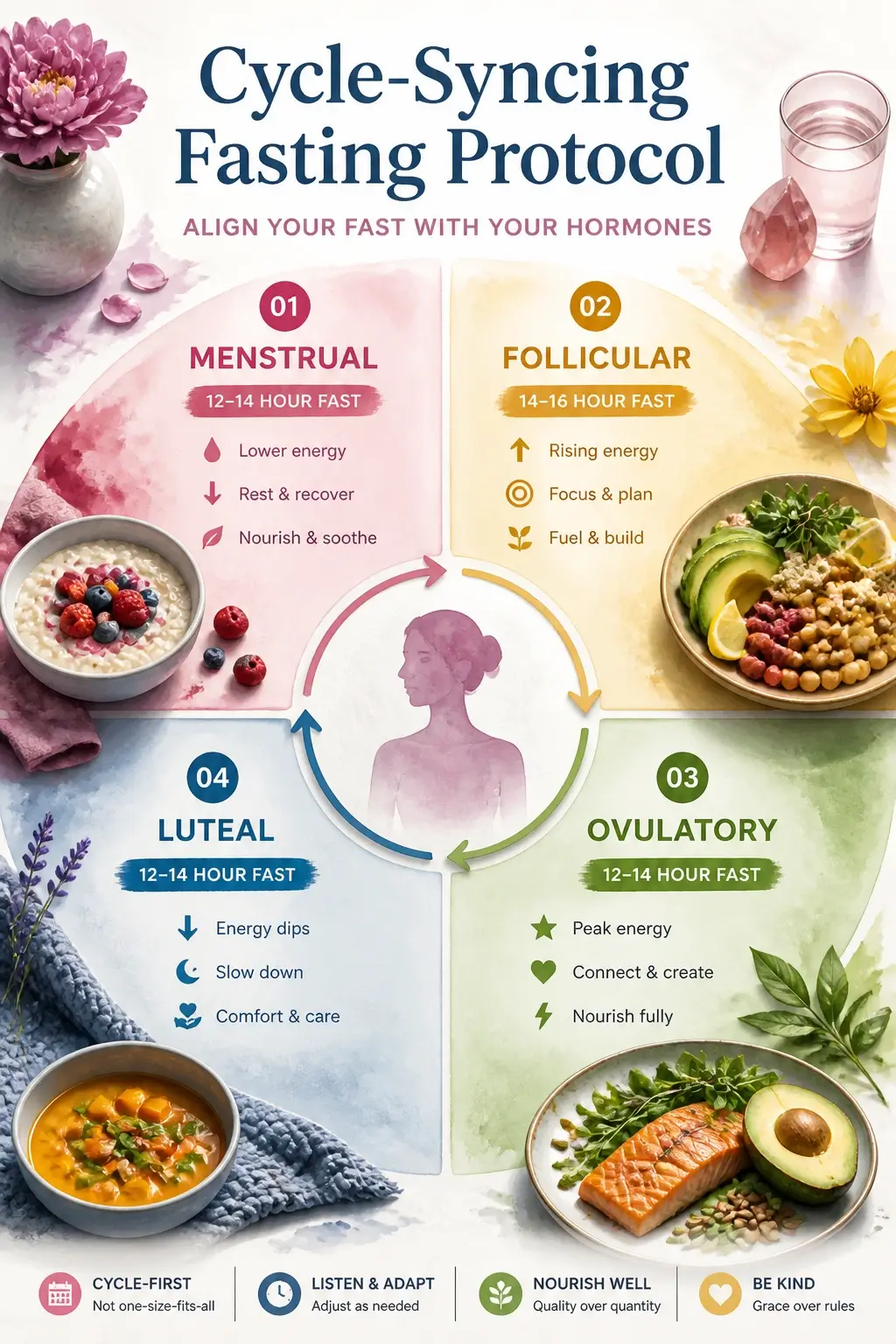
Follicular Phase (Days 1–14): Estrogen is rising, insulin sensitivity is at its monthly peak, and appetite is naturally more manageable. This is the most fasting-tolerant window in the cycle. A 14- to 16-hour fast is generally well-supported here – but the key word is selectively. The Crescendo Method applies: use longer fasts on 2–3 non-consecutive days per week rather than daily. Daily fasting, even in the follicular phase, can accumulate enough HPA-axis stress to tip the cortisol balance over time.
Ovulatory Phase (Around Day 14): Estrogen peaks sharply right before ovulation – this is the highest-estrogen moment of the cycle. The kisspeptin system is most active, and GnRH pulsatility is at its monthly high. This is not the moment to layer on metabolic stress. Dial the fast back to 13–14 hours maximum, and avoid high-intensity exercise combined with fasting in this window, which compounds the hormonal load.
Luteal Phase (Days 15–28): Progesterone dominates. The body is running warmer, burning more at rest, and is more insulin-resistant by design. Genuine hunger in this phase is not a lack of discipline – it’s the body accurately communicating an increased nutritional requirement. The appropriate response is a gentle 12-hour circadian-aligned overnight rest (eating dinner by 7 p.m. and breakfast by 7 a.m., for example), or no deliberate fast at all. Front-load calories earlier in the day to work with the natural cortisol curve rather than against it.
The Early Eating Window Principle: Across all phases, finishing food by 6–7 p.m. aligns with the body’s natural circadian cortisol and insulin rhythms more effectively than the popular “skip breakfast” model. Skipping breakfast extends the cortisol spike that peaks in the morning; finishing dinner early allows insulin sensitivity to recover overnight. For women specifically, the early eating window is often the higher-leverage adjustment – more impactful than simply extending the morning fast.
Fasting Before and After Menopause
Menopausal fasting strategies require a different map – not because the underlying biology reverses, but because the hormonal reference points shift dramatically. Perimenopause and post-menopause present two distinct environments, and conflating them produces the same kind of mismatch as treating the follicular and luteal phases as identical.
Here’s how the approach changes across the transition, along with an illustration of what this looks like as a daily practice.

Perimenopause is characterized by erratic estrogen and progesterone fluctuation – not a smooth decline, but an unpredictable oscillation that can produce surges and crashes within the same week. The HPA axis is already sensitized in this period; hot flashes, sleep disruption, and anxiety are all signs of a stress-response system that is running closer to its threshold. Layering aggressive fasting onto an already-sensitized HPA axis is a reliable way to amplify those symptoms. The recommendation here is a steady, mild overnight fast of 12–14 hours – enough to support circadian alignment and metabolic function without adding another stressor to an already-loaded system. Longer fasts, and particularly daily 16:8, carry a meaningful risk of worsening sleep fragmentation and hot flash frequency during this transition.
Post-menopause presents a different calculus. Once estrogen and progesterone are low but stable, the monthly hormonal variation that required cycle-syncing disappears. The primary metabolic concerns shift: post-menopausal women face a meaningful decline in insulin sensitivity, a shift in body fat toward visceral (abdominal) distribution, and early signals of increased cardiovascular and cognitive risk. Time-restricted eating becomes a genuinely useful tool here – not a hormonal risk to manage, but a mechanism to counteract the metabolic changes that low estrogen drives. A 14:10 or 16:8 window can be appropriate, with the same early eating window principle applying: finish food earlier rather than skipping breakfast.
Even in post-menopause, cortisol sensitivity doesn’t vanish. Estrogen had a buffering effect on the HPA axis – lower estrogen means the stress response can run hotter. If thyroid function is compromised or adrenaline-driven sleep disturbance appears (that 2–3 a.m. awakening again), shorten the fasting window before adding any other intervention.
Dr. Kristina A. Varady, a leading intermittent fasting researcher at the University of Illinois Chicago, offers a grounded read on the post-menopausal evidence:
“Post-menopausal women demonstrate similar hormonal and metabolic benefits from IF compared to younger women, including improved glucose and insulin concentrations… In addition, some studies have also demonstrated a decrease in serum cortisol concentration with IF, potentially improving stress-related hormonal imbalances, and an increase in DHEAS, a hormone that usually declines during menopause and may contribute to menopausal symptoms.”
The DHEAS finding is worth sitting with. DHEA declines naturally with age and more sharply with the loss of ovarian function – an increase under fasting conditions in post-menopausal women is a meaningful signal, and one that runs in the opposite direction from the DHEA decline observed in premenopausal women in other trials. The same hormone, moving in different directions depending on hormonal context. This is exactly why the life-stage distinction matters.
Research specifically on post-menopausal women and fasting is still in early stages, but the metabolic signals are encouraging enough that a thoughtful, early-window time-restricted eating approach is a reasonable starting point – with self-monitoring as the non-negotiable companion.
Signs Your Fast Is Hurting Your Hormones
Fasting-related hormonal distress signs don’t always announce themselves loudly. Sometimes they arrive as a cycle that’s a few days late, a restless 3 a.m. awakening, or a mood that feels off but doesn’t quite fit the usual PMS pattern. These are the body’s feedback signals – and learning to read them is more valuable than any fasting protocol.
The following symptoms are the clearest indicators that fasting stress has crossed from beneficial to disruptive:
- Menstrual irregularity: A period that arrives late, skips a month, or becomes noticeably lighter is the most direct signal that the kisspeptin-GnRH axis has been suppressed. This is the body’s first line of reproductive self-protection, and it should be taken seriously at the first occurrence – not after several months of hoping it resolves.
- Middle-of-the-night awakening: Waking abruptly between 2 and 3 a.m. with a racing mind or a sense of anxiety is the signature of a midnight cortisol spike. The body, perceiving insufficient energy stores, triggers a cortisol-adrenaline response to mobilize glucose. This is a direct fasting artifact, and it disrupts sleep architecture in ways that compound hormonal stress over time.
- Hair shedding, brittle nails, or sudden adult acne: These are slower-moving signals. Hair shedding, in particular, often lags the hormonal disruption by 2–3 months – meaning by the time you notice it, the stressor has been running for a while. Brittle nails and acne can reflect both thyroid downregulation and the androgenic shift that elevated cortisol can drive.
- Persistent cold hands and feet with unexplained fatigue: These are classic signs of a downregulated thyroid – specifically, reduced conversion of T4 to active T3. Fasting-induced cortisol elevation suppresses this conversion. If you’re consistently cold and tired despite adequate sleep, thyroid function is worth investigating before extending any fasting window.
- New anxiety, irritability, or mood crashes: Mood changes that feel qualitatively different from normal cycle fluctuation – sharper, less predictable, or present in phases of the cycle where you’re usually stable – are worth noting. These can reflect both the cortisol-progesterone dynamic described earlier and disrupted serotonin availability (gut health and nutrient intake both influence serotonin precursor availability, and aggressive fasting affects both).
Any single one of these signals is sufficient reason to shorten the fasting window or pause entirely. Two or more occurring simultaneously is a clear instruction to stop and reassess. If symptoms persist after adjusting the protocol, a healthcare practitioner – ideally one familiar with hormonal health – should be in the conversation.
Fasting is a voluntary stressor. The entire logic of its benefit rests on the body having enough resilience to adapt to it. When the body signals it has crossed into overload, continuing is not discipline – it’s ignoring the data.
The video below walks through some of the most common fasting mistakes that drive these hormonal warning signs, with practical context for how to recognize them in real time.
What the Research Really Shows (And Where the Gaps Are)
Intermittent fasting research evidence for women is growing – but it is not settled. What exists is a small number of well-designed trials, a larger body of mechanistic and animal data, and a significant landscape of unanswered questions that most popular summaries paper over. Understanding what the studies actually measured, what they found, and where they went silent is the most useful thing you can take from this section.
DHEA Drop, PCOS Improvement, and an Unexplained Selectivity
The DHEA reduction and PCOS benefit findings from recent trials represent the most important – and most underreported – data points in the women’s fasting literature. The University of Illinois Chicago (UIC) 6-month randomized controlled trial is the most relevant anchor: participants doing time-restricted eating lost approximately 3–4% of body weight, comparable to calorie restriction controls. But the hormonal findings were more interesting than the weight data.
DHEA – a precursor hormone used in fertility contexts and a marker of adrenal reserve – dropped by 14% in the time-restricted eating group. The researchers labeled this decline “within normal range,” which is technically accurate. But as UIC’s own reporting on the trial notes, the clinical meaning of a within-range decline in a fertility-relevant precursor hormone has not been established. The science didn’t close that door; it just didn’t open it further.
The PCOS finding runs in the opposite direction and is arguably more striking. Women with PCOS in the same study saw reductions in testosterone and free androgen index (FAI), alongside improvements in A1C. For women whose primary hormonal problem is androgen excess – which is the defining feature of PCOS – fasting appears to be therapeutically useful, not harmful.
Then there’s the detail that most summaries miss entirely. Dr. Sofia Cienfuegos, a leading researcher in intermittent fasting and metabolic endocrinology, puts it plainly:
“Our results suggest that intermittent fasting decreases androgen markers (i.e., testosterone and the free androgen index (FAI)) while increasing sex hormone-binding globulin (SHBG) levels in premenopausal females with obesity… The evidence in this area is still very limited… Future studies should also examine how other sex hormones in females respond to fasting such as progesterone and estrone.”
The FAI reduction occurred only in the time-restricted eating group – not in the calorie-restriction control group, despite both groups losing approximately the same weight (~10 lbs) on a similar caloric deficit (~200 kcal/day). Identical weight loss, different hormonal outcome. That’s not an energy balance story. That’s a timing-dependent biological switch, and no current study explains the mechanism. It challenges the foundational assumption that a calorie deficit is a calorie deficit – that what matters is the amount, not the timing.
Evidence Gaps and What They Mean for Your Practice
The evidence gaps in women’s intermittent fasting are not minor footnotes – they are the shape of the field right now, and understanding them is what separates an informed practice from a blind one.
The most significant gap is the one that matters most to the women most worried about fasting: no large clinical trial has reported amenorrhea incidence under any intermittent fasting protocol. Not 16:8, not 5:2, not any variant. The risk that women fear most – losing their period – has no published frequency data. That absence doesn’t mean the risk doesn’t exist; it means no one has properly measured it.
Cycle-syncing protocols – the phase-by-phase framework described earlier – are physiologically reasoned and clinically sensible, but they are experimentally untested. There is no randomized trial comparing cycle-synced fasting to daily fasting in cycling women. The recommendation rests on what we know about luteal-phase physiology and cortisol dynamics, not on direct outcome data. That’s a meaningful distinction.
Perimenopausal data are thin. Post-menopausal data are slightly better, but still early. The mechanistic case for fasting in post-menopause is strong; the clinical outcome data are preliminary.
What this means in practice: intermittent fasting is not inherently unsafe for women, and the evidence does not support a blanket warning. But it is not one-size-fits-all, and the research is not mature enough to tell you exactly where the lines are. For cycling women, a moderate, cycle-aware approach is the most defensible path – one that uses the follicular phase’s resilience and respects the luteal phase’s demands. For women with PCOS, the evidence tilts toward potential benefit. For post-menopausal women, the metabolic case is encouraging and the hormonal risks are lower.
In every case, self-monitoring remains the most reliable instrument available. Until better data arrive, your body’s feedback signals – your cycle regularity, your sleep quality, your energy and mood – are the most real-time, individualized trial you have access to.
Key Takeaways on Intermittent Fasting for Women
- The female brain uses a kisspeptin-leptin energy gate that can suppress ovulation when fasting lowers leptin – a mechanism that has no direct equivalent in male physiology.
- Elevated cortisol from aggressive fasting competes with progesterone for the same biosynthetic precursor, making progesterone the first hormonal casualty of chronic fasting stress.
- The luteal phase increases resting metabolic rate and insulin resistance by design; extending a fast past 12 hours in this window compounds cortisol and works against the body’s nutritional requirements.
- A 14% drop in DHEA was the only quantitative hormonal shift reported across female fasting trials – its clinical meaning in fertility contexts has not been established.
- Time-restricted eating reduced testosterone and free androgen index in women with PCOS while calorie restriction alone did not, suggesting a timing-specific hormonal mechanism beyond simple energy balance.
- No published clinical trial has reported amenorrhea incidence under any intermittent fasting protocol, meaning the most-feared risk for cycling women has never been properly measured.
Frequently Asked Questions About Intermittent Fasting for Women
Does intermittent fasting negatively affect women’s hormones?
It depends entirely on the protocol, the phase of the cycle, and the woman’s underlying hormonal health. For cycling women doing daily 16:8, fasting can suppress progesterone and disrupt GnRH pulsatility – but for women with PCOS, the same style of fasting has shown measurable hormonal improvements.
How long is it safe for women to fast each day?
For most cycling women, a 12-hour overnight fast is the safest consistent baseline – particularly in the luteal phase. Longer windows of 14–16 hours can be appropriate in the follicular phase, used selectively rather than daily.
Can intermittent fasting cause you to lose your period?
It’s biologically plausible – fasting suppresses the kisspeptin-GnRH axis that drives ovulation – but no large clinical trial has actually measured how often this happens under any specific fasting protocol. If your period becomes irregular or stops, that’s a clear signal to shorten or pause your fasting window.
Can intermittent fasting lower A1C?
Yes – the UIC trial found improvements in A1C alongside weight loss in women doing time-restricted eating, with particularly notable metabolic improvements in women with PCOS. The effect appears to involve more than calorie reduction alone.
Is fasting good for people with Hashimoto’s?
Fasting-induced cortisol elevation suppresses the conversion of T4 to active T3, which is already a common dysfunction in Hashimoto’s. For women with this condition, aggressive fasting protocols carry a specific risk of worsening thyroid function and fatigue – a conservative 12-hour overnight window and close symptom monitoring is the more prudent starting point.
What’s the difference between cycle-syncing fasting and standard intermittent fasting?
Standard intermittent fasting applies the same fasting window every day regardless of cycle phase. Cycle-syncing adjusts the window to match the hormonal environment of each phase – longer fasts in the follicular phase when estrogen supports them, shorter or no fasts in the luteal phase when progesterone demands more fuel. The approach is physiologically reasoned but not yet validated in large randomized trials.
Is fasting safe on tirzepatide for women?
Tirzepatide already significantly reduces appetite and alters insulin and GLP-1 signaling – combining it with deliberate fasting can create a compounded caloric deficit that may amplify the kisspeptin-suppression and cortisol effects described above. This combination warrants direct guidance from a prescribing clinician rather than a self-directed protocol.
At what age should women stop doing intermittent fasting?
There’s no universal cut-off age, but the protocol should shift with life stage. Perimenopausal women benefit from shorter, gentler windows due to HPA-axis sensitization. Post-menopausal women can often tolerate more structured time-restricted eating without the cycle-syncing complexity. The signal to adjust is always symptoms, not a number.
References
- Leptin/leptinR-kisspeptin/kiss1r-GnRH Pathway Reacting to Fasting – pubmed.ncbi.nlm.nih.gov
- Metabolic Regulation of Kisspeptin – the Link Between Energy and Reproduction – pmc.ncbi.nlm.nih.gov
- Importance of Leptin to Reproduction – academic.oup.com
- Beyond Leptin: Emerging Candidates for the Integration of Metabolic and Reproductive Function – pmc.ncbi.nlm.nih.gov
- Fasting Modulates GABAergic Synaptic Transmission to Kisspeptin Neurons – academic.oup.com
- Intermittent Fasting and Women’s Hormones – Dr. Bradley S. Appelhans, Nutrients – mdpi.com
- New Data on How Intermittent Fasting Affects Female Hormones – UIC Today – today.uic.edu
- Intermittent Fasting and Hormonal Health in Premenopausal Women – Dr. Sofia Cienfuegos – mdpi.com
- Intermittent Fasting and Menopausal Women – Dr. Kristina A. Varady, Nutrients – mdpi.com