
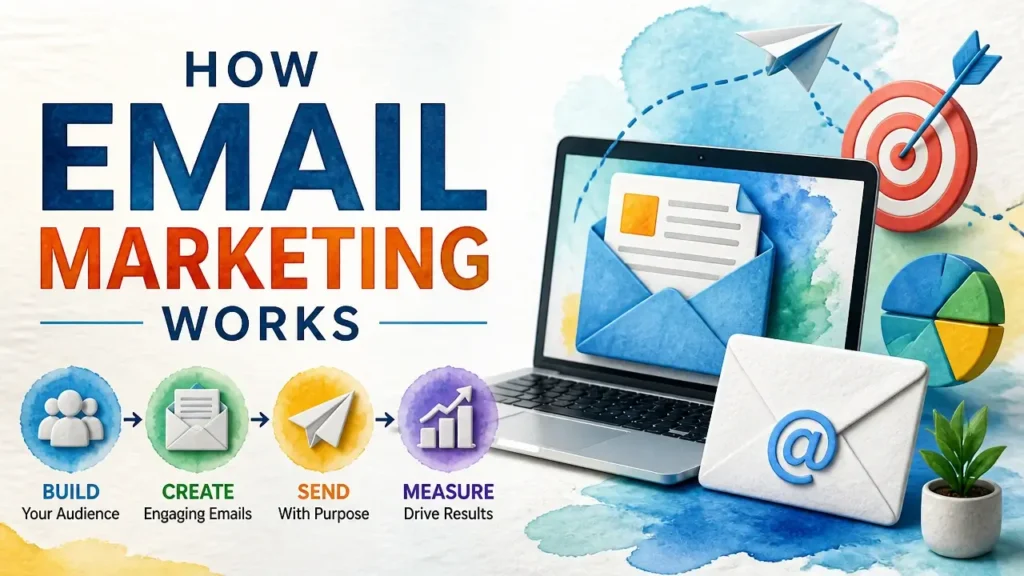
Permission-based email marketing operates as a closed-loop system – not a broadcast tool – where every send either builds or erodes the trust that determines whether your next message lands in the inbox or disappears into spam. Most beginners inherit the wrong mental model before they write a single subject line.
Understanding how this system actually works – from the opt-in moment through automation, measurement, and deliverability – is the difference between an email list that compounds in value over time and one that quietly destroys your sender reputation while you wonder why revenue isn’t moving.
What Email Marketing Actually Is
Permission-based email marketing functions as a closed-loop owned media channel where a specific subscriber grants explicit authorization before receiving any message – making it structurally different from every other digital direct marketing channel available to a business today. That single word, permission, is what separates a high-performing email program from a spam operation, regardless of how sophisticated the creative is. The authorization is the foundation; everything else is architecture built on top of it.
Most beginners arrive with a social media frame of reference. They think about reach, follower counts, and feed algorithms. Email marketing operates on a different logic entirely: you own the list. No platform can change its algorithm and cut your organic reach by 80% overnight. No account suspension erases your audience. The relationship between you and your subscriber exists on infrastructure you control through your Email Service Provider – the software layer that manages your contacts, executes your sends, and tracks what happens after.
What email marketing is not is equally important to establish before going further. It is not cold outreach to purchased contact lists. It is not sending the same message to every subscriber regardless of where they are in their relationship with you. And it is not a revenue machine you configure once and leave running. Each of those assumptions produces a different failure mode, and all three are common.
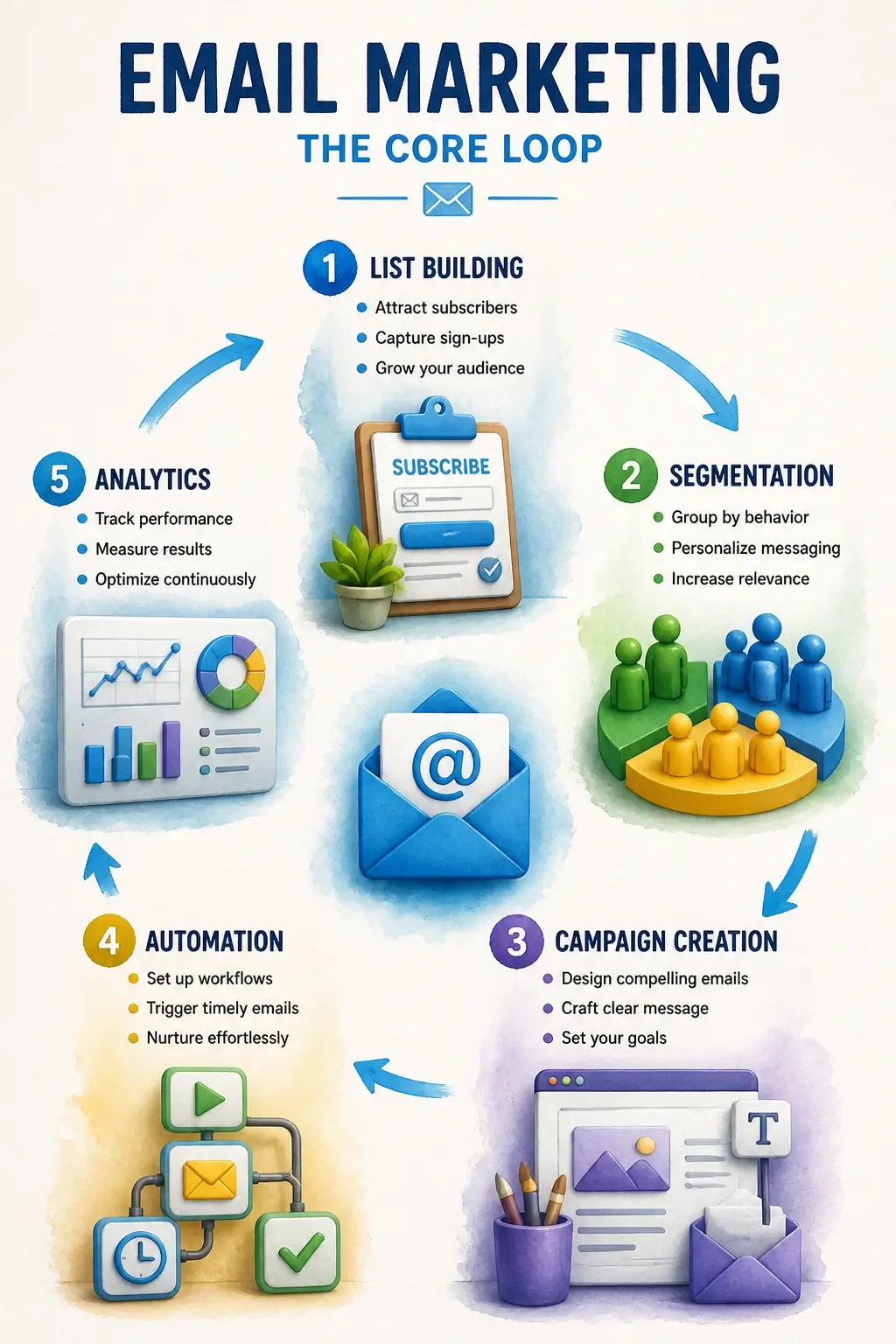
The system that makes email marketing work follows a repeatable internal loop: you build a list of consenting subscribers, sort them by relevant characteristics, create campaigns matched to those segments, automate the sequences that would be impossible to manage manually, and measure the results to improve the next cycle. That loop – List Building → Segmentation → Campaign Creation → Automation → Analytics – is the architecture this article walks through, section by section.
Here is a visual of how that loop connects as a functioning system:
The permission model is not just an ethical preference. Dr. Suchul Cha and Dr. Yenegeun Joung, cybersecurity and networks researchers published in the Journal of Systems and Software, frame it as a data ownership question:
“The idea is to treat email address as a data owned by the addressee, and any use of the data-that is, to send messages to the addressee-must be authorized by the person through the issue of licenses.”
That framing reorients the entire practice. Your subscriber’s email address is not a lead you captured – it is data they own and chose to share with you under specific conditions. The moment you treat it otherwise, the system starts breaking down.
The Opt-In Moment: Building a List Worth Owning
Effective opt-in mechanisms function as value transactions – a visitor hands over their email address in exchange for something they perceive as genuinely useful, and the quality of that exchange determines the engagement level of every subscriber who enters through it. A sign-up form with no clear reason to fill it out is not a list-building tool; it is friction with a submit button.
The most common opt-in entry points each attract a different type of subscriber intent. An embedded form on a content page captures readers who are already engaged with your thinking. A behavior-triggered pop-up – one that fires after a visitor has spent 60 seconds on a page or scrolled 70% down – catches people at a moment of demonstrated interest rather than interrupting them on arrival. A standalone landing page, stripped of navigation and built around a single offer, converts paid traffic with focused intent. Where someone enters your list tells you something about why they entered, which is useful context for what you send them next.
The single most common mistake beginners make is purchasing an email list. The causal chain is direct and unforgiving: purchased lists contain addresses that never consented to hear from you, which means a meaningful percentage will mark your email as spam the moment it arrives. Spam complaints above a certain threshold – Google and Yahoo now enforce a 0.1% complaint rate ceiling for bulk senders – signal to mailbox providers that your messages are unwanted. Once your sender reputation takes that hit, even your legitimate subscribers who want your emails start receiving them in the spam folder. One shortcut poisons the entire program.
This is where the “more subscribers is better” assumption breaks. An engaged list of 200 people who consistently open and click will generate more clicks, more replies, and more revenue than a neglected list of 2,000 people who signed up for a discount two years ago and have not opened anything since. The 2,000-person list looks more impressive in a dashboard. It performs worse in practice, and it costs more to maintain.
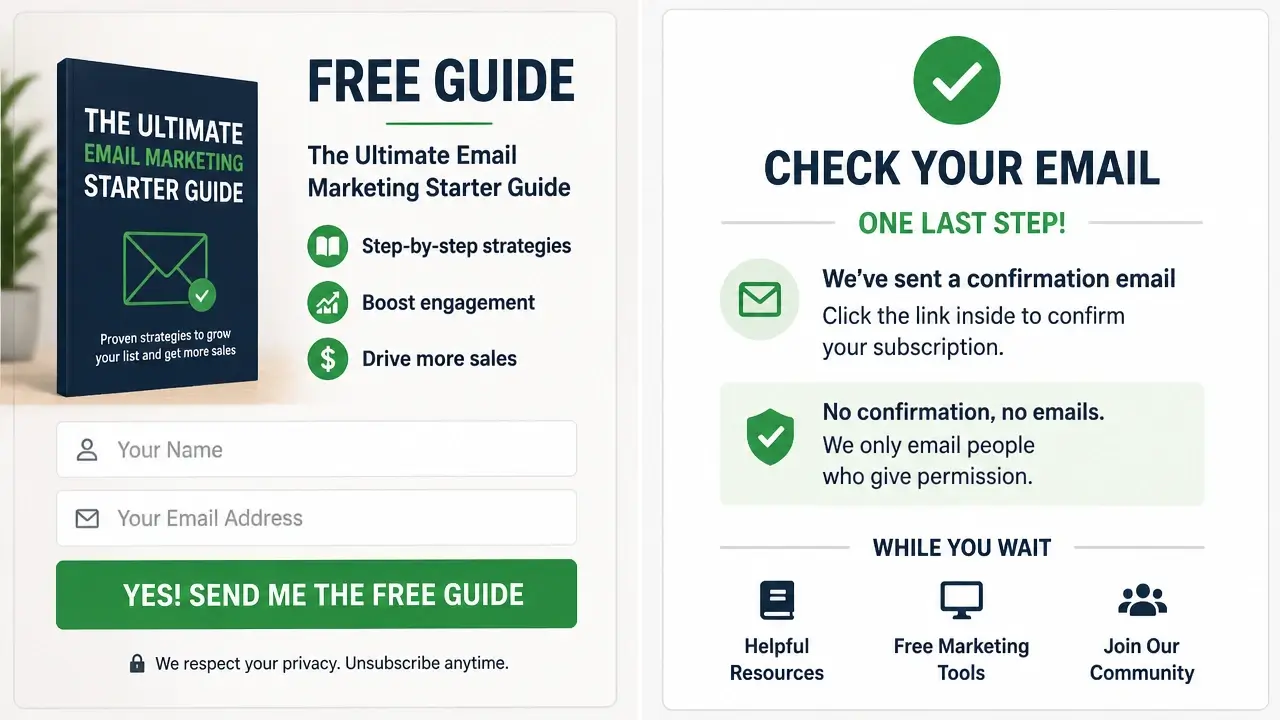
The choice between single opt-in and confirmed (double) opt-in reflects this tension directly. Single opt-in adds subscribers immediately after they submit the form – faster list growth, lower friction. Double opt-in requires them to confirm via a follow-up email before they’re added – slower growth, but the resulting list contains only people who were motivated enough to take a second action. Neither is universally correct; the tradeoff is between growth speed and engagement quality, and that choice has downstream consequences for deliverability that will surface later.
Here is what a well-constructed opt-in form looks like in practice:
Research on what actually motivates subscribers to opt in supports a non-obvious conclusion. Dr. Hongsik John Cheon, Dr. JaeMin Cha, and Dr. Marilyn S. Roberts, academic researchers in advertising and marketing published in Decision Support Systems, found:
“Firms and marketers may be able to elicit information from customers with strong privacy concerns by providing persuasive non-monetary benefits… Persuasive non-monetary benefits such as personalized services based on disclosed customer data outweigh monetary incentives in enticing customers to disclose information.”
The practical implication: a discount code gets someone onto your list. A promise of genuinely personalized, relevant content keeps them there. The lead magnet is the door; what’s on the other side of it determines whether they stay.
What You Send and to Whom: Segmentation and Campaign Types
Segmentation processes divide a subscriber list into smaller groups based on shared characteristics so that each group receives messages relevant to their specific situation – and the difference between a segmented send and a broadcast is the difference between a relevant message and noise. The simplest way to understand why segmentation matters is through a concrete contrast: the email you send to someone who subscribed this morning should be nothing like the email you send to someone who hasn’t opened anything in four months.
The primary segmentation dimensions a beginner can act on immediately fall into three categories. Demographics – location, age, job role – are the bluntest instrument but useful for geography-dependent offers or industry-specific content. Behavioral segmentation is more powerful: what links did someone click, what product pages did they visit, what did they purchase? These actions reveal intent more reliably than demographic data. Lifecycle stage – new subscriber, active customer, lapsed subscriber – determines what kind of relationship you’re in with that person, which should shape the entire tone and purpose of the email.
Understanding campaign types is the vocabulary layer that makes segmentation actionable. Five types form the core of any email program:
The Welcome Series is the highest-open-rate moment you will ever have with a subscriber. Attention and curiosity are at their peak. A two or three-email sequence in the first week introduces your brand, delivers whatever you promised at sign-up, and makes a soft first offer while trust is still fresh.
Promotional campaigns are time-bounded sends around specific offers – a product launch, a sale, a limited enrollment window. They are transactional in intent and should be treated as such: clear offer, clear deadline, clear call to action.
Newsletters are the ongoing relationship maintenance layer. No hard sell; the purpose is to deliver consistent value that keeps you in the subscriber’s mental landscape between purchase moments.
Transactional emails – order confirmations, shipping notifications, password resets – have the highest open rates of any email type because the subscriber is expecting them. They are not marketing emails in the traditional sense, but they are opportunities to reinforce trust and introduce the next relevant step.
Re-engagement campaigns target subscribers who have gone cold. Before you remove them from your list, you make one deliberate attempt to remind them why they signed up – and if they don’t respond, you remove them. Their departure protects the deliverability health of everyone who stays.
The relationship between segmentation and campaign type is not sequential – it’s structural. A Welcome Series is inherently segmented to new subscribers. A re-engagement campaign is inherently segmented to lapsed ones. Beginners often try to learn segmentation as a standalone skill before understanding what they are segmenting for. The campaign type defines the purpose; the segment defines the audience.
Here is a reference table mapping each campaign type to its function, timing, and subscriber stage:
| Campaign Type | Purpose | Timing | Segmentation Basis | Optimal Subscriber Stage |
|---|---|---|---|---|
| Welcome Series | Introduce brand, deliver lead magnet, make soft first offer | Immediately after opt-in (Day 0–7) | New subscribers only | Brand new |
| Promotional Campaign | Drive conversions around a specific offer or event | Time-bounded (sale, launch, enrollment) | Purchase history, interest tags, engagement level | Active subscribers |
| Newsletter | Sustain relationship, deliver ongoing value | Recurring (weekly, biweekly, monthly) | Full list or broad segments by interest | Active and semi-active |
| Transactional Email | Confirm actions, deliver receipts, trigger notifications | Immediately after triggering action | Behavior-triggered (purchase, sign-up, reset) | Customers and active users |
| Re-engagement Campaign | Revive cold subscribers before list pruning | After 60–90 days of inactivity | Lapsed subscribers (no opens or clicks) | Cold or inactive |
A segmented, well-timed campaign creates the conditions where good content can succeed. But sorting your subscribers correctly does not guarantee results – it removes the ceiling that would otherwise prevent them.
The Invisible Engine: How Automation Sends Emails You Didn’t Write
A well-configured marketing automation framework sends pre-written emails automatically when a subscriber meets a specific trigger condition – meaning the right message reaches the right person at the right moment without anyone manually initiating the send. The trigger is the intelligence layer: it replaces the human judgment call of “when should I send this?” with a rule that fires consistently at scale.
The two fundamental automation categories work differently and serve different purposes. A behavioral trigger fires once in response to something a subscriber did: they abandoned a cart, clicked a specific link, downloaded a resource, or made a purchase. The email that follows is a direct response to that action, which is why it tends to perform well – it arrives in context. A lifecycle sequence is a timed series that guides a subscriber through a stage regardless of specific actions. An onboarding sequence runs for new customers over their first 30 days. A post-purchase follow-up series runs after a transaction to encourage a second purchase or build product adoption.
For a beginner, the highest-impact automation to build first is the Welcome Sequence. When someone subscribes, they have just made a micro-commitment – they raised their hand and said they want to hear from you. That moment of peak attention is brief. A two or three-email series delivered over the first seven days capitalizes on it: the first email delivers whatever was promised at opt-in, the second introduces your brand’s perspective or most useful content, and the third makes a first soft offer. By the time that sequence ends, the subscriber has a genuine sense of what you stand for and whether they want to keep engaging.
The phrase “set and forget” gets attached to automation constantly, and it is misleading. Automation reduces the repetitive manual work of sending individually timed emails. It does not eliminate the need for ongoing review. Your offers change. Subscriber expectations evolve. An abandoned cart sequence written for a product that no longer exists, or a welcome email referencing a lead magnet you retired six months ago, erodes trust rather than building it. Automation requires a maintenance calendar, not just a setup session.
To see how a welcome sequence automation is actually configured inside an ESP, this walkthrough covers the mechanics step by step:
The research on triggered automation supports the efficiency argument directly. Dr. Inigo Gallo and Dr. Ines Recio, digital marketing experts published in the Journal of Interactive Marketing, describe the structural advantage:
“Triggered email marketing is an automated process that sends messages to customers as a response to specific actions taken by website visitors. Compared to traditional emails, triggered messages can be cost-effective, allowing for communication with the right customer at the right time.”
The cost-effectiveness argument is real, but it depends on the trigger logic being accurate. A trigger that misfires – sending a “welcome back” email to someone who never left – signals to the subscriber that the system doesn’t actually know them. The trigger condition parameters are where automation either earns trust or burns it.
How to Know It’s Working: Metrics, Misconceptions, and the Open Rate Trap
Email performance metrics are the diagnostic instruments that tell you which part of the system is failing – but only if you know which numbers are still reliable and which ones were quietly broken by an infrastructure change most practitioners haven’t accounted for. Starting with the standard metric definitions is necessary; understanding their current limitations is what separates a practitioner who optimizes from one who chases numbers that no longer mean what they used to.
Apple MPP and the Open Rate Distortion
Core email performance metrics each diagnose a different failure point in the system, and Apple Mail Privacy Protection has fundamentally altered what the most-watched metric actually measures. Before applying any of these numbers, you need to know what each one is actually counting.
Open Rate is the percentage of delivered emails that were recorded as opened. It has historically been the headline metric – the first number every beginner checks. The caveat, addressed below, is significant enough to change how you weight it.
Click-Through Rate (CTR) is the percentage of all recipients who clicked any link in the email. It measures the combined effectiveness of subject line, preheader, content, and call to action together – because a click requires all of those to have worked.
Click-to-Open Rate (CTOR) is the percentage of openers who clicked. This metric isolates content effectiveness: once the subject line did its job and someone opened, did the email deliver enough value to earn a click? A high open rate with a low CTOR tells you the subject line overpromised.
Unsubscribe Rate is the percentage of recipients who opted out after a given send. A rising unsubscribe rate is a frequency or relevance signal – you’re either sending too often or sending content that doesn’t match what the subscriber signed up for.
Each of these metrics points to a specific part of the system. A low open rate is a subject line or sender name problem. A low CTOR is a content and offer alignment problem. A climbing unsubscribe rate is a segmentation or frequency problem.
Now the structural problem with open rate specifically. In 2021, Apple introduced Mail Privacy Protection – a feature that pre-loads email content, including tracking pixels, on Apple’s proxy servers before the subscriber ever sees the message. The tracking pixel fires automatically, regardless of whether a human opened the email. The result: any subscriber using Apple Mail generates a recorded “open” that may have no human behind it.
According to data compiled by Sender.net’s 2026 analysis of Apple MPP, Apple Mail holds a significant share of the email client market, which means a meaningful percentage of every send to a mixed list is generating artificial open signals. The industry has largely continued presenting open rate as a primary success metric without contextualizing this distortion – a gap that misleads practitioners into believing their emails are performing better than they are.
The practical adjustment is to treat open rate as a directional indicator at best. Shift your analytical weight toward CTOR, click rates, and conversion tracking – metrics that still require a human to take a deliberate action that no proxy server can replicate.
Dr. Anna-Maria G. Symeonidou and Dr. Irene Rigara, neuromarketing researchers published in Multimodal Technologies and Interaction, surface the deeper measurement challenge:
“Most people struggle to articulate the reasons why a promotional email they are exposed to influences them to make a purchase. Marketing experts and companies find it beneficial to understand these reasons, even if consumers themselves cannot express them…”
The implication for measurement: even the metrics that work correctly only capture what happened, not why. Clicks and conversions tell you the outcome; understanding the mechanism behind them requires the kind of ongoing testing and observation that no single dashboard view provides.
List Quality as the Root of Every Metric Problem
List quality is the upstream variable that determines whether any of your performance metrics are worth optimizing – and the clearest proof that subscriber count is a vanity metric is visible in the math. A list of 500 subscribers with a 30% engagement rate produces 150 active responders. A list of 5,000 subscribers with a 3% engagement rate produces 150 active responders. Same output, ten times the cost to maintain, and the larger list is actively degrading your sender reputation while you watch.
The unsubscribe rate is the most honest signal of this dynamic. A growing list with a climbing unsubscribe rate means you are acquiring subscribers faster than you are earning their trust. The net effect is a list that looks healthy in the contact count column and is quietly collapsing in engagement quality.
Deliverability is where list quality becomes an infrastructure problem rather than just a performance one. An email can be “delivered” – meaning your ESP recorded no hard bounce – and still land in the spam folder or the promotions tab where no subscriber will ever see it. The gap between “delivered” and “actually seen in the inbox” is invisible to standard dashboard reporting. You will never know how many of your sends were technically delivered but practically invisible unless you monitor inbox placement separately.
The causal chain connecting unengaged subscribers to deliverability failure is well-documented. A case study published by MarketingSherpa documented TBC Corporation’s experience: after separating inactive subscribers onto a dedicated IP and isolating them from the active list, overall delivery rates climbed from the 50–60% range to consistently above 90%, eventually reaching over 99%. The mechanism is straightforward – inactive subscribers generate low-engagement signals, potential spam-trap hits, and bounce accumulation that mailbox providers read as negative reputation indicators. MailMonitor’s analysis of the same experiment confirms the mechanism: removing those contacts eliminates the negative signals, allowing the sender’s reputation score to recover and inbox placement to improve.
Removing cold subscribers is not abandoning potential customers. It is protecting the inbox placement of every subscriber who actually wants your emails.
Why Your Emails Disappear: Permission, Infrastructure, and the Invisible Gatekeepers
Email deliverability – the measure of whether your message actually lands in the inbox rather than the spam folder or a silent block – is the final variable in the system, and it is the one most beginners discover only after something has already gone wrong. Delivery and deliverability are not the same thing. Your ESP reports a successful delivery the moment the receiving server accepts the message. Where that message goes after acceptance – inbox, spam, promotions tab, or nowhere – is determined by a set of infrastructure, behavioral, and compliance factors that your dashboard will never surface for you.
The first layer of that infrastructure is email authentication. Three protocols form the identity verification system that inbox providers use to decide whether to trust your messages.
SPF (Sender Policy Framework) verifies that the server sending your email is authorized to send on behalf of your domain. It answers the question: “Is this sender who they claim to be?” Dr. Yusuf Uzun and Dr. Ismail Sengor Altingovde, network and security researchers published in Computer Networks, describe its role directly:
“The SPF protocol is one of the most common sender authentication techniques. Popular e-mail services like Gmail, Hotmail and Yahoo recommend users to create an SPF record for their domains… An SPF check is the simplest, cheapest and quickest method to prevent the use of fake addresses in e-mails.”
DKIM (DomainKeys Identified Mail) adds a cryptographic signature to your outgoing emails that the receiving server can verify. It answers: “Was this message tampered with between sending and arrival?” If the signature doesn’t match, it signals that the email may have been altered in transit – a red flag for spam filters.
DMARC (Domain-based Message Authentication, Reporting, and Conformance) is the policy layer that sits above SPF and DKIM. It tells receiving servers what to do when those checks fail – quarantine the message, reject it, or deliver it anyway – and sends you reports on what’s happening with emails that claim to be from your domain. Without DMARC, you have no visibility into whether someone is spoofing your address.
These are not optional technical configurations for advanced practitioners. They are the baseline identity credentials that mailbox providers require before they will trust your sends. An email program without all three in place is operating without identification.
The legal framework adds a second layer of obligation. Permission-based marketing is not just an ethical best practice – in most jurisdictions, it is a legal requirement. CAN-SPAM in the United States requires accurate sender identification, a functional unsubscribe mechanism in every commercial email, and honoring opt-out requests within ten business days. GDPR in the European Union requires explicit consent before sending marketing emails to EU residents, along with the right to access and delete personal data. CASL in Canada applies some of the strictest consent requirements globally, requiring express or implied consent and a clear unsubscribe mechanism. The specifics vary by jurisdiction, but the common thread is this: compliance protects your sender reputation and your legal standing simultaneously. A complaint to a regulator costs more than a complaint to a mailbox provider.
The behavioral layer connects list hygiene directly to deliverability in a way that most beginners don’t anticipate. When a subscriber stops opening your emails – for weeks, then months – their inactivity is not neutral. Mailbox providers track engagement signals across their user base. A pattern of low engagement from your sends tells Gmail, Yahoo, and Outlook that your messages are not wanted, which incrementally lowers your sender reputation score. Once that score drops below a threshold, more of your emails start landing in spam – including emails to subscribers who are engaged and genuinely want to hear from you. The unengaged subscribers are collateral damage that becomes collateral damage to you.
The practical discipline is list hygiene: identifying subscribers who have not engaged in 60 to 90 days, running a re-engagement campaign as a last attempt to revive them, and removing those who don’t respond. This is not giving up on potential customers. It is the mechanism that protects inbox placement for every subscriber who is still paying attention.
The complete system – permission at the opt-in moment, quality over quantity in list building, relevant segmentation, timely automation, honest measurement, and deliverability discipline – does not work when any single component is neglected. Each layer depends on the ones before it. A beautifully segmented campaign built on a purchased list will fail at deliverability. An authenticated domain with perfect SPF and DKIM records cannot save a program that sends irrelevant content to an unengaged list. The system converts when all of it functions together.
Key Takeaways on Email Marketing
- Email marketing is a permission-based owned channel – your list belongs to you, no algorithm can take it.
- A small, engaged list consistently outperforms a large, neglected one in clicks, conversions, and deliverability.
- Apple’s Mail Privacy Protection has made open rate an unreliable primary metric; shift focus to CTOR and click rates.
- Segmentation creates the conditions for relevance – but it does not cause revenue on its own without strong content and timing.
- SPF, DKIM, and DMARC are not advanced configurations; they are baseline identity credentials every sender needs from day one.
- Removing unengaged subscribers protects inbox placement for the subscribers who actually want your emails.
Frequently Asked Questions About Email Marketing
How does email marketing work step by step?
A subscriber opts in through a form, gets added to your list inside an Email Service Provider, receives a welcome sequence, then enters segmented campaigns and automations triggered by their behavior or lifecycle stage. The whole loop – opt-in, segment, send, measure, adjust – repeats continuously as your list grows.
What’s the actual difference between a delivered email and one that reaches the inbox?
Your ESP marks an email as “delivered” the moment the receiving server accepts it, but that says nothing about where it lands. An email can be delivered and still go straight to spam or be silently filtered – which is why inbox placement monitoring is separate from the delivery rate your dashboard shows.
Is a bigger email list always better?
Not even close. A list of 500 engaged subscribers who open and click will generate more revenue and maintain better deliverability than a list of 5,000 cold contacts. Raw subscriber count is a vanity metric; engagement rate and inbox placement are the numbers that actually matter.
What is double opt-in and do I actually need it?
Double opt-in requires a new subscriber to confirm their email address via a follow-up message before they’re added to your list. It slows list growth but produces higher-quality subscribers who are less likely to mark your emails as spam. Whether you need it depends on how much you prioritize growth speed versus long-term list health.
How much does email list size affect what the list is worth?
List size alone tells you almost nothing about value. A list worth anything has consistent engagement, clean deliverability, and subscribers who match your offer. A 1,000-person list of buyers in your exact target market is worth more than a 10,000-person list of freebie-seekers who haven’t opened an email in a year.
What is the rule of 7 in email marketing?
The rule of 7 is a general marketing principle suggesting a prospect needs to encounter your message roughly seven times before taking action. In email, it reinforces the case for welcome sequences and lifecycle automations – repeated, relevant contact over time builds the familiarity that converts, rather than a single send expecting immediate results.
Why do my emails sometimes go to spam even when I’m not doing anything wrong?
Spam folder placement is driven by your sender reputation score, which mailbox providers calculate based on engagement signals across your entire list. If a significant portion of your subscribers are inactive and never open your emails, those low-engagement signals accumulate and push even your legitimate sends toward spam – regardless of how good your content is.
What happens if I send email marketing without SPF, DKIM, and DMARC set up?
Without those authentication protocols, receiving servers have no way to verify your identity, which makes your emails significantly more likely to be filtered or blocked. Google and Yahoo both tightened bulk sender requirements in 2024, making authentication effectively mandatory for anyone sending at volume. It’s not a nice-to-have; it’s the entry fee for inbox placement.
References
- Email Address Licensing Model for Permission-Based Email Marketing – ScienceDirect (Journal of Systems and Software)
- Privacy Concerns and Non-Monetary Benefits in Customer Data Disclosure – ScienceDirect (Decision Support Systems)
- Triggered Email Marketing in Digital Contexts – ScienceDirect (Journal of Interactive Marketing)
- Apple Mail Privacy Protection: The 2026 Guide to MPP, iOS 18, and the Metrics That Actually Matter – Sender.net
- Neuromarketing and Consumer Response to Promotional Email – MDPI (Multimodal Technologies and Interaction)
- Email Delivery Rate Increases from 60% to 99% by Separating Inactive Subscribers – MarketingSherpa
- Inactive Subscribers and Email Deliverability – MailMonitor
- SPF Protocol and Sender Authentication in Email Networks – ScienceDirect (Computer Networks)