

Email marketing platforms are not interchangeable tools with different price tags – they are operational bets with compounding consequences. Pick the wrong one and you’re not just switching software; you’re rebuilding automations, re-authenticating domains, and absorbing weeks of campaign disruption while your sending reputation resets.
The five platforms compared here – MailerLite, Brevo, Kit, Klaviyo, and ActiveCampaign – each win in a specific context. The goal isn’t to find the cheapest option. It’s to find the one you won’t need to escape from.
Before You Compare: The Real Factors That Break Platform Decisions
Platform selection factors are the variables most buyers skip entirely, treating email marketing platforms as interchangeable products differentiated only by starting price – and that assumption is where the real cost gets buried. The gap between what a platform charges at signup and what it actually costs 18 months later can be several hundred percent, and the pain of unwinding a wrong choice runs deeper than any monthly subscription difference.
Start with a concrete picture of what migration actually means. When you leave a platform, you’re not just canceling a subscription. You’re rebuilding email templates from scratch because design systems rarely transfer cleanly between tools. You’re re-integrating API connections into your email marketing platform, your e-commerce stack, or your lead capture forms. In many cases, you’re losing historical campaign data – open rate trends, click maps, A/B test results – that informed your current strategy. That’s a sunk cost that no “introductory offer” on the new platform comes close to offsetting.
So before you look at a single pricing page, anchor your evaluation to four pillars.
Pricing model scalability – don’t price the plan you’re on today. Project your subscriber count at 18 months and price that tier. The headline “starts at $X” is almost always the smallest the bill will ever be.
Automation depth matched to your capacity – a platform with 900 pre-built recipes is a liability if your team can’t maintain complex branching logic. Match the tool’s ceiling to your team’s realistic operating altitude, not its theoretical maximum.
Deliverability reputation tied to infrastructure and support – not a single claimed percentage. There is no controlled, cross-platform deliverability test available anywhere. Any figure you see – including a platform’s own published inbox rate – comes from a single-platform, uncontrolled environment that conflates the platform’s infrastructure with the sender’s own practices. List hygiene, content quality, and sending cadence account for the majority of your deliverability outcome. What you’re actually evaluating is whether the platform gives you dedicated IP support and a competent deliverability team when things go wrong.
Best-fit alignment with your business model – e-commerce, content creation, B2B services, and SaaS have fundamentally different email needs. A platform optimized for behavior-triggered purchase flows is over-engineered and overpriced for a newsletter operator. A creator-first tool is under-equipped for a sales team running account-based sequences.
Three scenarios run through the rest of this comparison and map directly to those pillars: the solopreneur on a tight budget, the small e-commerce store, and the content creator. A fourth – the B2B team needing CRM-level automation – enters later.
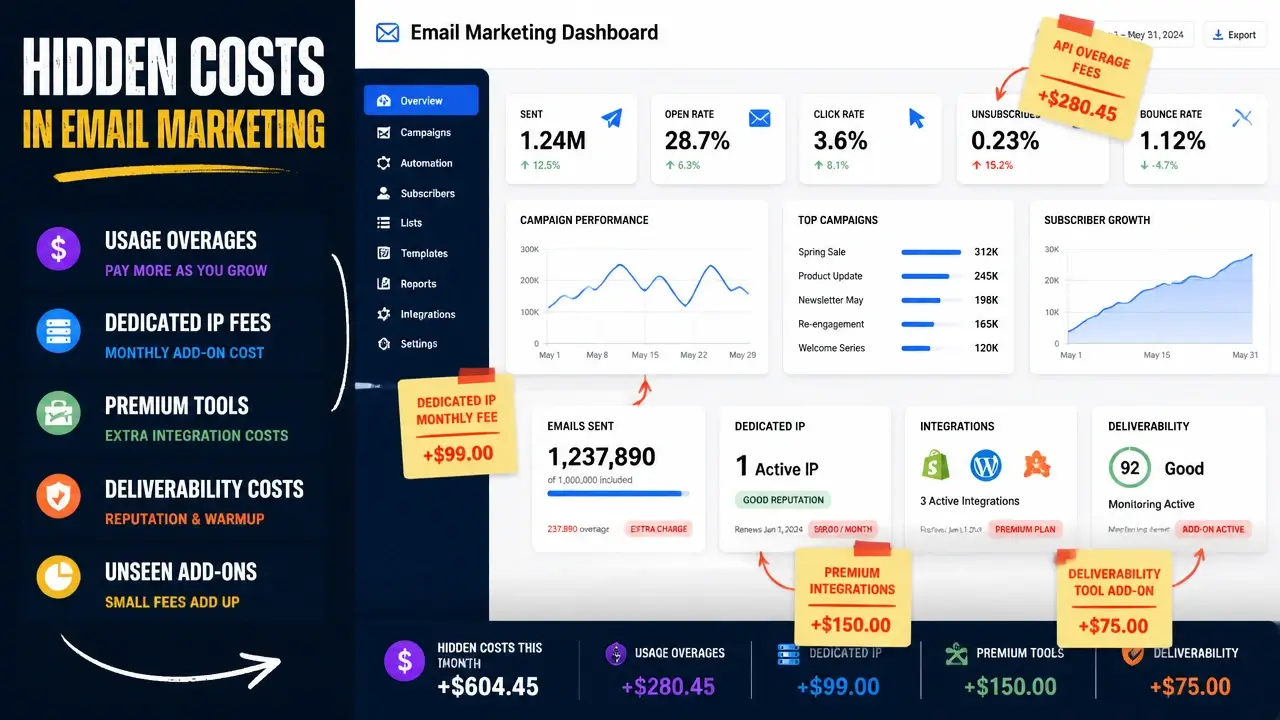
One more thing before the platform breakdowns. The real cost of any platform is not the subscription. Hidden line items quietly multiply the bill: API overage fees running $0.10–$1.00 per thousand emails beyond plan limits, dedicated IP addresses priced at $50–$200 per month as a separate add-on, SMS credits that expire before you use them, premium support tiers gated behind enterprise plans, and data export fees that surface only when you try to leave. For an agency scaling from 10 to 50 clients, enterprise tiers with white-label multi-client management can silently multiply costs by 500% while the vendor still quotes a “starting at” price in every comparison article.
The costs you can’t see on the pricing page are the ones that will define your actual experience.
Here’s a look at what that hidden cost accumulation looks like in practice:
Robert Brandl, Founder and Chief Editor at EmailToolTester – one of the most widely cited independent review platforms for digital marketing tools – puts the migration risk in direct terms:
“When evaluating email marketing platforms, looking only at the introductory tier is a major mistake. Delivering high-volume campaigns successfully requires robust infrastructure, and switching costs-re-building complex automations, re-authenticating domains, and risking temporary deliverability drops during the IP warming period-can be incredibly steep.”
The warming period alone – the weeks your sending reputation rebuilds on a new IP – is enough to disrupt an active campaign calendar. That’s the cost that never appears in a competitor’s promotional comparison.
MailerLite: The Budget-Friendly Workhorse for Solopreneurs
MailerLite’s transparent pricing model makes it the clearest entry point among email marketing platforms for operators who need to control costs without sacrificing essential functionality. At $9 per month for up to 1,000 subscribers, and a free tier that supports the same subscriber count with 12,000 emails per month, the cost structure stays predictable as you grow – scaling increments remain among the lowest in the market, and there are no surprise tier jumps that reward you for adding subscribers.
The visual automation builder handles the workflows a solopreneur actually needs: welcome sequences that fire immediately on signup, abandoned cart reminders for light e-commerce, and date-based campaigns for renewals or anniversaries. What it doesn’t do is branch deeply. If your automation logic requires conditional splits based on CRM fields, lead scores, or multi-touch attribution, you’ll hit the ceiling quickly. For a one-person operation sending a weekly newsletter and running a simple product funnel, that ceiling is comfortably far away.
Deliverability reputation is strong by word-of-mouth, though the standard caveat applies – no independent cross-platform test confirms it. The platform’s emphasis on clean sending practices and its relatively conservative infrastructure approach contributes to consistent inbox placement for users who maintain healthy lists. It won’t rescue a dirty list, but it won’t punish a clean one.
The free tier has one notable gap: pre-made templates are locked behind paid plans. If you’re starting from zero and need a polished design baseline without building from scratch, that’s a real friction point. Advanced segmentation and landing page features also require a paid subscription. These aren’t deal-breakers for a solopreneur – they’re just line items to factor in when projecting your 18-month cost.
Robert Brandl frames the positioning plainly:
“MailerLite stands out as a breath of fresh air in an industry dominated by complex, expensive systems. It is the ultimate affordable, transparent solution for small businesses and content creators who need to send beautiful, simple newsletters without being forced to pay for enterprise-grade automation features they will never use.”
That framing is accurate as long as your needs stay within those boundaries. The moment you need native email platform sync, complex B2B sequences, or deep behavioral triggers, you’re looking at a migration – and that’s the moment the switching cost math from the previous section becomes very real.
Brevo: Affordable Multichannel Marketing (But Watch the Daily Cap)
Brevo’s free tier is the most structurally unusual offer in this comparison: 100,000 contacts at no cost sounds like an obvious winner until you register that it limits you to 300 emails per day. That ceiling changes everything about how the platform fits into your workflow.
The pricing model starts at $8.08 per month on the entry paid plan, and the contact-based free tier is genuinely generous for businesses with large databases they’re not emailing at high frequency. But the 300-email/day cap is not a soft suggestion – it’s a hard wall. If you’re running a time-sensitive promotional blast to 5,000 subscribers, that campaign takes more than 16 days to complete on the free tier. Any urgency-dependent sending requires an immediate paid upgrade, and that upgrade jump is steeper than the entry price implies.
The automation layer is functional. A visual workflow editor supports multi-step sequences, SMS and WhatsApp integration, transactional emails, and basic lead scoring. For a small team that needs multichannel reach without enterprise complexity, it covers the essentials. The interface can feel clunky compared to drag-and-drop leaders, and some users report that building non-linear workflows requires more manual configuration than platforms purpose-built for automation depth.
Deliverability sits on shared IP infrastructure with no independent third-party validation. User forum reports mention dips at higher sending volumes – consistent with what shared IP environments typically produce when neighboring senders behave poorly. A dedicated IP is available as a separate add-on, priced in the $50–$200 per month range that’s standard across the industry, and never bundled into the sticker price.
The hidden cost layer deserves explicit attention here. Brevo’s SMS credits expire after 12 months – unused credits disappear without refund. Email overage fees activate silently when you cross plan boundaries. And the jump from the free tier to a Business plan supporting 100,000 contacts reaches approximately $85 per month – a 10× increase that shocks users who projected growth without reading the tier structure carefully.
Robert Brandl identifies both the structural advantage and the scaling trap:
“Brevo’s pricing structure is unique because they charge based on the number of emails you send rather than the size of your contact list, which is incredibly generous for businesses with massive databases. However, users must be cautious of hidden cost considerations: as you scale up to multichannel features like SMS, WhatsApp marketing, or landing pages, those add‑on fees can quickly inflate what initially seemed like a low‑cost service.”
The platform earns its place in this comparison for one specific profile: a small business that genuinely needs multichannel reach – email plus SMS – at a low entry cost, and can plan campaigns within daily send limits. Outside that profile, the daily cap and the SMS expiry terms become operational liabilities that the headline pricing doesn’t prepare you for.
Kit: The Creator-First Platform Built for Newsletters and Audience Relationships
Kit’s free plan gives content creators up to 1,000 subscribers with unlimited email sends – a deliberate product decision that signals exactly who this platform was built for. Unlike tools that meter your sends or restrict automations behind paid walls, Kit’s free tier is structured around growing an audience first and monetizing it second.
Paid plans start at $15 per month and scale by subscriber count, keeping cost predictable for a newsletter operator whose primary variable is list size rather than send volume. That predictability matters when you’re building a content business: you know what your infrastructure costs at 2,000 subscribers, at 5,000, at 10,000, and you can model it against your revenue without surprises.
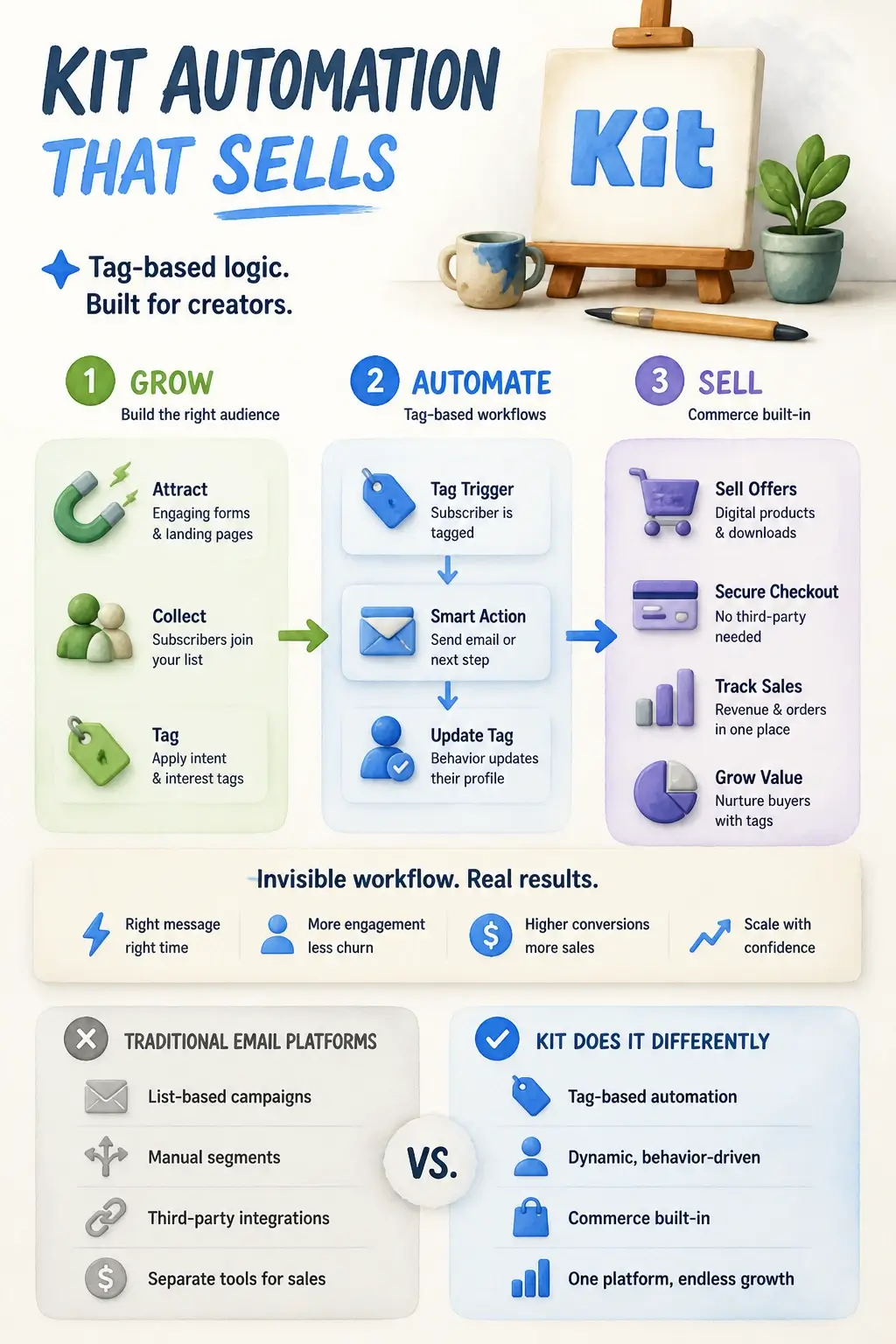
The automation system is built around tags and segments rather than rigid list structures. A subscriber can carry multiple tags – “downloaded lead magnet,” “attended webinar,” “purchased course” – and automations trigger based on tag combinations rather than list membership. For a creator managing a single audience across multiple content tracks, this is the right mental model. It’s also purposefully constrained: there are no complex multi-branch workflow trees, no lead scoring matrices, no CRM-style pipeline views. That simplicity is a feature for a creator who doesn’t want to become a marketing automation specialist. It’s a limitation for anyone who does.
The built-in commerce features let you sell digital products – courses, templates, ebooks – directly through Kit without a third-party integration. For a creator whose business model is audience monetization, removing that integration dependency is a real operational simplification.
The one friction point is visible and non-negotiable on the free tier: Kit’s branding badge appears on all emails and landing pages and cannot be removed without a paid subscription. For many creators, that’s a professional compromise they won’t accept. If your brand presentation matters from day one, budget for the paid plan immediately and don’t treat the free tier as a viable long-term operating mode.
The tag-based automation architecture is worth seeing in context before you build your first workflow:
Robert Brandl on Kit’s positioning and its most visible trade-off:
“Kit (formerly ConvertKit) is uniquely tailored to the creator economy. Its visual automation builder is exceptionally intuitive for building subscriber funnels, and its native digital commerce tools make selling digital downloads seamless. However, the branding badge drawback remains a notable nuisance, as free‑plan users are forced to display a prominent Kit badge that can detract from a professional brand image.”
The platform’s narrowness is its strength. It doesn’t try to serve e-commerce stores, B2B sales teams, or enterprise marketing departments. It serves creators building audience-driven businesses, and within that lane it removes more friction than any other tool in this comparison.
Klaviyo: The E-commerce Standard for Behavior-Driven Email
Klaviyo’s contact-list pricing model starts at $20 per month for 250 contacts, with a free tier that caps at 250 contacts and 500 emails total – making it effectively a testing environment rather than a viable free operating mode. For a small e-commerce store with any real list size, a paid plan is the practical starting point, and the cost trajectory accelerates as your contact list grows.
What you’re paying for is automation depth that no other platform in this comparison matches for e-commerce use cases. Browse abandonment flows fire when a visitor views a product page but doesn’t add to cart. Post-purchase upsell sequences trigger based on what was bought, not just that something was bought. Win-back series segment lapsed customers by recency and purchase value. Every flow connects directly to Shopify or WooCommerce data, and revenue attribution shows you – at the campaign and flow level – exactly which emails generated which sales. That’s not a marketing vanity metric; it’s the operational data a product-focused business needs to decide where to invest in email.
Predictive analytics add a layer that moves beyond historical behavior: expected next purchase date, predicted lifetime value, churn probability. For a store running a tight margin, those signals change how you sequence offers and how you segment win-back attempts.
Deliverability on Klaviyo benefits from the nature of its sends. Behavior-triggered emails – abandoned cart, post-purchase – carry inherently high engagement signals because they reach subscribers at moments of demonstrated intent. High open and click rates strengthen your sender reputation over time. That said, no independent head-to-head test validates a specific percentage advantage over competitors under identical conditions.
The academic evidence on behavioral segmentation specifically is worth examining. A peer-reviewed case study published in the International Journal of Research and Scientific Innovation examined three e-commerce firms using Klaviyo’s behavioral segmentation – browsing behavior, cart abandonment – over a 90-day period. Compared with non-segmented flows, behaviorally segmented campaigns produced open rates of 42.5% versus 28.7%, click-through rates of 18.3% versus 9.5%, and conversion rates of 7.8% versus 3.4%. Those aren’t marginal improvements. They represent the operational difference between email as a broadcast channel and email as a revenue system.
The limitation is equally clear: Klaviyo is over-engineered for any business that isn’t running product-driven purchase flows. A SaaS company, a B2B services firm, a content creator – all of them would be paying for infrastructure they’ll never use and navigating a platform architecture built around a commerce data model that doesn’t match their reality.
Robert Brandl draws the boundary precisely:
“Klaviyo is the undisputed powerhouse for e-commerce, offering a deep, one-click Shopify integration and laser-accurate revenue attribution that shows exactly how much money each flow generates. But if you are not running an e-commerce store, its highly sophisticated features are largely wasted, and you will find yourself paying a very steep premium for data tracking tools you simply do not need.”
The platform earns its premium – but only inside the use case it was built for.
ActiveCampaign: The Automation Powerhouse for B2B and Complex Growth
ActiveCampaign’s visual automation builder sits at the top of this comparison for operational complexity, and the pricing reflects that. Entry starts at $15 per month for 1,000 contacts, but the features that justify choosing ActiveCampaign over simpler tools – built-in sales tools, lead scoring, AI-driven predictive sending, site tracking – unlock at higher tiers. There is no permanent free plan; a trial period lets you test before committing.
The pre-built recipe library contains over 900 automation templates spanning welcome series, lead nurturing sequences, re-engagement campaigns, and sales pipeline triggers. That breadth sounds like a shortcut, but it’s only useful if you have the operational capacity to configure, test, and maintain complex branching logic. A team that can’t dedicate time to building and auditing automations will accumulate broken sequences faster than they build working ones.
ActiveCampaign’s built-in sales tools are the differentiator that separates it from everything else in this comparison. Sales and marketing can operate from the same contact record: a lead scores points based on email engagement, page visits, and form submissions; that score triggers a task for a sales rep; the rep’s activity feeds back into the contact’s automation journey. For a B2B company or a SaaS business running account-based sequences, that closed loop between marketing behavior and sales action is the entire value proposition.
Deliverability is self-reported at 94.2% – a figure generated from a single-platform test that cannot be compared against competitors under identical conditions. The more meaningful data point is the quality of the deliverability support infrastructure: dedicated tools, a responsive support team, and guidance on IP warming and list hygiene. That operational support is where the real deliverability advantage lives, not in a percentage that no third party has validated.
The learning curve is real and steeper than any other platform in this group. Users consistently report that mastering the full automation and CRM system requires dedicated training time – not a weekend of clicking around, but structured onboarding. Pricing also escalates sharply as contacts and feature tiers increase, and some users at scale report limitations in the reporting layer that require workarounds.
To understand the platform selection decision from a pricing model perspective before committing, this breakdown is worth 10 minutes:
Robert Brandl on where the platform wins and where it costs you:
“ActiveCampaign is unmatched when it comes to extensive automation and built-in sales integration, making it a favorite for mid-to-large B2B enterprises. The trade‑offs are a famously steep learning curve that requires dedicated training to master, and a pricing trajectory that has steadily climbed over the years, making it an expensive option for growing businesses on a tight budget.”
The honest framing for any buyer evaluating ActiveCampaign: don’t price the $15 entry tier. Price the tier you’ll actually need at 18 months – with the sales tools, lead scoring, and attribution features active – and build your business case from that number.
Which Email Marketing Platform Should You Actually Pick?
Platform decision scenarios are where the abstract evaluation framework becomes a concrete choice, and the right answer depends almost entirely on which of the four operating contexts you’re actually in. Here’s how the map reads.
If you’re a solopreneur on a tight budget, start with MailerLite. It delivers the lowest total cost with the fewest surprises, covers the essential automation toolkit, and scales transparently. If multichannel reach – email plus SMS – is non-negotiable from day one, Brevo is a viable short-term window, but enter it with eyes open: the 300-email/day cap limits time-sensitive sends, SMS credits expire after 12 months, and the jump to a plan that unlocks real volume is steeper than the entry price suggests.
If you’re running a small e-commerce store, Klaviyo is purpose-built for your use case. Behavior-triggered flows, Shopify integration, and revenue attribution at the campaign level are the exact tools a product-driven business needs to turn email into a measurable revenue channel. If your sales volume is still small and budget is genuinely constrained, MailerLite’s basic automations can serve temporarily – but plan the Klaviyo migration before you need it, not after your list has grown and your automation history is buried in a different platform’s format.
If you’re a content creator, Kit’s tag-based system and built-in commerce features make it the natural home. The subscriber funnel logic matches how creators actually think about their audience: not as a single list, but as people at different stages of a relationship. Factor in the branding badge question immediately – if a Kit-branded footer is incompatible with your professional presentation, budget for the paid plan from day one and don’t start on the free tier expecting to stay there.
If you’re a B2B company or a SaaS business that needs sales-and-marketing alignment, CRM-level automation, and deep segmentation, ActiveCampaign is the only tool in this comparison that closes that loop. But that capability comes with two honest conditions: you need the operational capacity to build and maintain complex automations, and you need to price the tier you’ll actually use at 18 months – not the $15 entry point – before you commit.
The table below maps all five platforms across the factors that determine your real 18-month cost:
| Platform | Starting Price | Approx. Price at 18 Months* | Automation Depth | Best-Fit Use Case | Key Hidden Costs |
|---|---|---|---|---|---|
| MailerLite | $9/mo (1K contacts) | ~$18–$25/mo (5K contacts) | Essential triggers, visual builder, no complex branching | Solopreneur, simple newsletters, light e-commerce | Templates locked behind paid plan; landing pages require upgrade |
| Brevo | $8.08/mo | ~$85/mo (100K contacts, Business plan) | Multi-step workflows, SMS/WhatsApp, basic lead scoring | Small businesses needing multichannel reach | SMS credits expire (12 months); overage fees activate silently; dedicated IP separate |
| Kit | Free → $15/mo (1K contacts) | ~$50–$79/mo (10K contacts) | Tag/segment-based visual automations, built-in commerce | Content creators, newsletter operators, course sellers | Branding badge on free plan; advanced segmentation requires paid tier |
| Klaviyo | $20/mo (250 contacts) | ~$150–$400/mo (10K–25K contacts) | Deep e-commerce flows, predictive analytics, revenue attribution | E-commerce stores on Shopify/WooCommerce | Rapid price acceleration at list growth; no viable permanent free tier |
| ActiveCampaign | $15/mo (1K contacts) | ~$79–$145/mo (full CRM + automation tier) | 900+ recipes, branching logic, built-in CRM, lead scoring, AI sending | B2B, SaaS, teams needing sales-marketing alignment | Steep learning curve; CRM and scoring features gated behind higher tiers; reporting limits at scale |
Projected estimates based on published tier structures; verify current pricing directly with each vendor.
One final point that belongs in every platform decision: the single most expensive move you can make is choosing a platform you’ll need to leave in six months. Before you commit, run real sends during the trial period – not test emails to yourself, but actual campaigns to a live segment. Read the terms on data export and template portability before you need them. And price your shortlisted platforms at your projected 18-month subscriber count.
The regret cost is never on the pricing page. It’s in the weeks of rebuild time, the disrupted campaigns, and the IP warming period on the other side.
Key Takeaways on Email Marketing Platforms
- Migrating platforms means rebuilding automations, re-integrating APIs, and often losing historical campaign data – a cost that dwarfs any monthly subscription difference.
- No cross-platform deliverability test exists; your list hygiene and sending practices determine inbox placement more than the platform’s infrastructure does.
- Hidden costs – API overages, expiring SMS credits, dedicated IP fees, data export charges – routinely multiply the real bill beyond the headline starting price.
- MailerLite is the clearest low-risk entry point for solopreneurs; Klaviyo is purpose-built for e-commerce; Kit serves creators; ActiveCampaign owns B2B automation depth.
- Always price your shortlisted platform at your projected 18-month subscriber count – never the entry tier you’re on today.
- The most expensive platform decision is choosing one you’ll outgrow or regret before you’ve recovered the cost of building on it.
Frequently Asked Questions About Email Marketing Platforms
Can I switch email marketing platforms without losing my subscribers?
You can export and re-import your contact list, but you’ll lose automation history, campaign performance data, and any behavioral triggers tied to the old platform’s data model. The contacts move; the operational context doesn’t.
Why does my deliverability drop after switching platforms?
When you move to a new platform, your sending IP is either shared or fresh – neither has an established reputation. The warming period, where you gradually increase send volume to build inbox trust, can take four to eight weeks and will suppress your open rates in the interim.
Is a free email marketing plan good enough to run a real business?
It depends on the cap structure. Kit’s free plan with unlimited sends to 1,000 subscribers is genuinely usable for a growing newsletter. Brevo’s free plan with a 300-email/day ceiling is not viable for time-sensitive campaigns. Always check what the cap is on sends, not just on contacts.
What does a dedicated IP address actually do for email deliverability?
A dedicated IP means your sender reputation is yours alone – neighboring senders on a shared IP can’t drag your inbox placement down. It matters most at high send volumes (typically above 100,000 emails per month); at lower volumes, a well-maintained shared IP is usually sufficient.
How do I know if I need CRM-level automation or just a basic email tool?
If your sales team needs to act on email engagement signals – scoring leads, triggering follow-up tasks, tracking pipeline stage – you need CRM integration. If your workflow is broadcast newsletters and simple welcome sequences, a basic tool handles it without the added cost and complexity.
Do SMS credits on platforms like Brevo actually expire?
Yes. Brevo’s SMS credits lapse after 12 months regardless of usage. If you purchase a credit bundle for a campaign that gets delayed or cancelled, those credits don’t roll over. Factor expiry terms into any multichannel platform cost projection.
What’s the real difference between subscriber-based and send-volume-based pricing?
Subscriber-based pricing (Klaviyo, Kit, MailerLite) charges you for the size of your list regardless of how often you email it. Send-volume pricing (Brevo) charges based on how many emails you send, which favors large lists with infrequent sends. If you email your list daily, subscriber-based pricing is usually cheaper; if you email monthly, send-volume pricing often wins.
When does Klaviyo stop making financial sense for an e-commerce store?
Klaviyo’s pricing accelerates steeply as your contact list grows – at 25,000 contacts you’re typically paying $400 per month or more. If your store’s email-attributed revenue doesn’t clearly justify that spend, it’s worth auditing whether you’re using the behavioral flows and attribution features that differentiate Klaviyo from cheaper alternatives. If you’re not, you’re paying for infrastructure you’re not using.
References
- Best Email Marketing Services Compared – emailtooltester.com
- MailerLite Review – emailtooltester.com
- Brevo Review – emailtooltester.com
- Kit (ConvertKit) Review – emailtooltester.com
- Klaviyo Review – emailtooltester.com
- ActiveCampaign Review – emailtooltester.com
- The Effectiveness of Behavioral Segmentation in Email Campaigns: A Case Study Using Klaviyo – rsisinternational.org